
It Seemed Invincible. But Now It Is Just a Mirage
Editor’s Note
The following reflection marks the beginning of Unmixed’s ongoing investigation into the closure and demolition of Brooklyn Mirage and the wider questions it raises for New York’s nightlife. We approach this story with respect for everyone who helped build a space that defined a generation and with a commitment to understand what its loss means for artists, crews, and audiences alike. More details, interviews, and on-the-ground reporting will follow in the coming weeks.
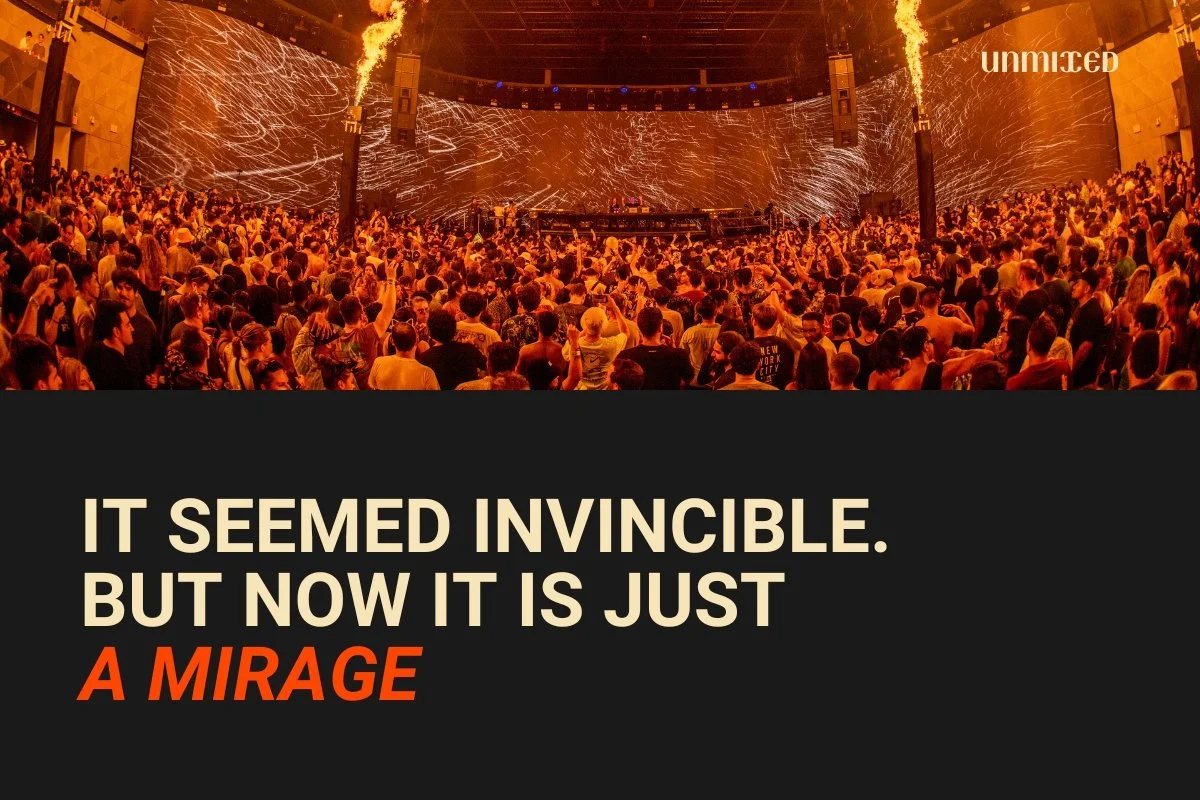
Reading the news about the Brooklyn Mirage filing for bankruptcy and demolition felt odd. The Mirage seemed invincible, like watching the credits roll on a film that changed the way New York looked at itself. It is easy to treat this as another headline about a failed venue, but for anyone who has lived, worked, or danced in this city, the Mirage represented something much deeper. It was a living symbol of how creative risk can still build worlds inside a place that keeps trying to price them out, literally.
Cityfox, you will be missed this Halloween. For nearly a decade, these nights defined a generation of underground culture in New York. They gave artists and dancers a sense of belonging that was bigger than the music itself.
The Avant Gardner, also known as Brooklyn Mirage, was never perfect, but it was ambitious. It gave hundreds, if not thousands, of artists and workers the space to create something truly cinematic, and that alone deserves respect. We are not interested in pointing fingers or romanticizing collapse. We are more interested in what this moment reveals about the systems we have built, the ones that run nightlife like a venture portfolio and investment fund instead of a cultural ecosystem.
When a venue like the Mirage goes dark, the impact ripples far past the backstage. It touches the sound engineers who worked overnight, the barbacks whose rent depends on weekend shifts, and the DJs, big or small, whose calendars suddenly fall apart. The story is not just about a company. It is about people who built something extraordinary in their time and are now left searching for what comes next.
We also cannot ignore how easily this could have gone in another direction. The fact that it did not end up absorbed by a corporation like Live Nation feels like a small victory. It proves that not everything independent has to sell itself to survive. But survival now requires resources and imagination.
Maybe this is where a new model begins. What if artists and workers started funding the spaces that keep their culture alive? What if we treated nightlife as a collective project instead of a competition? Crowdfunding and unions might sound idealistic, but they are also practical ways to redistribute power in an industry that runs on passion and precarity.
In psychology, there is a concept called a cognitive illusion, when perception feels so certain that it overrides reality. We believed the Mirage would last because it looked like permanence. The scale, the production, the thousands of people every weekend, it all created the illusion of stability. But permanence in nightlife, like a mirage in the desert, only lasts as long as the conditions around it do. That is the cognitive illusion, believing scale means safety when in reality, nothing in nightlife is ever static.
Those of us who still care about the culture, the ones who show up early, stay late, and keep documenting, have a responsibility to protect it. We can appreciate what the Avant Gardner achieved while admitting that the future has to be built differently.
The lights may be coming down on Stewart Avenue, but the energy does not disappear. It shifts into smaller rooms, safer systems, and stronger connections between the people who make the night happen. If the Mirage taught us anything, it is that the music does not stop when the venue closes. It finds another home in the people who refuse to give up on it.
It seemed invincible. But now it is just a mirage.
Unmixed continues to investigate the story behind its collapse and what comes next for New York’s independent nightlife ecosystem. Stay tuned for upcoming interviews with former staff, crew members, and artists as we trace what happens next.
