
Zohran Mamdani Wins NYC Mayoral Election: A Turning Point for Art, Music, and the City Itself
When art, intellect, and politics finally find each other again.
An Unmixed editorial on imagination as infrastructure and how Zohran Mamdani’s New York might rewrite the future of art, housing, and cultural power.

Images: Zohran for NYC Campaign Media Kit photo credit: Kara McCurdy
It was a campaign that will be studied long after Mamdani — and, for that matter, all of us who are now alive — are gone.
Born to filmmaker Mira Nair, whose cinema gave voice to diasporic longing and defiance, and Mahmood Mamdani, a Columbia University professor whose scholarship reframed how the world understands power and post-colonial thought, Zohran was raised at the intersection of intellect and imagination. In that home, ideas were not abstractions; they were instruments — one to see, the other to understand.
Now their son stands at City Hall, fusing those traditions into one purpose: unity between education and art, between the analytical and the emotional, between why and what if.
He became a symbol of youth, energy, and possibility: proof that intellect need not be sterile, that compassion can be strategic, that art can govern. His campaign didn’t feel like politics; it felt like cinematic composition. Posters became visual poetry, rallies turned to block parties, and the beat of the city became its political language.
Voter turnout shattered a century-long record. His call that New York is and always has been an immigrant-led city resonated across boroughs. Here, survival is a creative act. To live here is to build, to work here is to invent, to endure here is to perform. And as you might have heard NYers say: “If you can make it here, you can make it anywhere”, - this still serves as ultimate truth.
And yet, those who profit from inequality labelled this vision “freeloading.” The irony is blunt: the true freeloaders aren’t the artists, immigrants, or teachers holding the city together — they’re the executives and landlords extracting value from everyone else’s labor. What they fear most is a city governed by imagination rather than extraction.
He’s not governing from power — he’s composing from purpose.
The Artist-Spouse
Beside him stands Rama Duwaji, a Brooklyn-based Syrian-American illustrator, animator, and ceramicist whose work has appeared in The New Yorker, The Washington Post, and Tate Modern. Together they form a partnership that bridges art and policy.
Where previous political spouses played ceremonial roles, Duwaji communicates through motion and intriguing lines instead of speeches. Her illustrations explore tenderness, womanhood, and collective memory, the same themes her husband now translates into social policy.
Their story suggests a new kind of civic intimacy: the policymaker as architect, the artist as conscience. The city’s new leadership is not only multicultural but multimedia — one paints with legislation, the other with light.
Rama Duwaji’s art doesn’t decorate power; it reminds it to feel deeply.
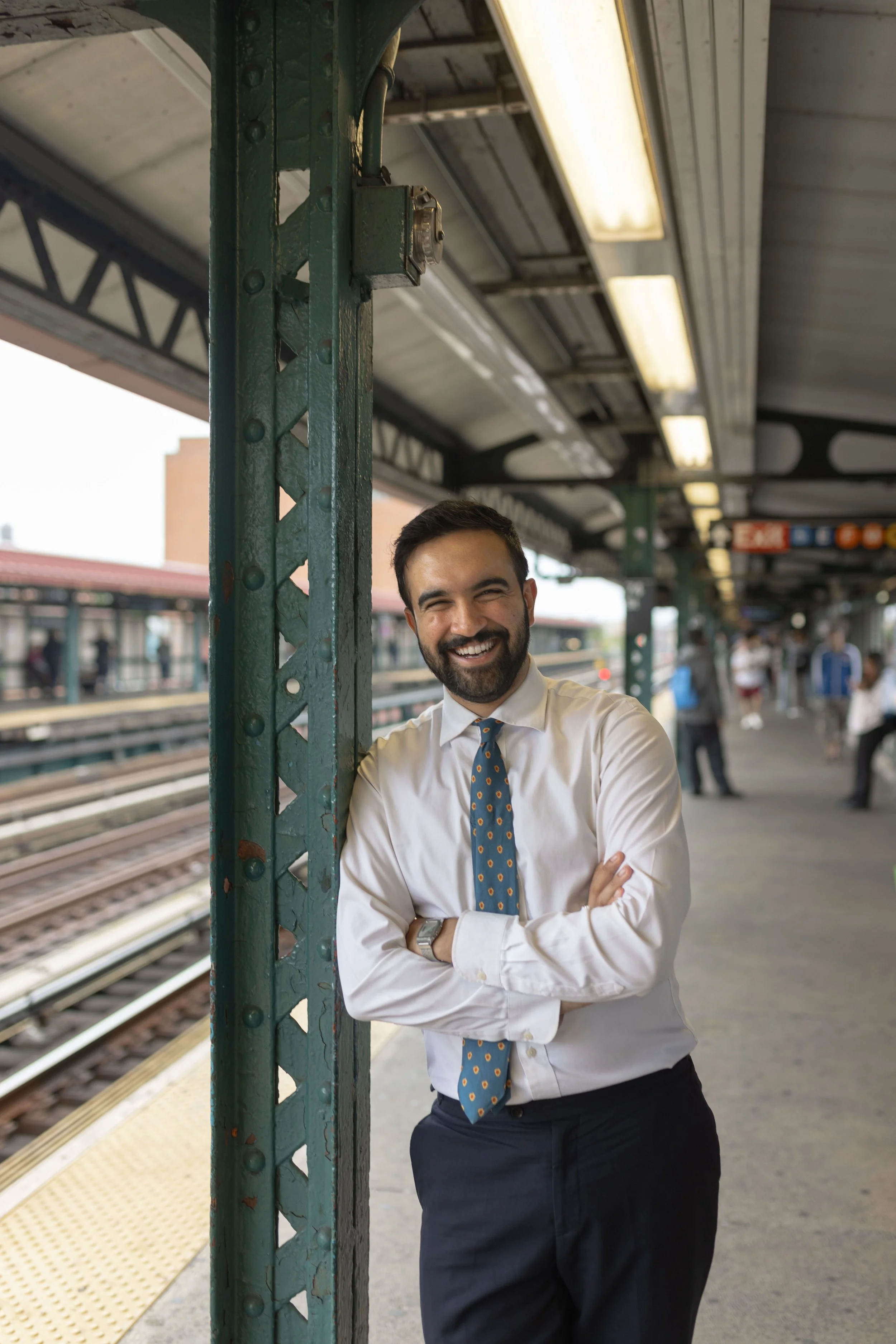
Zohran for NYC Campaign Media Kit photo credit: Kara McCurdy
Art as Infrastructure
Art has always been the impulse that made science ask why. Mamdani’s victory restores that connection between art and inquiry: not as metaphor, but as method.
His platform on housing, transit, and affordability doubles as cultural policy. Affordable rent keeps studios open. Fare-free transit connects boroughs and scenes. Community ownership allows culture to flourish without permission from capital.
Meanwhile, federal arts funding is collapsing. The National Endowment for the Arts has frozen programs; local grants are on hold; exhibitions face censorship. In this climate, the underground becomes the city’s immune system: reorganizing itself to survive.
The DIY venue becomes civic space. The pop-up show becomes policy prototype. Creation becomes governance.
When the funding disappears, the underground doesn’t vanish — it reorganizes.
The Cultural City
Mamdani’s campaign mirrored the way New York’s underground already functions: collaborative, improvisational, hybrid. It sampled languages, aesthetics, and communities like a great DJ set moving across genres. The politics once again became an ecosystem of mutual care.
Imagine a city where the subway doubles as gallery, a community garden as stage, a public school as studio. Imagine civic budgets written with the precision of design briefs. Under this mayor, those ideas feel less like fantasy and more like blueprint.
An affordable city is an artistic city. A connected city is a collaborative one.
A Global Imagination
Zohran’s Ugandan-Indian roots and Rama’s Syrian-American heritage embody what New York has always been: a world condensed into a few square miles. That duality will likely shape the city’s next cultural wave: sound bridging continents, exhibitions speaking in multiple tongues, neighborhoods once again becoming global classrooms.
New York has long been the capital of hybridity. Now it may finally govern like one.
The Call
This victory doesn’t end the struggle; it redirects it. Artists must now act like citizens: organized, informed, ambitious! The infrastructures they demand must be as imaginative as their art: co-op studios, subsidized rehearsal halls, public residencies, cultural unions.
If culture is to shape policy, then cultural workers must enter the conversation not as guests but as authors. The new avant-garde isn’t waiting for grants; it’s designing systems.
The next avant-garde won’t be funded. It will be assembled.

Zohran for NYC Campaign Media Kit photo credit: Kara McCurdy
Closing Reflection
New York stands once again at the intersection of sound and system. Zohran Mamdani’s victory redefines what power looks like: thoughtful, collaborative, creative and full of hope!
The city’s next renaissance will happen not in boardrooms but in basements, train cars, and rooftops. Art and politics have finally found each other again in a city that refuses to sleep or sell its soul to billionaire technofeudal-capitalist BS.
New York for New Yorkers, not for billionaires.
Or, as Billie Eilish asked: If you are a billionaire — why?
By Unmixed Magazine
Words: Nina Katashvili-Malik
Images: Zohran for NYC Campaign Media Kit
