
Wasserman Is Up for Sale After Epstein Fallout as Artists Exit
The crisis at a major talent agency has triggered a sale process - and exposed how reputational risk at the top can cascade through the touring infrastructure that sustains the live-music economy.
words by Nina K.Malik
The Break
Wasserman was, until very recently, one of the stable fixtures of the contemporary live business: large enough to appear on nearly every festival routing grid, discreet enough to stay out of gossip columns, and established enough to feel permanent. That sense of permanence cracked once Department of Justice–released Epstein files resurfaced flirtatious emails between Casey Wasserman and Ghislaine Maxwell, alongside renewed attention to his 2002 flight on Epstein’s plane, prompting public criticism and client pressure, according to Reuters reporting.
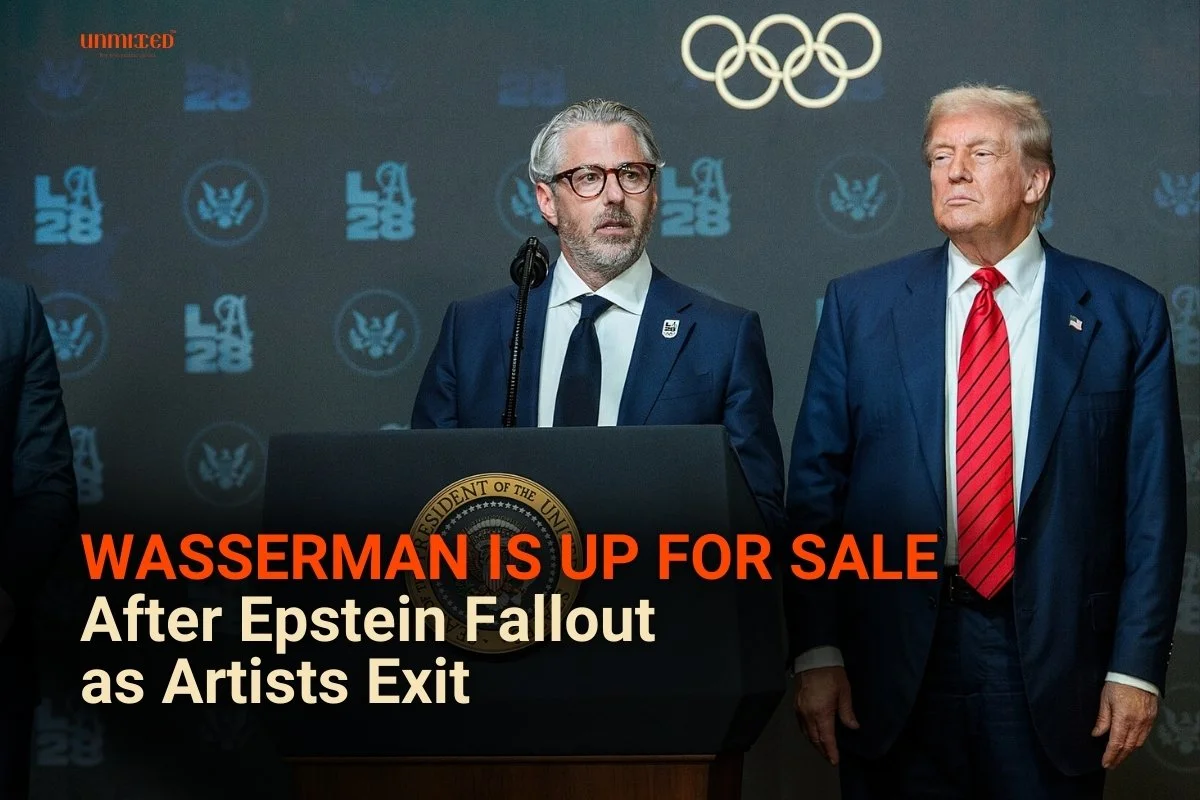
President Donald Trump delivers remarks before signing an executive order creating a task force for the 2028 Los Angeles Olympics, Tuesday, August 5, 2025, in the South Court Auditorium of the Eisenhower Executive Office Building at the White House. (Official White House Photo by Joyce N. Boghosian)
Roster Risk
The erosion has been visible on the roster side as well as in the boardroom. Clients including Chappell Roan have publicly cut ties, explicitly citing discomfort with continued representation by an agency whose leadership appears in Epstein-related documents, while others have exited more quietly in an effort to preserve touring plans and festival holds.
In trade coverage this appears as a drip-feed of exits; internally it has functioned more like a controlled disassembly, with artists, managers, and agents seeking continuity under time pressure while the agency’s name shifts from stabilising intermediary to reputational risk.
For years, agencies like Wasserman have handled the practical mechanics of the live-music economy: matching touring plans to promoter budgets, negotiating fees and radius clauses, mediating sponsor demands, and distributing performance risk across a roster so that individual underperformance does not compromise aggregate viability. None of this is glamorous, but it produces a crucial intangible asset–confidence that the intermediary is stable and capable of managing risk for both sides of the market.
That confidence only functions if leadership does not itself become the principal source of systemic uncertainty.
Public threats to exit have also begun to function as signalling devices in their own right. On February 12, John Summit posted that he would not remain with Wasserman if Casey Wasserman did not step down, framing continued representation as incompatible with his own professional standards. Whether such statements translate into immediate contractual movement or operate primarily as reputational distancing, they illustrate the extent to which agency affiliation has become a public-facing ethical posture rather than a backstage administrative choice. In scenes where commercial visibility and underground credibility still coexist uneasily, the episode has exposed a fault line between artists able to leverage exit threats for brand positioning and those whose touring dependencies make even symbolic rupture materially costly.
A Formal Auction
The Epstein material punctured that assumption. Some clients have framed their departures in explicitly ethical terms–discomfort with continued association given leadership’s documented contact with Epstein and Maxwell–while others are less focused on personal morality than on concentration risk. A single executive’s communications are now sufficient to place an entire cross-genre touring infrastructure into play, forcing hundreds of participants who did not participate in those decisions to navigate a crisis window they did not choose.
There is now a formal auction. Wasserman and majority owner Providence Equity Partners have retained Moelis and held conversations with more than a dozen potential bidders, as reported by Sports Business Journal. The combined platform–sports, music, brand consulting, and Brillstein–is being marketed at a valuation reportedly north of $1 billion, though any realised transaction price is likely to incorporate a reputational discount relative to that sell-side positioning.
Reported scenarios range from a private-equity take-private–following the Excel Sports Management acquisition–to consolidation by rival agencies, Providence increasing its own stake and rebranding, or an external consortium assuming control.
If the story ends there, Wasserman becomes another consolidation case study: a reputationally damaged asset re-wrapped or partitioned, with rivals and funds acquiring divisions and the macro-structure of representation largely unchanged.
Olympic Spillover
Parallel pressure has emerged in his public role as chair of the LA28 Olympic organising committee, where Los Angeles Mayor Karen Bass has called for Casey Wasserman to step down following the same Maxwell correspondence disclosures, warning that the controversy could distract from preparation for the 2028 Games despite the organising board’s decision to retain him, according to CNN reporting.
Institutional Confidence
At a certain point, the issue is no longer confined to legal exposure or transactional risk but extends to the moral legitimacy of the enterprise itself. Questions about judgement, humanity, and leadership ethics begin to bear directly on whether a multi-billion-dollar intermediary should continue to exist in its current form, or at least under its current governance. That kind of scrutiny does not simply affect clients or counterparties; it reshapes internal trust and external confidence in ways that are difficult to quantify but materially consequential. It can distort decision-making, alter negotiating posture, and introduce a persistent background instability that affects how staff, artists, and partners interpret even routine interactions.
It is not an excuse for opportunism or reputational arbitrage to note that the documentary record cited in recent reporting includes numerous repetitions of substantially similar email text; however, the volume of references — reportedly numbering in the dozens — has nonetheless been sufficient to trigger institutional review across both private representation and public-facing roles. In governance terms, the distinction between unique communications and repeated correspondence is less salient than the aggregate signal they send about leadership risk and organisational oversight.
The Default Path
The less measurable question is whether anyone uses the disruption to construct materially different governance architectures.
The default breakaway-boutique pathway is well established: senior agents depart with clusters of their artists, secure outside capital, and recreate a smaller firm that still converts volatile careers into forecastable commission streams. Ownership changes; incentive structures do not. The agency continues to manage uncertainty upward, smoothing career volatility into EBITDA-compatible revenue that can be underwritten, leveraged, and ultimately exited.
A substantive departure would instead reconfigure the relationship between representatives and represented. Client-co-owned agencies — with capped commissions and sunset clauses embedded in charter, transparent prohibitions on dual representation, and systematic internal sharing of rate and term data — would still operate commercially, but would import union-like properties into the commercial layer: a shared information base, enforceable minimums, and some degree of coordinated bargaining power.
Touring labour remains too fragmented and multinational for a straightforward union model; co-ownership structures also run into hard constraints around capitalisation without control dilution and cross-jurisdictional liability. However, the institutional outline is legible.
“Pen and Paper”
At present, however, much of the immediate response has focused on liability management. One New York agency head, asked about the fallout, remarked: “I’m thinking of using only pen and paper now.”
That instinct is not operationally neutral. It reframes the lesson of the episode from “avoid abusive or compromising conduct” to “avoid durable records of conduct.” The problem becomes discoverability rather than behaviour; the proposed solution is opacity rather than accountability.
Aggregation of risk remains necessary in a volatile live environment. Tours fall apart, festivals underperform, demand shifts unexpectedly; bundling many acts and many deals makes those shocks survivable at scale. Historically, however, that aggregation has stabilised agencies and major buyers more than artists as a class. A co-governed intermediary could, in principle, redeploy the same aggregation logic to elevate minimums and harden contractual floors for its membership rather than smoothing cash flows for investors.
Counterparty Risk
That risk is not hypothetical. In October 2025, Wasserman Music filed a $1,125,500 unsecured claim in the Avant Gardner bankruptcy case in the District of Delaware, seeking payment for cancelled shows performed by its clients at Brooklyn Mirage across late-2025 and early-2026. The filing lists more than thirty scheduled performances—from Green Velvet and Gryffin to AC Slater, Sub Focus, and Zedd—whose fees were rendered unrecoverable following the venue operator’s insolvency. In effect, the same intermediary now being marketed as a billion-dollar platform was, months earlier, attempting to recover seven-figure touring income lost to the collapse of a major U.S. dance-music venue.
What Happens Next
The Wasserman process will likely proceed along the path of capital: Moelis will run a disciplined auction, Providence will optimise its exit, and some combination of funds and strategic buyers will reconfigure the platform.
For most artists, the rational short-term move will be to secure continuity — dates honoured, crews paid, routing intact — even if that entails re-entry into a structurally similar environment under new branding.
There is nonetheless a narrow opening, especially for agents departing with clusters of their artists. Coordinated movement — treating a roster not as discrete projects but as a bargaining bloc — creates the possibility of affiliating only with entities that grant defined governance rights and transparent internal standards.
Any alternatives formed in the next year are likely to be modest in volumetric terms, but their significance would lie in altering how at least some participants choose to structure their dependency on intermediaries whose first instinct, when exposed to scrutiny, is to reach for a pen rather than reform the underlying practice.
credits:
Photo: Official White House Photo by Daniel Torok via Wikimedia Commons (Public Domain)
