
A Century Before Techno: Busoni, Russolo, and The Art of Noises
In collaboration with Max Durante.
Double-click to edit...
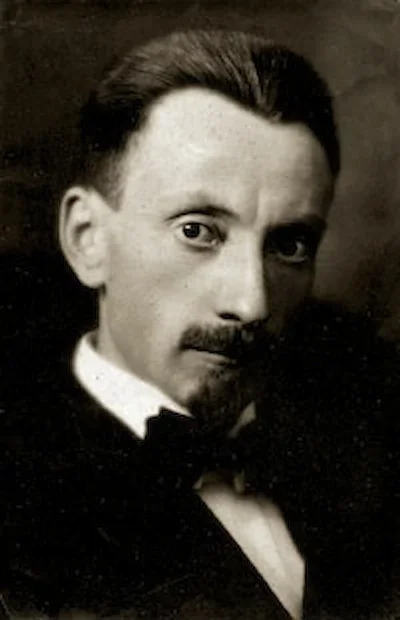
portrait of Luigi Russolo.
In English, timbre (pronounced /ˈtæm.bər/ or /ˈtɪm.bər/) means the unique quality or "color" of a sound. It is what allows you to distinguish a piano from a guitar or recognize a specific person's voice, even when they are making the exact same note and volume.
Luigi Russolo first explicitly mentioned "timbre" in his seminal 1913 futurist manifesto¹, L'arte dei Rumori (The Art of Noises). A century later, these sounds would become the music we dance to. But before we could get here, society first had to reinvent how we listen.
It seems reasonable to ask why we spend so much time reporting on what is happening now-the newsworthiness-while spending remarkably little on what I call culture-worthiness. In the music industry, we report on festivals, streaming numbers, artist beefs, algorithms, AI-generated music, yet rarely spend time thinking about who imagined the sounds shaping our everyday lives. We hear these sounds all around us, at cafes and shopping malls, and we take them for granted.
Before synthesizers, before drum machines, and before electric guitars were a thing, there were artists who believed music was not finished yet. They were not inventing a new genre–they were inventing entirely new ways of hearing.
Russolo's manifesto called for a new music built from industrial sounds-but it wasn't politically neutral. The Art of Noises emerged from the same Futurist ideology that glorified war, speed, and technological violence. This doesn't invalidate his innovations-but it does mean we can't separate the “neutral” exploration from the violent ideology that birthed it.
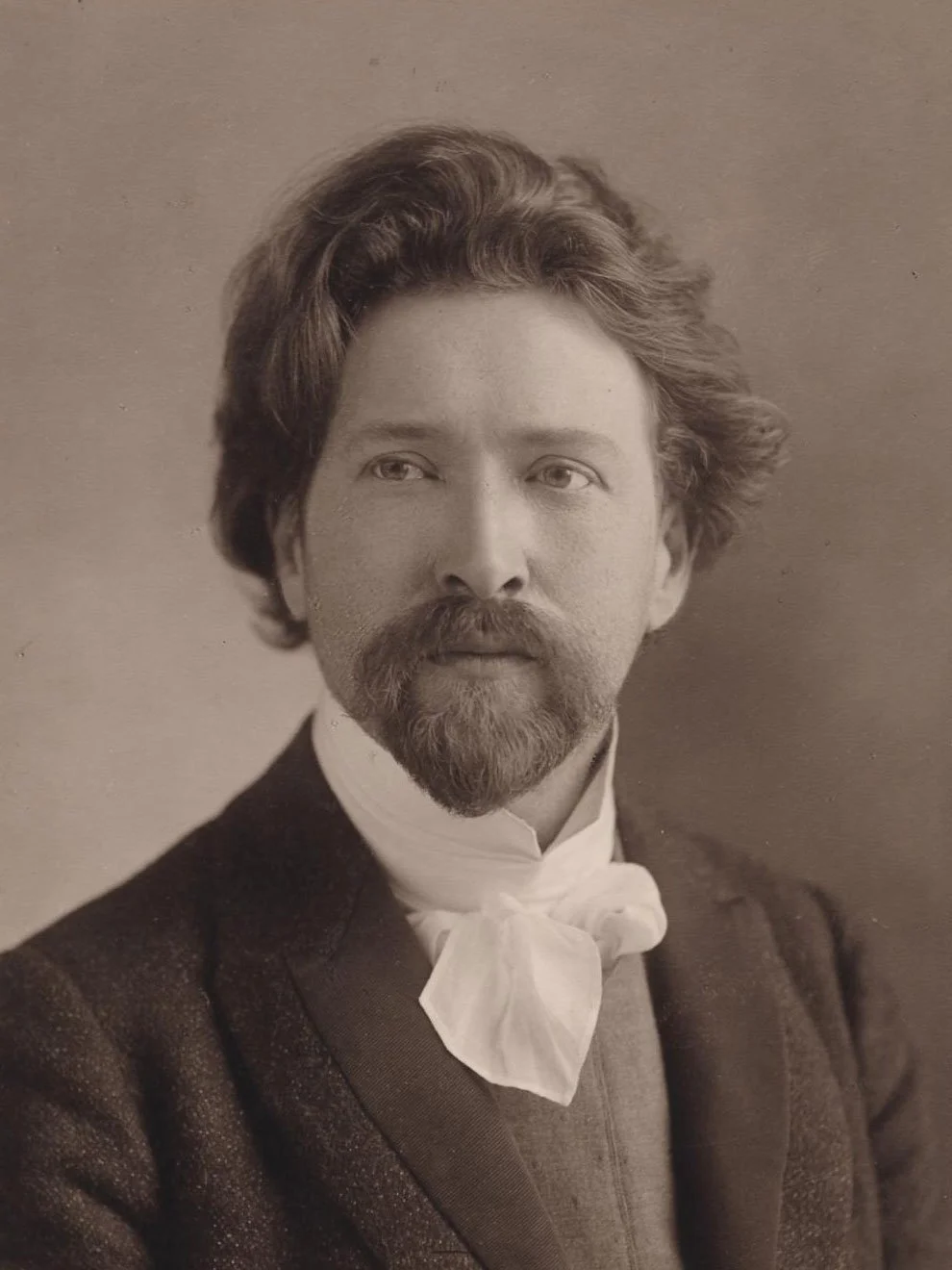
Ferruccio Busoni, 1904 in New York | Public Domain Mark 1.0
In 1907, the Italian pianist and composer Ferruccio Busoni published Sketch of a New Esthetic of Music. The title itself feels important. It was not a manifesto. It was simply a sketch, an experience he and his contemporaries must have had boiling up inside their earlobes from imagining what music would become rather than what it already was.
Busoni writes:
Let us experiment with sensible irregularities.
What he longed for was everything that existed outside of modern musical understanding–it was the space "in between." The sounds that instruments could not yet produce. He was not imagining electronic music. He was trying to explain that traditional harmonies were simply not enough. He was imagining the possibility of a space that exists between the notes that, prior to this evolutionary leap, had not been explored.
Only a few years later, another Italian artist, Luigi Russolo–a painter who in 1913, marveling at another Futurist pianist's performance at the theatre–wrote him a letter. It remains one of the strangest texts in the history of music, because Russolo doesn't begin by discussing instruments. He begins by discussing humanity. Russolo's ideas were largely forgotten after WWII, partly due to futurism's association with fascism. By the late 20th century, experimental musicians rediscovered The Art of Noises.
Before there were orchestras, before concert halls, before the word "composer" even carried the meaning we assign to it today, there was silence. Or at least, what Russolo describes as a "scarcity of noises." As he writes:
In this scarcity of noises, the first sounds that men were able to draw from a pierced reed or a taut string were stupefying, something new and wonderful. Among primitive peoples, sound was attributed to the gods. It was considered sacred and reserved for priests, who used it to enrich their rites with mystery. Thus was born the idea of sound as something in itself, as different from and independent of life. And from it resulted music, a fantastic world superimposed on the real one, an inviolable and sacred world. The Greeks greatly restricted the field of music. Their musical theory, mathematically systematized by Pythagoras, admitted only a few consonant intervals. Thus, they knew nothing of harmony, which was impossible.
He argues that the first sounds early humans managed to pull from a pierced reed or a stretched string must have felt almost supernatural. Something entirely new. Sound itself was sacred before it became entertainment. It belonged to priests before it belonged to performers. Music, in its earliest form, wasn't separated from life. It was woven into ritual, mystery, and the unknown.
Then, gradually, things started to change.
The Greeks systematized music. It was Pythagoras's theory that measured it. Harmonies were mathematical–in fact, mathematics itself. Perfect symmetry, and everything within its consonance became laws. Century after century, Western music refined and refiltered itself, becoming increasingly sophisticated. The only issue was: it was being confined within these laws, and in a way, it hit a ceiling.
While Russolo admired this history, he was also the one who acknowledged, in writing, that the old ways of thinking about music had reached their threshold. It was time to reimagine it. It was time to free the music and later, "break free."
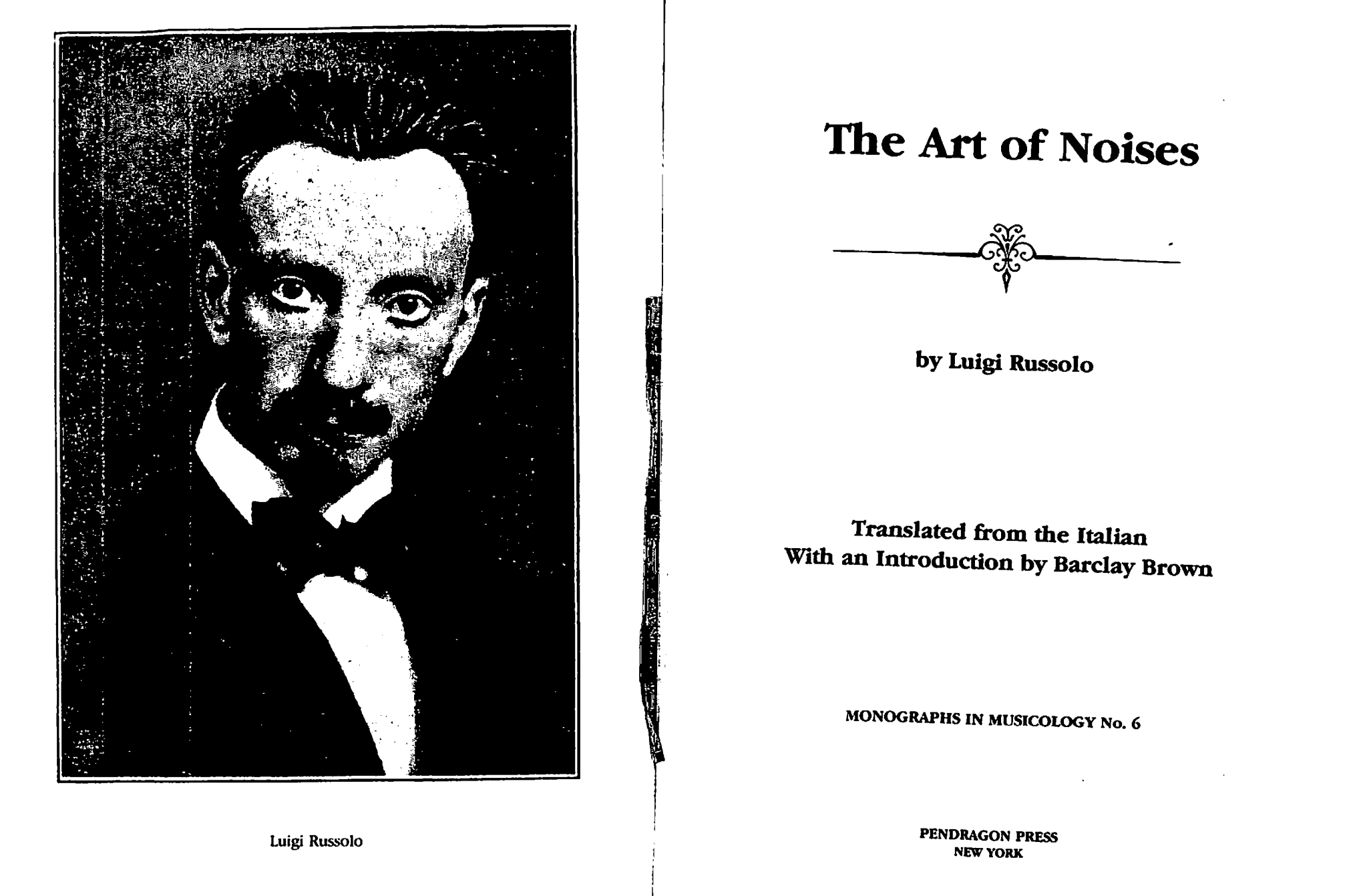
Luigi Russolo , L'arte dei Rumori (The Art of Noises) - paragon press NY.
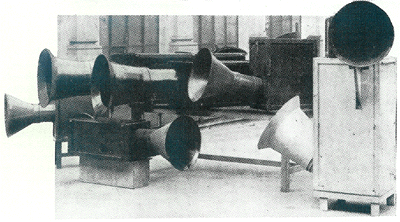
Luigi Russolo’s “intonarumori” in 1919.
But Russolo wasn't content with theory alone. While he himself was not a trained musician, he understood something deeper than most of his contemporaries knew about music. In The Art of Noises, he identified six families of sounds that had been excluded from the concert hall but surrounded us in daily life:
Roars, thunderings, explosions
Whistlings, hissings, puffings
Whispers, murmurs, rustlings
Screeches, creaks, buzzes
Percussions on metal, wood, stone
Voices of animals and people: shouts, screams, groans, howls, laughs
These weren't abstract categories. They were the actual flavors of industrial modernity–the sounds of trains, factories, crowds, and machines. Sounds that classical music had systematically ignored.
This was the era when musicians, artists, writers, and composers of all sorts formed a group of inventors. These were dreamers who dared to imagine what was utterly unthinkable, shameful even, to envision.
Music was meant to be diversified.
The field of arts has no substance–you can't touch it, you can't examine it in a lab under a microscope, you can't observe it–yet when you hear it, it enters you and you become the experiment of it. And music? Music is just there to observe and guide those who dare to follow.
Walking through Downtown Brooklyn, following the long stretch of Myrtle Avenue toward the B train, you can hear machines from every angle. Construction drilling, A/C humming and dripping, subway brakes screaming against steel and "please stand clear of the closing doors," delivery trucks turning round the corner, firefighter sirens exploding–everything all at once hissing and rattling.
This is what Russolo heard in 1913. This is what he tried to capture in his intonarumori (noise intoner) - mechanical instruments designed to produce industrial noise-but their cultural function was inseparable from Futurist politics. Russolo and Marinetti performed Risveglio di una città (Awakening of a City) in 1914, a noise concert celebrating urban industrialization. Later concerts celebrated warfare and would often end in riots.
But between his wooden noise boxes and the synthesizers that would eventually lead us to techno, there's a missing century of sound filled with complex textures and layers that need to be addressed equally, in order to make any sense of it.
The discomfort some feel engaging with Futurist art is real. But it's worth asking: why does it differ so drastically from how we approach, say, Napoleonic-era paintings?
Jacques-Louis David signed over 300 arrest warrants during the Reign of Terror. Thirty to fifty thousand people were killed. He painted propaganda for Robespierre, then Napoleon, then whoever held power next. Today, the Louvre celebrates his work. We teach The Death of Marat in Art History 101. We print Napoleon Crossing the Alps on postcards and tote bags.
No one asks whether we should engage with David's work. We just do. So what's different? Temporal distance. Two hundred years versus eighty. Cultural prestige. French Neoclassicism versus Italian Futurism. Aesthetic legibility. Beautiful paintings versus ugly noise. And maybe most importantly: the outcome. The French Revolution "won" its place in history. Fascism lost.
Marxist theorist Leon Trotsky distinguished Bonapartism-authoritarian rule imposed from above by a single strongman-from fascism, which mobilizes mass movements through ideology and fervor. Napoleon's wars killed hundreds of thousands. His court painters glorified conquest, empire, and military power. Yet we hang David's paintings in museums without hesitation.
Russolo's innovations are no less significant. His complicity is no more extreme. The difference is simply this: we've decided which regimes get historical distance and which get permanent scrutiny.
Either we contextualize both-naming the arrest warrants and the fascist manifestos-or we admit that our discomfort with Russolo has less to do with ethics and more to do with time, aesthetics, and which ideologies history decided to forgive.
If we can teach David, we can teach Russolo. But only if we're willing to name what both of them were part of.
¹ Italian Futurism, founded by F.T. Marinetti in 1909, glorified war and violence. While Russolo's Art of Noises (1913) predates the rise of fascism, futurism's aesthetics became closely associated with Mussolini's regime in the 1920s. Scholars debate Russolo's personal politics; this essay engages with his artistic innovations while acknowledging this contested history.
