
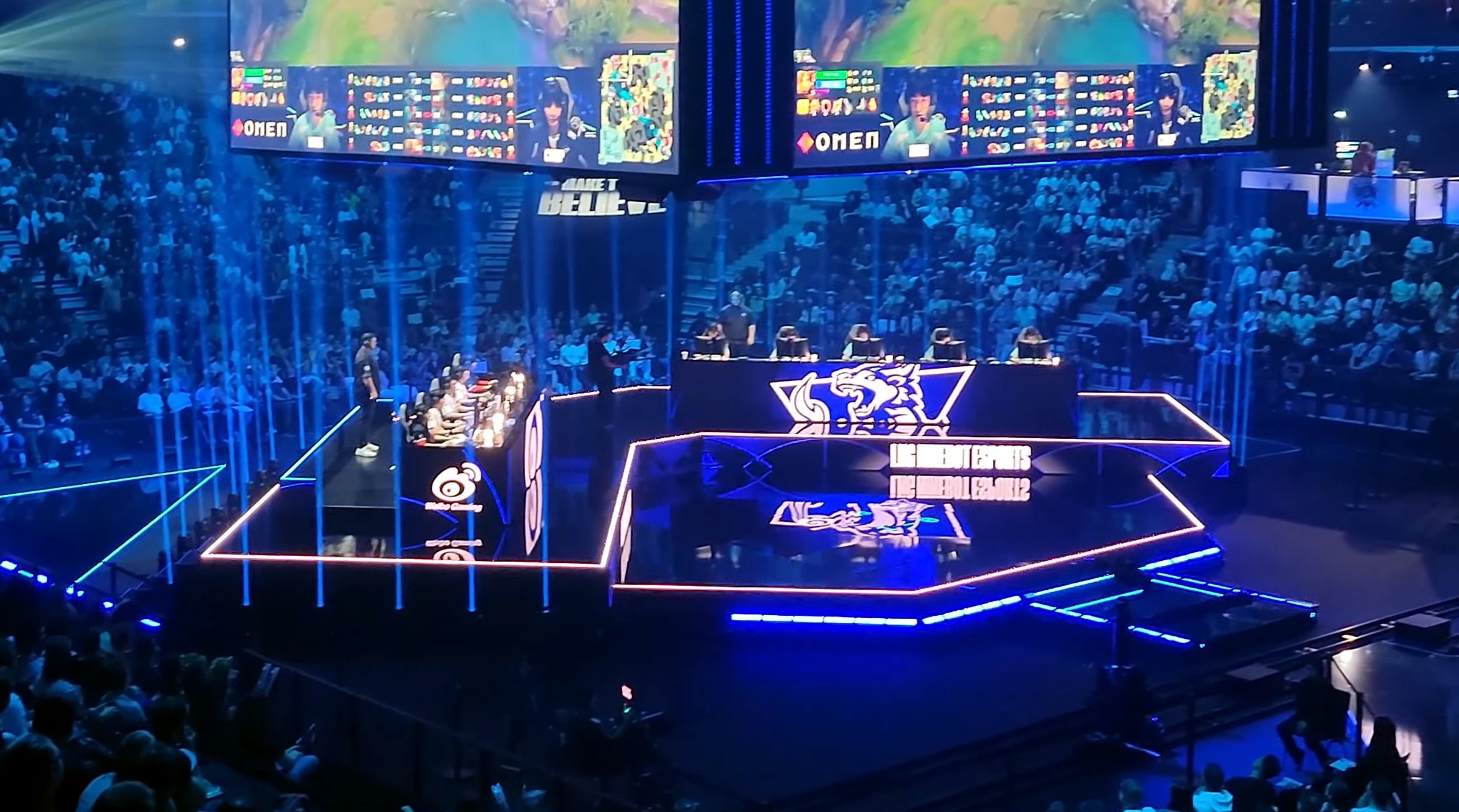
Photo: Michael Min / Wikimedia Commons, CC BY 3.0. LNG vs Weibo Gaming, 2024 Worlds quarterfinals.
To me League of Legends looks like a game that was painted by people who dreamt about it for a long time. I can visualize the tussle of ideas and the eventual creation of a world where champions appear like saints in cathedral windows. The majestic cadence continues in its anthems but what’s hard to believe is that the heroes who are so digitally ethereal on screen are actually adjusted every few weeks by a team. Their strength is determined by mere decimals and the fans watching know about this.
This is the right time to make a disclosure: I don’t play League of Legends. Which may be why I’m so stunned by how completely the fans believe in the world, even while being aware of the numbers behind it. Having said that, I came to this game precisely because of the stories it tells about itself. It was the songs that came to me first and then led me into the world.
Actually, these anthems interest me because they turn a competition into the sacred. They remind me of the Korean gut, which is a shamanic rite involving music and dance between the human and spirit worlds. A Worlds anthem is definitely not a gut but both bring people together through performance and give meaning to the participating sentiments beyond the event itself. I wanted to understand how a song made for a commercial spectacle can become a vessel for belief.
The Regal Anthems
Since Imagine Dragons’ creation of “Warriors” in 2014, the League of Legends songs have been molded to travel. They run through the themes of immortality, rebirth, kingship and sacrifice. The anthems, from “Legends Never Die” (2017) and “Phoenix” (2019) to “Heavy Is the Crown” (2024) and “Sacrifice” (2025), invoke power. The people who live inside the system stop experiencing it as numbers and the anthems show what they experience instead, that is, something otherworldly which draws out both loyalty and solemn resolve. Two of them do this most clearly.
Sacrifice
In 2025, Riot released “Sacrifice,” performed by G.E.M. as the tournament returned to China. Riot’s head of music described G.E.M. as a superstar and said that Riot “had to find the biggest possible stage.” The animated video is set among stunning constellations and it revisits plays from earlier Worlds, ranging from Caps’ Sylas turning an Ashe arrow against Gen.G in 2020 to TheShy’s 1v5 Aatrox dive against G2 in 2018 and Faker facing Ruler’s Varus in the 2023 semifinal against JDG. The closing frame belongs to Shushei, the first world champion, lifting the Summoner’s Cup in 2011; he died in April 2025, six months before the video came out. The song, with G.E.M.’s voice, sits over orchestral strings and holds most of its force back, right until a soaring final bridge, the place where a rite would put its climax.
The title of the song asks for an offering. For a system run on decimals, giving something up is a trade whose price one can look up at any moment in time. A ritual offering needs someone to receive it. So who receives this one?
The lyrics, which talk of ambition and the cost of glory, highlight the need to sacrifice everything to be known. Fittingly, the tournament’s slogan that year was “Earn Your Legacy.” This legacy is something only spectators can grant. Which makes them the gods and the players the offering.
The release was delayed after Riot removed a player from the video following controversial comments he had made. It shows that whoever ends up among the stars has been chosen.
GODS
NewJeans sang the 2023 Worlds anthem “GODS.” The video follows the pro player Kim “Deft” Hyuk-kyu from discovering the game in high school through years of near-misses (Faker’s Zed beating Baron in the 2013 final while Deft watches, a 2014 semifinal exit against PawN’s Jayce, a 3-0 loss to DAMWON in 2020 and finally DRX lifting the cup in 2022). It also gives Faker, his old schoolmate and the eventual rival he beat in that final, a place in the story. The gods of “GODS,” therefore, are professional players elevated into heroic figures. The song conveys both the grind and the glory waiting for players at Worlds. I see the song as a mirror image of “Sacrifice.” One asks what needs to be given up to be known, the other answers what one becomes once one has that fame.
But worshipping a champion in a painted pose is easy precisely because the champion is fiction till then. Nobody has insight into the training. Worshipping Deft asks the audience to know him as the man who puts in the hours and as the player who is a god in the field.
The K-pop connection does not automatically draw a parallel to ritualism though. Riot had already run K-pop through the game with K/DA, a virtual group whose vocal performers included (G)I-DLE’s Miyeon and Soyeon, Madison Beer and Jaira Burns. “GODS” itself was written by Riot’s senior composer and a longtime Riot collaborator. So, a Korean act singing a Korean-hosted anthem tells us about the industry but rarely makes the song a ritual. It is the structure that makes it so.
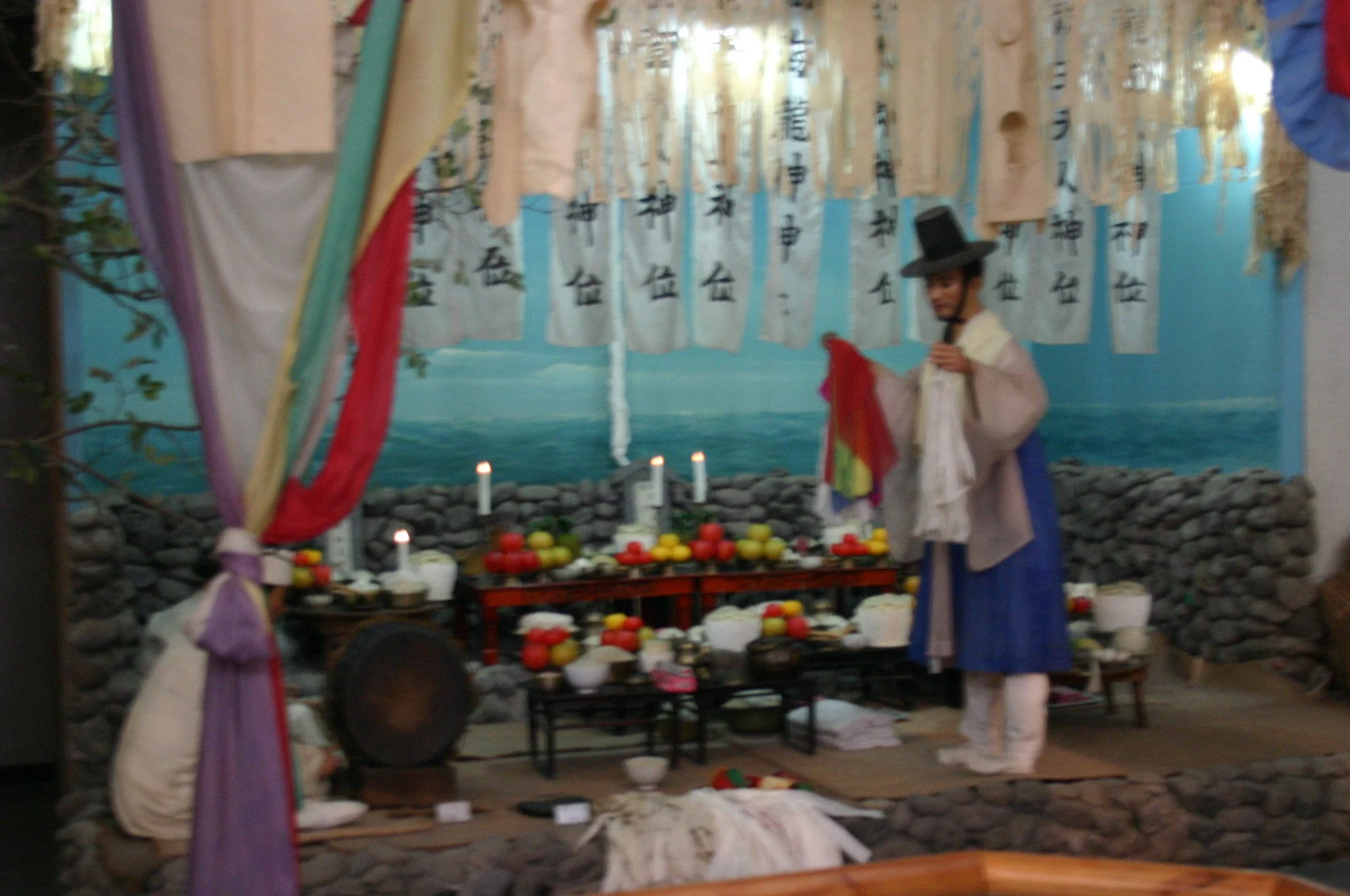

A museum display of a gut: a shaman performing a ritual to pacify spirits, at the Jeju Folk and Nature Museum. Photo: karendotcom127 / Wikimedia Commons, CC BY 2.0.

What the Korean Rituals Say
Laurel Kendall, who followed the same shamans across decades of fieldwork, writes in her Education About Asia article “Old Gods, New Times” that in a gut the shaman dances to rapid drumbeats and speaks in the god’s persona. It is a voice that oscillates between angry and demanding, sometimes comic, usually promising good fortune before the god departs. A few features of the rite map onto Worlds.
For one, the gods’ temperaments are malleable. The form has room for temper and comedy, and it does not require reverence for every minute. The fan who distrusts the balance team and still cries at the final is in good company.
Next is how the gut has a program. The gut unfolds through a sequence of ritual acts, with different gods and ancestors appearing in turn. A Worlds final has its own architecture, moving from ceremony to competition and climax. The parallel is that both organize an audience’s experience through a structured sequence.
Finally, the gut lives inside the economy. Kendall’s Shamans, Nostalgias, and the IMF follows a handful of shamans through the rise of Korean capitalism and the IMF crisis. By the 1990s, the shamans Kendall knew were performing the gut in commercial shaman shrines, adapting their work to the changed circumstances of modern life.
Who Pays the Mudang
The comparison has a hard edge because a mudang makes a living through ritual work. This makes the gut a service. Similarly, Riot is a company and the anthem is a product that also happens to console. So, if I wrote that the song is simply a rite, I would be catering to a marketing department.
Perhaps this is what the song offers that the game cannot. The 2011 cup-lift that closes “Sacrifice” belongs to a man who is no longer alive, and no patch note can adjust that frame. The game will change, the numbers will shift, and new champions will take their place. Yet the song remains, holding a moment still long enough for people to return to it. I have no champion to lose, only the songs, which I continue to listen to. For the length of a song, at least, the god is real.