
Pacha New York: What the Press Release Won’t Say Out Loud
Pacha’s return is backed by a Dubai luxury group with a 460 million dollar credit line, hundreds of millions in hotel revenue, and global expansion plans—not a mom‑and‑pop club rescue for Brooklyn’s once largest independent venue, while bankruptcy language and unpaid claims trail behind.
words by Nina K. Malik
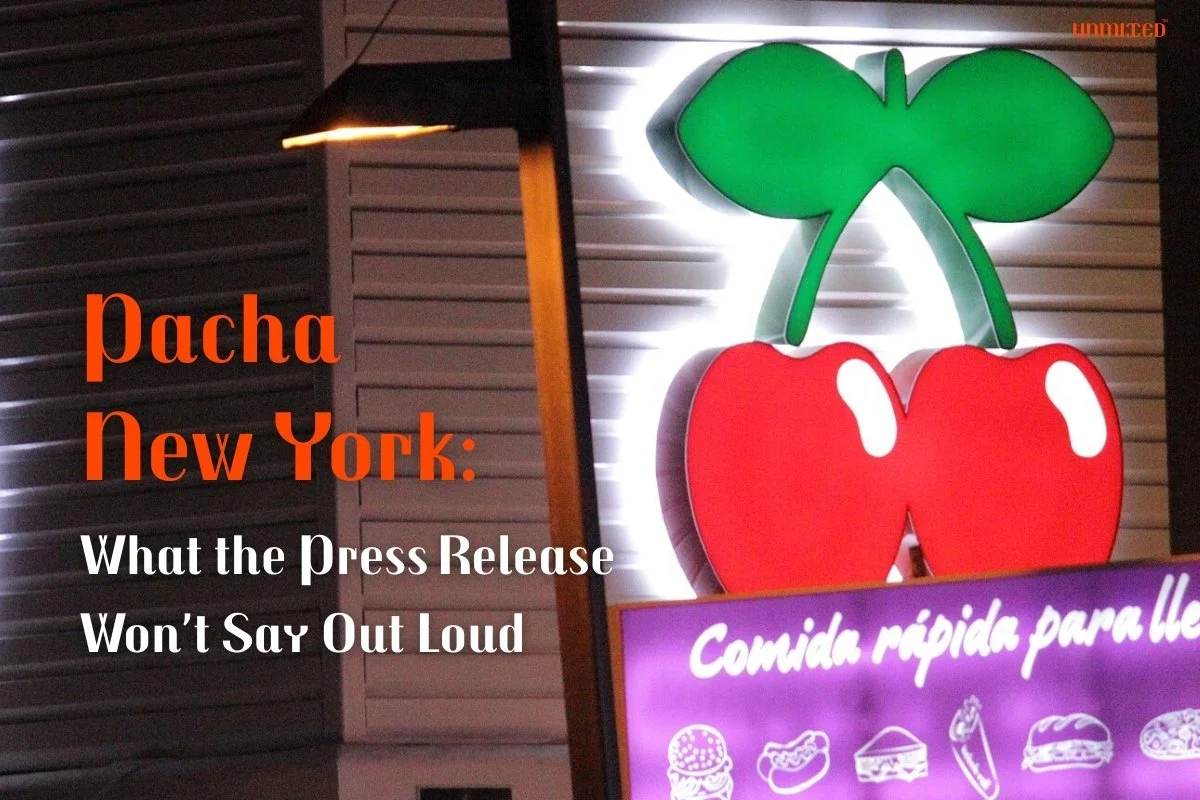
Photo Credit: Wikki Commons. Pacha Ibiza Cherries by Angel Abril Ruiz
Pacha once branded itself as a champion of dance music culture and community. It now returns to New York as part of a Dubai‑based luxury resorts and hotels group whose structure is unmistakably corporate. That shift is not cosmetic; FIVE Holdings is not a small rescue partner; it is a luxury hospitality group that just secured a 460 million dollar revolving credit facility from a syndicate including Commercial Bank of Dubai, AAIB, and Santander to fund global expansion. The company says that facility will allow it to repay a 350 million dollar green bond three years early and free up more than 300 million dollars in cash for strategic investments, including entertainment‑focused hospitality plays in Dubai, Ibiza, the US, and Asia.
When the press release announces that FIVE Holdings has entered into a “long-term agreement assuming full operational management of the Brooklyn Mirage and The Great Hall complex,” it dresses that move up as a partnership between “recapitalized Avant Gardner’s deeply rooted local legacy” and Pacha’s “globally celebrated expertise in building culturally defining destinations and large-scale entertainment experiences.” The sentence reads like a bridge between worlds. In practice, it spells a transfer of control to a luxury lifestyle operator.
“Large-scale entertainment experiences” is not the language of an underground refuge. It is the language of destination property: scale, volume, tiered access, premium product. The subtext is straightforward enough that it barely qualifies as subtext: this is an environment designed around throughput, spend, and bottle service, not around the fragile, local ecology of a scene.
The release goes on to claim that “from June through October 2026, Pacha New York ignites its first season,” with “Grammy‑winning performers” and “large‑scale shows rarely seen in New York City.” It speaks in the register of inevitability and hype, even as the formal court approvals that would lock in that future are still in motion. The language is more definitive than the underlying process.
Pacha New York Takes Brooklyn Mirage: What the Headlines Miss, again..
Brooklyn Mirage sale approved. Pacha New York opens June 2026. FIVE Holdings assumes full control after $110M credit bid clears bankruptcy court. BKMAG, NY Post, Brooklyn Paper, EDM.com, Bushwick Daily confirm similar version to one or all of this: demolition underway at 140 Stewart Ave, seasonal shows June–October, Great Hall year-round under Dubai-backed management.
Search terms spiking now: Brooklyn Mirage Pacha, Pacha New York opening date, FIVE Holdings Avant Gardner acquisition, Brooklyn Mirage bankruptcy sale 2026, East Williamsburg venue reopening summer. Press calls it revival—$155M debt settled, Black Coffee unpaid no more, global icons booked.
Our read goes deeper: creditors' "trickery" objections withdrawn, Axar Capital's closed-door handshake, what Pacha's talent-buying power does to NYC promoters already starved for bookings.
We hear it clearly: for a lot of people who heard that Pacha was “coming back,” this is not the version they were waiting for. The nostalgia was for a feeling, a set of values, a way of being in a room—not a vertically integrated brand extension promising “rarely seen” spectacle.
Kabir Mulchandani’s quote crystallizes the hierarchy at work. He opens by calling New York “the financial and cultural capital of the world.” The ordering is the point: finance first, culture second. He then calls the project “a statement of intent about the scale.” Scale is not a throwaway word; it is the metric around which the entire announcement turns. Read plainly, the combination of “financial,” “intent,” and “scale” describes a corporate takeover of a high‑value cultural asset, not a grassroots revival.
The scale Mulchandani invokes is already visible in FIVE’s books. The group reported 589 million dollars in revenue in fiscal 2024, up 28 percent year‑on‑year, with EBITDA of 208 million dollars, up 17 percent. In the first half of 2025 alone, revenues climbed to 298 million dollars and EBITDA to 105 million dollars, driven in part by Dubai properties generating 177 million dollars in revenue at 85 percent hotel occupancy and 310 dollars revenue per available room.
In the same text, Andrew Axelrod announces that the company has “achieved an agreement in principle with the Committee of Unsecured Creditors resolving all material matters.” The phrase is doing a lot of quiet work. “Agreement in principle” is not the same as money in creditors’ hands, and “resolving all material matters” lands differently when the people behind those claims—ticket buyers, workers, vendors—have not spoken publicly about being made whole. The category of “unsecured creditor” here includes consumers who paid for experiences they never received, and people whose work was never fully compensated. They are referenced as a box ticked, not as a constituency addressed.
Axelrod continues: “We are thrilled to partner with FIVE and Pacha.” That enthusiasm leaves key structural questions open. If this is a “partnership” rather than a straight sale, who ultimately owns the asset? Who controls the cash flows and appreciates the upside? Who collects returns on a venue whose recent history includes assault allegations, cancellation chaos, and unpaid debts? On the other side of the ledger, who is left carrying losses that have been translated into claims, lawsuits, or simple write‑offs?
What We Asked Pacha and FIVE
In light of those ambiguities, Unmixed reached out to Pacha New York and FIVE Holdings for clarification before publishing this piece. Our questions were narrow by design: to understand what has actually been approved, and what remains “in principle.”
We asked whether the Chapter 11 plan underlying this deal has been formally confirmed by the court, or if confirmation is still pending. We also asked whether any court‑approved sale of assets or ownership interests has closed—or whether, at this stage, FIVE and Pacha should be described strictly as operators or managers under a long‑term agreement, rather than owners.
Because the press release says these developments are “reflected in yesterday’s filings,” we requested the specific docket entries relied on, and whether they expressly authorize public rebranding, renaming, and operational transition prior to plan confirmation, including the status of the CVR motion. Finally, we asked how Pacha New York should be accurately described editorially right now: operator, manager, brand licensee, or owner.
In that outreach, we made the obvious point explicit: our aim is to describe the situation precisely and avoid overstating legal finality while the proceedings remain active. We invited their legal or press representatives to respond or redirect as needed.
Until those answers are on the record, a gap remains. The announcement speaks in the language of completed transformation—“long‑term agreement,” “first season,” “all material matters resolved”—while the underlying status is still framed, even by its own authors, as an “agreement in principle.” That is where the story sits for now.
Evolution for Whom?
Following its 2023 acquisition of Pacha Group for 302.5 million euros, FIVE grew Pacha’s revenue to 43.2 million euros in the first half of 2025, with EBITDA from the unit up 26 percent year‑on‑year to 13.1 million euros—backed by 64 events at Pacha Ibiza in one quarter alone and six‑figure guest counts. Those are portfolio metrics, not grassroots scene economics.
The boilerplate at the end of the release completes the picture. FIVE Holdings describes itself as “a vertically integrated, global luxury lifestyle group” with a portfolio spanning “hotels, real estate, branded residences, nightlife, fashion, music, and entertainment.” Pacha Group is presented as a “globally acclaimed lifestyle brand” across “music, leisure, entertainment, hospitality, and fashion.” The operative category in both cases is “lifestyle brand,” not venue, not independent operator, not community institution.
This is arriving in a nightlife economy recently valued in the tens of billions, increasingly dominated by consolidation, private capital, and destination‑driven concepts. In that environment, “Pacha New York represents the evolution of nightlife” is less a neutral observation than a thesis: nightlife as branded asset class, nightlife as part of a luxury portfolio strategy.
The real question is not whether this counts as “evolution.” The question is who profits from that evolution—and who is once again asked to absorb the losses. That is the question the press release does not raise. It is the question this coverage will keep on the table.
