
Brooklyn Mirage’s Chapter 11: What’s in the Committee’s 14-Point Objection
words by Nina K. Malik
What Chapter 11 Actually Does
Chapter 11 is restructuring, not liquidation. A business that can't pay its debts files in federal court and becomes a debtor in possession—free to operate but tethered to a judge's oversight. Major moves like selling assets, taking new loans, or settling lawsuits don't happen quietly. They go before the court, where creditors get notice and a chance to object.
This isn't bureaucracy for its own sake. It's the firewall that stops powerful lenders from cutting side deals that wipe out everyone else. In nightlife, where "creditors" means DJs, former employees, sound techs, and vendors, not just banks, that protection matters.
No Venue Leaves Chapter 11 Without a Judge's Signature
The rule is simple: in Chapter 11, nothing gets sold in the dark. A venue, a brand, a lease — are part of the bankruptcy estate and can only be transferred with court approval. You need three things before "sold" is true: a filed contract, a place in the confirmed plan, and the judge's order. Without those, you have negotiation, not transaction.

Brooklyn Mirage 2023. photo by Chris Lavado
"Everyone I speak to has had the best sets and very special memories at the Brooklyn Mirage."
— Gary Richards, new CEO, August 4, 2025 | Official Statement
Brooklyn Mirage's Path Through the Courtroom
The venue that created the memories Gary Richards has mentioned is now ground zero for a fight over whether its workers get paid. Avant Gardner filed Chapter 11 on August 4, 2025. From that moment, the Stewart Avenue complex belonged to the court. By October, Judge Mary F. Walrath approved a "remarkable" global settlement between Axar Capital, the restructuring's hedge-fund driver, and the Official Committee of Unsecured Creditors. The deal's centerpiece was a Contingent Value Right - a CVR- promising artists and vendors upside if the reborn business thrived.
What followed looked like the machinery of orderly restructuring: a settlement everyone claimed to support, a plan moving toward confirmation, a timeline for court approval. Then, on January 1, 2026, reports emerged that Axar had secretly negotiated a separate deal: a side arrangement with an undisclosed buyer (later reported as Pacha's parent, FIVE Holdings) that would be consummated after the asset sale closed.
The problem, the committee would argue four weeks later, was that this arrangement had been negotiated in secret, concealed from the committee, from the debtors' board, and from the court itself. And its structure would render the CVR—the very protection the October settlement had established "valueless".
The Committee's 14-Point Objection
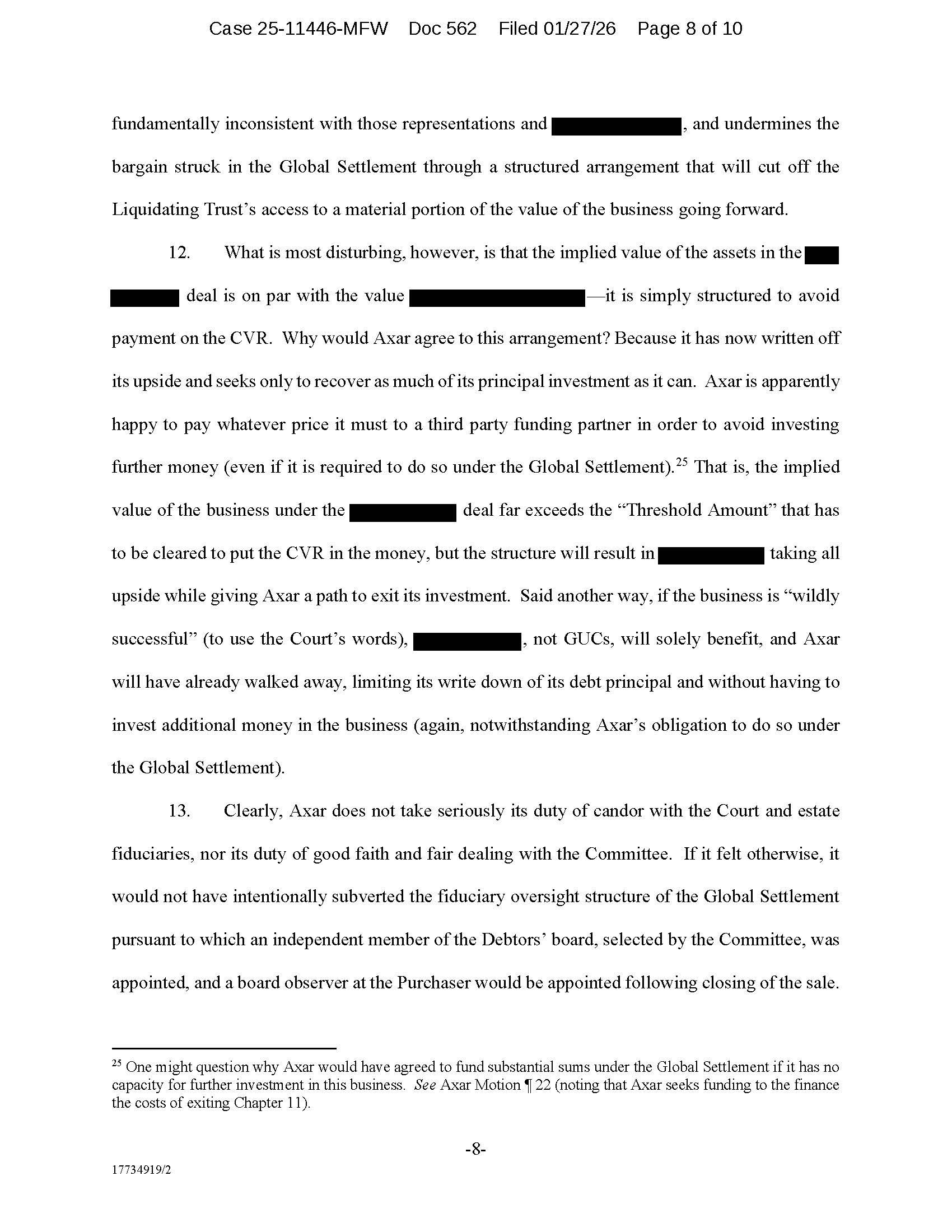
Page 8, Doc 562: Committee argues Axar violated "duty of candor" and "good faith and fair dealing." Case 25-11446-MFW, Jan 27, 2026.
On January 27, 2026, the Official Committee of Unsecured Creditors filed a statement withdrawing its support for the plan. The document was surgical and quite frankly, very ‘techno’ in spirit. Point by point, the committee laid out how Axar had:
Negotiated the side deal without disclosure, refusing to share documents even after the January 1 press leak forced the issue.
Deliberately timed disclosure: A "summary of terms" arrived Friday afternoon before a holiday weekend, less than one business day before the original confirmation hearing.
Structured the deal to render the CVR "valueless from inception", pushing future value into forms untouchable by creditors, as Axar later admitted in its own motion.
Dodged oversight mechanisms: When pressed, Axar's counsel claimed the committee had "no reason (or right)" to see documents, insisted the CVR and deal terms should remain "independent," and pressured the committee to sign off, knowing the structure would gut the promised recovery.
Weaponized technicalities: The committee reminded Axar that post-confirmation, the Global Settlement required sharing such documents with the board observer. Axar responded that the observer "had not yet been appointed," claiming they were "well within their rights" to conceal negotiations from fiduciaries and the court.
The committee's language was direct: "Axar's lack of candor with the Court, and all estate fiduciaries, should not be permitted because it violates the fiduciary oversight mechanisms embodied in the Global Settlement, it violates Axar's duty of candor to this Court, and it violates Axar's duty of good faith and fair dealing with the Committee."
The committee's suspicions hardened when Axar finally produced a summary of terms under "strict confidences," prohibiting the committee's own professionals from sharing it with anyone, including committee members themselves. Those members didn't see it until January 20, a full week later. "At this time, Axar has not even agreed that the Summary of Terms can be shared with this Court."
Most shocking: when asked if the summary had been shared with the debtors' board of directors, Axar's counsel replied, tersely: "No."
"Suspicions confirmed," the committee wrote. "It became clear that the Committee's concerns regarding the trustworthiness of Axar expressed at the beginning of these cases were, unfortunately, well-placed. Under cover of darkness, without involving a single case fiduciary, Axar negotiated a pre-arranged deal... that destroys the value of the Global Settlement."
Most disturbing: "The implied value of the assets in the deal is on par with the value assumptions underpinning [the settlement]... it is simply structured to avoid payment on the CVR." Axar had written off its upside, seeking only to recoup principal by paying a third-party partner whatever price necessary to exit—leaving the business potentially "wildly successful" (the court's words) but funneling all upside to the partner, not GUCs.
"Clearly, Axar does not take seriously its duty of candor with the Court and estate fiduciaries, nor its duty of good faith and fair dealing with the Committee," the filing concluded. "If it felt otherwise, it would not have intentionally subverted the fiduciary oversight structure of the Global Settlement."
What This Means for Nightlife
The creditors aren't numbers on the spreadsheets to ‘trim down’. They're the event planners who mapped every night, the bookers and coordinators who locked in talent, the bar staff who worked on handshake promises, the touring artists whose schedules got shredded around radius clauses that still bound them, it’s the one who ensured that each night went smooth.
Chapter 11 gives them a seat at the table when debt collapses a venue. When a restructuring firm uses procedural gaps to sidestep creditor oversight, when it times disclosures to avoid scrutiny, when it structures transactions specifically to drain the upside workers were promised, that's not bankruptcy law functioning properly. That's the system breaking under pressure from capital that moves faster than courts can follow.
The committee's willingness to withdraw support, to make allegations of "deceit," to issue a reservation of rights and open the door to future claims - that's the last tool left when negotiation fails. It means the fight over who built Mirage and who gets to profit from its future has not only moved from the settlement table to the courtroom, but also from good-faith negotiation to adversarial litigation.
The Floor That Needs Raising
We don’t expect everyone to be a bankruptcy lawyer but we can all simply know this: no Chapter 11 venue is "sold" until the judge signs. Until then, creditors retain leverage. The committee's statement proves it.
On February 12, 2026, the Delaware Bankruptcy Court will hold a hearing on the plan's confirmation. The committee will present its case. Axar will defend its structure. And the judge will decide whether a settlement billed as "remarkable" in October should be allowed to proceed now that its central protection — the CVR —appears to have been gutted by design.
That's where the real story is in whether the people who kept it alive get to survive its restructuring.
SOURCES
All sources are public court filings (Case 25-11446-MFW) and media archives. Everything cited here is legally accessible via PACER. Verify it yourself.
Investigation by Unmixed Magazine
