
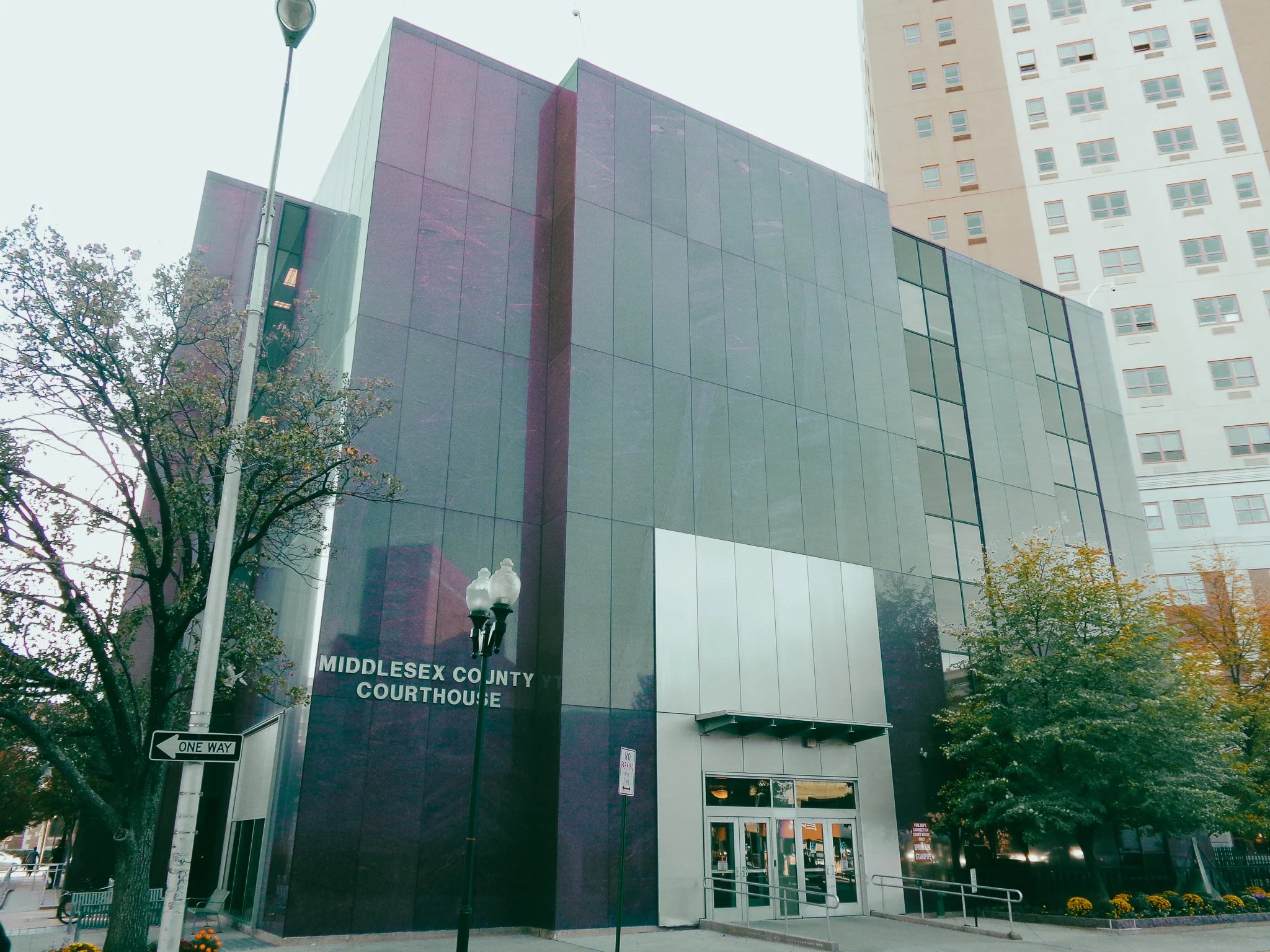
The Middlesex County Courthouse in New Brunswick, N.J., where Toma v. Vitacco is heard. Photo: Hudconja / Wikimedia Commons, CC BY-SA 4.0.
A New Jersey judge has ordered outside experts to conduct safety checks for any Teksupport show still scheduled before November 7. The order follows a disputed report that a piece of equipment fell before a Four Tet show at Brooklyn Storehouse in September. The judge made no finding of negligence, which means he did not decide that anyone was careless.
TCE Presents runs Teksupport, and its shows are ending. The judge’s October 5 order says: “Effective November 7, 2026, there will be no more events through TCE/Toma Vitacco Entities.” The new ruling says that date “remains unchanged.” The case is a legal fight between Rob Toma and Michael Vitacco over TCE.
Judge Thomas D. McCloskey filed the ruling on Thursday, October 22, in Toma v. Vitacco. It has 31 pages: a six-page order and a 25-page Statement of Reasons that explains it. The judge has an official helper, Ian Lagowitz, the court’s Special Fiscal agent. His job is to look into the finances of TCE and its related companies. The ruling tells Lagowitz to report by Monday, October 26, which shows are still scheduled and whether each one has had an independent safety review.
The Statement says the review entails a written confirmation from “an independent, qualified professional” that “the rigging, hoists, suspended equipment, and material safety protocols have been inspected and approved.” Rigging and hoists are the gear used to hang and lift things above a stage. The Statement also says Lagowitz “should have authority to retain an appropriate consultant and to suspend the use of equipment or a production plan that lacks adequate verification.” In plain terms, the judge says he should be able to hire an expert and stop using anything that hasn't been properly checked.

Brooklyn Storehouse, Four Tet show. photo by an anonymous concert goer.
On October 8, Four Tet’s agent, Evan Hancock from ‘The Teams’ (formerly Wasserman) wrote to Toma that a large piece of equipment fell from the ceiling minutes before doors and that “someone could have been killed.” Toma’s lawyer, Ross Fox, emailed the judge on October 9. Vitaccos’ lawyers responded on October 13. According to the Statement, they said the agent’s email was about an unresolved dispute over chargebacks, which are payments that get reversed. They also said Toma had been copied on the booking emails and that the equipment problem had been known and addressed.
Toma’s lawyers argue that account conflicts with a report from the production lead at TAG. TAG supplies stage and sound equipment, and it is in Chapter 11 bankruptcy, a court process that lets a company reorganize its debts. Toma’s lawyers point to two questions: whether an artist was under the equipment, and whether the artist was told.
The judge wrote that the court “need not decide those disputes to protect patrons at remaining events.” In other words, he did not have to decide who was right to make the remaining shows safer. He said the issues “remain factually disputed” and that the new directive is “not a finding of negligence or contempt.” Contempt means disobeying a court order. He also said he will not decide who is telling the truth “through competing letters.”
He did not grant Toma’s request to remove Vitacco from running SAVI and TAG, two companies on the court’s list of Teksupport-related businesses. He also did not put the remaining shows under Lagowitz’s control.
As of Friday, Resident Advisor lists four events before the cutoff with Teksupport as a promoter. Three are CircoLoco New York nights at Brooklyn Storehouse, on October 30, October 31, and November 1. The fourth is Teksupport: Volkoder at The Chocolate Factory on November 6, which is listed as sold out. The order does not name these shows or say whether any has been reviewed. Volkoder runs from 10 p.m. into November 7. The order does not say how a show that crosses midnight counts.
The judge also accepted Lagowitz’s findings about a $500,000 payment. Here is what the findings say. On August 1, Insomniac Holdings, LLC signed a contract with United Interior Group LLC. In it, Michael Vitacco is to provide services at four 2027 events in New York: Dreamstate, Factory 93, Bassrush, and HARD. On August 12, Insomniac wired $500,000 to a bank account. The report says the account belongs to United Interior Holdings, LLC. The court says the report does not explain why that name differs from the company in the contract.
The services had not been done. About $380,000 had already been spent. Lagowitz did not know about the payment until Toma raised it.
Lagowitz based the findings on the signed contract, bank information from Vitacco and “written or direct confirmation from Insomniac.” Insomniac itself told him the services had not been performed. The report also says Insomniac and its parent company did business with TCE, TAG, SAVI and Brooklyn Storehouse in the past 12 months. But it says the four 2027 events “have no visible relationship with any of the affiliated entities over the last 12 months.” The judge added a warning: “the fact that Insomniac had recent relationships with supervised entities does not by itself establish that every later Insomniac transaction belonged to one of those entities.” In other words, working together before does not prove this deal belongs to those companies.
Toma makes three arguments. He says the contract calls the money a “Production Advance,” an upfront payment. He says it was unearned when paid, because the events are in 2027. And he says Vitacco took a business opportunity that belonged to the companies under court supervision, and set up the deal to avoid Lagowitz’s oversight. Lawyers for the Vitaccos deny theft and call it a private arrangement for Vitacco’s work in 2027.
The judge wrote that Lagowitz’s report “corroborates important parts of Toma’s factual presentation but not his ultimate ownership conclusion.” That means the report backs up some of Toma’s facts, but not his claim about who owns the money. The court did not decide who owns it or whether anyone broke a court order. It ordered the remaining money kept in place and told Vitacco to give Lagowitz a full accounting.
Toma and Vitacco were each promised $500,000 under the October 5 order. No one gets paid until Lagowitz says how much cash exists and what must be paid or set aside first: “payroll, taxes, vendors, artists, refunds, secured obligations, wind-down costs, and professional fees.” Secured obligations are debts backed by property. Wind-down costs are the costs of closing a business.
The October 5 order also told the parties to let go of “non-essential” employees by October 9. The new order does not say how many people lost their jobs or who counted as non-essential.
The judge also tightened the rule on letters. A July 16 order barred “litigation by letter,” which means arguing the case in letters instead of in formal motions. The court repeated that on September 16. Now the Statement says the parties “have repeatedly used letters to seek sanctions, injunctive relief, evidentiary findings, and dispositive action.” It says the court’s “patience on this issue is now exhausted.”
Letters may now ask for permission to file something and describe an emergency. They may not include arguments, sworn statements or evidence unless the court asks. Letters arguing the case that the court did not request will not be considered, with two exceptions: formal objections allowed under court rule 4:41-5(b), and anything the judge permits.
The limit does not stop prompt reporting of “an immediate safety or asset-preservation concern” to Lagowitz. An asset-preservation concern is a risk that company property could be lost or sold off. The order does not say who may make that report or how.
The judge said no, for now, to several requests: contempt, sanctions, turnover (handing over assets), a public auction, and a change in the type of TAG’s bankruptcy case. The legal term is “without prejudice,” meaning the requests can be made again. The contempt hearing that began August 21 will be rescheduled. The order says it does not freeze, sell off or transfer TAG’s bankruptcy property.
Lagowitz’s investigation now runs through December 15. The judge set report deadlines on “safety, liquidity, asset preservation, and record access.” Liquidity means how much cash is available. RMTV, Flush To Go, and We Support Here are also on the court’s list of Teksupport-related companies. Next important dates:
Monday, October 26: Lagowitz says whether any show is still scheduled before November 7 and whether each one has had an independent safety review.
Tuesday, October 27: a first answer on whether there is enough money for the equal $500,000 payments to Toma and Vitacco.
Thursday, November 5: a plan to protect the equipment and other property of SAVI and the other court-supervised companies that are not in bankruptcy. It covers public listings of their equipment and how any sale or disposal would get approved.
Friday, November 20: a progress report on whether Lagowitz can get the records of TAG, RMTV, Flush To Go, We Support Here and Brooklyn Storehouse.
Tuesday, December 15: a full report on money owed to the companies, money they owe, cash set aside for creditors, what the assets are worth, where the money can be traced, how assets would be sold off, and whether a provisional manager, a temporary outside manager, is warranted.
Source: Supplemental Order Pursuant to R. 4:41-5(b) and Statement of Reasons, filed Oct. 22, 2026, MID-C-000018-26, Trans. ID CHC2026338347 (Order pp.1-6; Statement pp.7-31). Order Pursuant to R. 4:41-5(b), filed Oct. 5, 2026, Trans. ID CHC2026318520.
