
Brooklyn Mirage Bankruptcy: What Weekly Updates Knew – and Who Was Briefed on Them
In the months leading up to the Brooklyn Mirage’s Chapter 11 filing, recurring internal reports tracked construction progress, financial performance, and forward ticket sales – offering a contemporaneous view of how the distressed venue’s final build phase was measured, reviewed, and circulated across management and governance stakeholders prior to bankruptcy.
words by Nina K Malik.
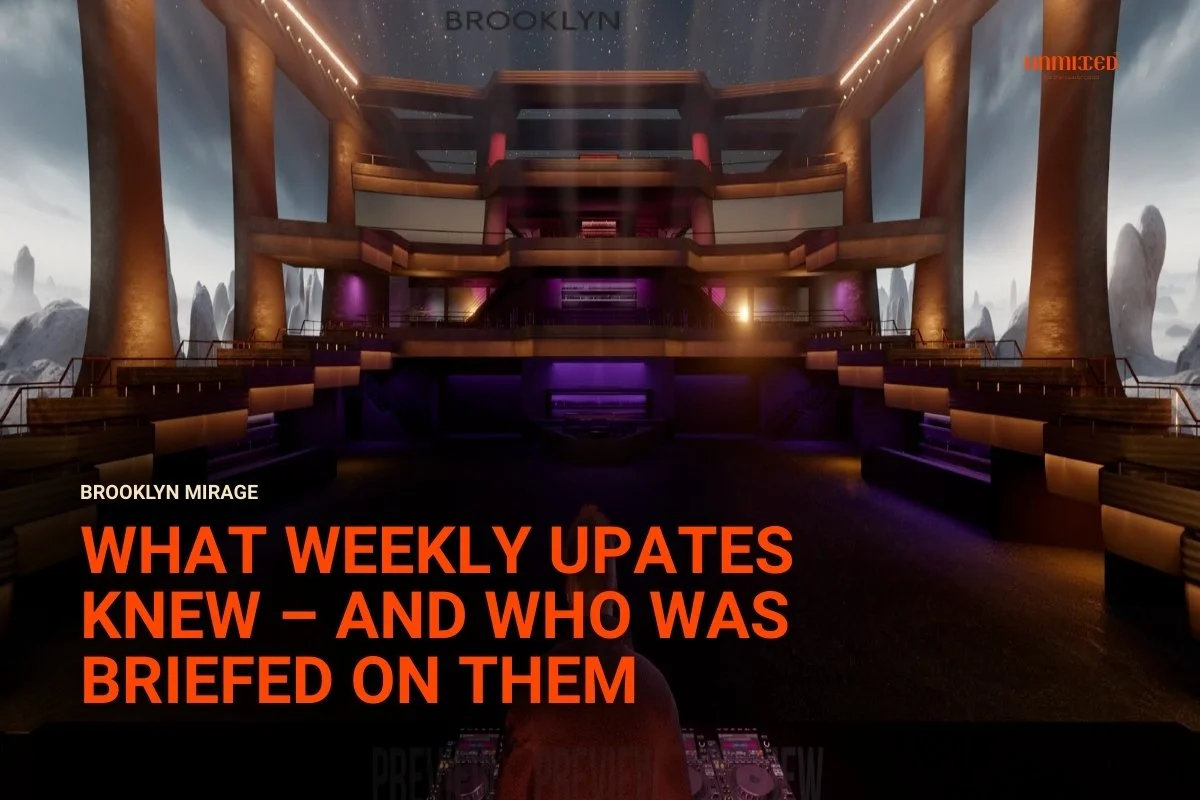
Photo: Internal project reporting materials reviewed by Unmixed included visual build-phase renders circulated during recurring weekly updates in early 2025.
The Mirage case has turned out to be a slow burn.
For months now, one disclosure after another has surfaced like burst pipes behind the rendered walls. But before the bankruptcy filings reduced the venue to a docket number and a creditor hierarchy, there was a different kind of work underway – one focused on keeping the project legible to itself as it moved toward reopening.
Unmixed has reviewed internal reporting materials indicating the existence of recurring operational and financial update processes during the Mirage build period in early 2025.
During the venue’s final construction phase, a structured weekly cashflow reports process was in place to track installation progress, budget performance, and forward-looking operational metrics tied to reopening. These updates documented construction milestones alongside procurement timelines and revised cost assumptions as the build moved through late-stage completion.
According to individuals familiar with the reporting structure, these updates were circulated across senior management and governance stakeholders on a recurring basis during the turnaround period. Formal board-level update sessions were also held during the same timeframe to review technical and financial metrics as revised timelines circulated through the project’s oversight layers.
In parallel, daily ticket sales and opening projections were tracked internally in the weeks leading up to launch. Advance sales data was incorporated into the same reporting stream as build status and financial performance, providing a consolidated view of operational readiness as reopening approached.
As reflected in visual planning materials circulated during these updates, installation timelines were tracked alongside reopening assumptions in the months preceding the August filing.
Who was on call
Beginning February 20, recurring weekly construction and financial review calls were held with Everstory Capital and Mirage management, according to individuals familiar with the reporting process. These sessions included presentation decks tracking installation progress, cost adjustments, and operational readiness in the weeks leading up to opening.
Participants in these update calls included Paras Shah, a financial analyst for Everstory who was embedded on site during the final eight weeks of the build period and reported to Everstory leadership including Lily Donohue. Management attendees on these sessions included Alec Ifshin, then head of finance, and Chris Cox, an external construction consultant retained to oversee project delivery.
According to people with knowledge of the governance cadence, Chief Executive Officer Josh Wyatt also participated in extended governance and reporting calls during this period with stakeholders including Axar Capital founder Andrew Axelrod, board member Hooman Yazhari, and project lead, the owner of AGDP holdings himself: Billy Bildstein. Some of these review sessions lasted several hours and were conducted on a recurring basis as reopening approached.
Vendor invoices accumulated as installation deadlines tightened. Payment instructions were routed through a financial administration process engaged during the active build phase to coordinate disbursements and track capital deployment across subcontractors working to a closing calendar.
By August, the Mirage would enter Chapter 11 proceedings that ultimately transferred ownership to its senior lender - Axar Capital.
That transfer – and the lender’s subsequent ownership position – has been the subject of recent public reporting, including coverage by The Wall Street Journal.
According to individuals familiar with internal reporting during the build period, project performance – architectural, financial, and operational, all of it – had been documented through a recurring update cycle in the months preceding the filing.
They – including stakeholders associated with Purchasing Power Parity – appear to have had been overseeing the Mirage’s evolving operational and financial position as early as 2024, based on internal reporting reviewed by Unmixed. Yet shows continued to be booked and tickets sold into 2025 as reopening approached.
In my view, this story is not primarily about DOB inspections or permitting timelines. It raises broader questions in, dance music and nightlife, about governance models and how private equity–backed restructuring processes can unfold in operational businesses that remain accountable while turnaround efforts are underway.ˆ
