
Delegating Accountability at Spotify: Daniel Ek’s Executive Chairman Step Back
Daniel Ek trades the CEO title for 'going quieter' and operating under the radar, not for less control.
words by Maya Lee
The Optics of Stepping Back
There is a familiar maneuver in the contemporary governance playbook: the leadership step-back that does not constitute an actual leave.
After stakeholder pressure consolidates–whether from investors, advocacy groups, or an intensified governance cycle–the announcement arrives in language calibrated to suggest consequence without delivering structural divestment. The founder will “transition.” The CEO will “refocus on long-term strategy.” Day-to-day operations will be “entrusted to a strengthened leadership team.” Headlines complete the inference.
In coverage of Daniel Ek and Spotify, this sequence frequently stabilized into a resignation-adjacent narrative: stepping down, relinquishing control, making way. Trade press and cultural outlets alike reproduced the framing until the distinction between operational management and ultimate authority collapsed into institutional shorthand.
Authority, however, did not exit the building.
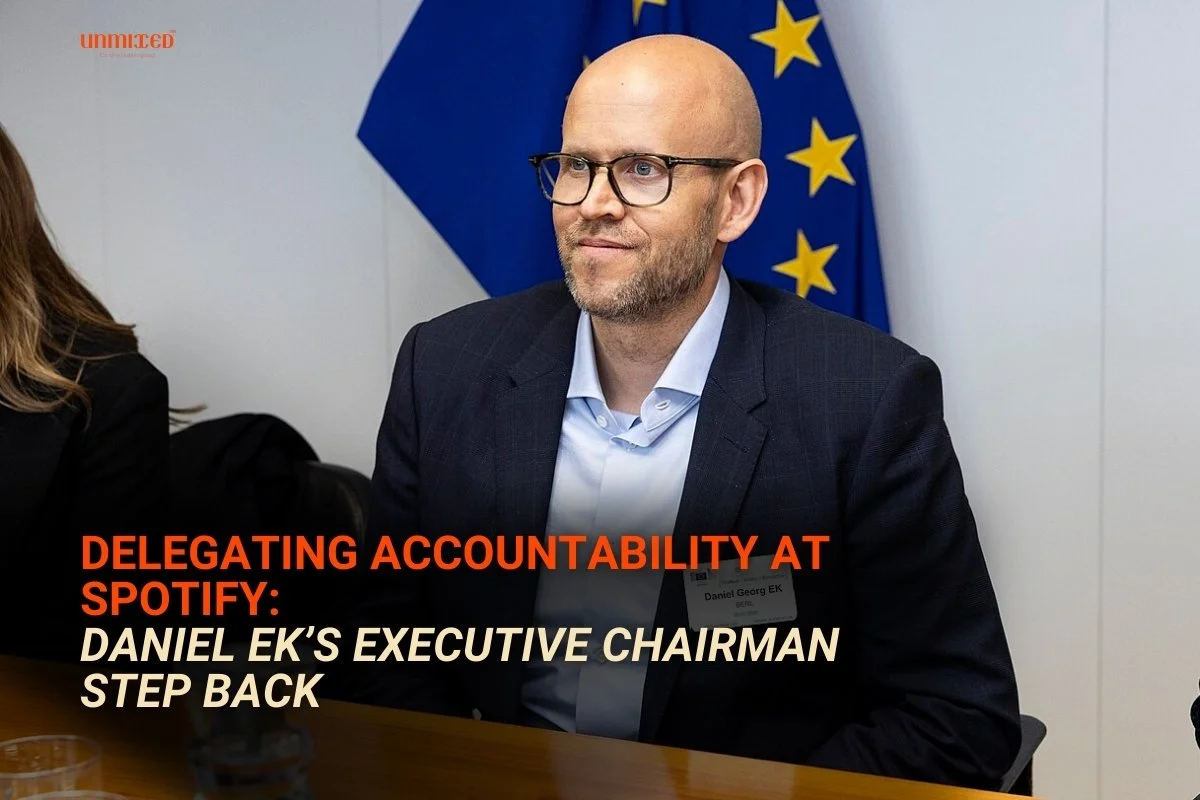
Photo: © European Union, 2025 – Audiovisual Service of the European Commission. “Visit of Daniel Ek, co‑founder and CEO of Spotify, to the European Commission, 25 February 2025”
Executive Chairmanship Without Losing Control
Ek’s movement toward an executive-chair posture reallocated involvement away from daily execution and toward long-horizon strategic direction, while senior executives assumed operational cadence. The optics register as retreat; the governance reality registers as consolidation–continuity of vision, insulation from execution-linked scrutiny, and preservation of founder-level agenda-setting power without day-to-day attribution.
It is distance without disappearance.
How the Executive Chairman Role Works
The Executive Chairman designation performs dual institutional functions. Outwardly, it signals responsiveness: leadership structure updated in alignment with stakeholder expectations, organizational maturation beyond founder-centric management. Inwardly, it preserves decision rights over capital allocation, strategic partnerships, acquisition appetite, platform policy, and the tempo at which the firm determines its future configuration.
This configuration is not anomalous to Spotify; it reflects a broader contemporary template.
Operational authority migrates downward to co-presidents or joint CEOs–roles structurally positioned to absorb scrutiny associated with execution risk–while the founder’s remit shifts upward into domains less legible to quarterly accountability but more decisive over long-term institutional trajectory. Media ecosystems optimized for personnel turnover frequently translate this into a clean break. Organizational continuity persists under a redistributed configuration of visibility.
That distinction becomes legible at points of formal stakeholder interface. During Spotify’s Q4 2025 earnings webcast, Founder and Executive Chairman Daniel Ek appeared alongside the company’s co-Chief Executive Officers and Chief Financial Officer to address investor inquiries regarding capital allocation, long-term strategy, and forward priorities. The CEO title migrated; the accountability channel did not.
Who Is Affected by This Governance Design
Stakeholders implicated in this governance architecture include:
Public market investors
Institutional asset managers
Label partners
Rights-holders
Independent distributors
Artists whose royalty flows are governed by platform policy
For musicians, this leadership configuration directly conditions how their work is surfaced, monetized, and paid.
How Strategy Shapes Artists’ Outcomes
Spotify’s strategic determinations structure discovery mechanics (algorithmic weighting, editorial surfaces), monetization pathways (ad-supported versus subscription revenue mix), payout frameworks (per-stream accounting versus alternative allocation systems), and contractual arrangements with labels and aggregators that flow downstream into artist income. When founder-level agenda-setting authority remains intact–irrespective of daily managerial reassignment–the platform’s economic architecture remains anchored to the same strategic center.
Execution may be distributed. Policy direction is not.
Delegation, Visibility, and Accountability
In reputational terms, the step-back reduces the individual visibly attached to execution while maintaining the individual institutionally positioned to determine strategy. Operational work proceeds. Strategic authorship persists. Public language updates its verbs from runs to oversees.
Control remains constant; attribution is what changes.