
Against the Popularity Contest: Zoé Del Rez
words by Nina Katashvili
Unmixed was built, and is still run, by people who were on the dancefloor before they were on guest lists—who knew the dancefloor before they post social media recaps. In a landscape where “electronic culture” is increasingly compressed into trending campaigns, overpolished press cycles, and branded stage takeovers, Zoé Falgarone aka Zoé del Rez comes in as both participant and a firsthand eyewitness: a DJ shaped from the floor up, and a writer more interested in power structures of the nightlife than commercial mainstream.
Her answers ditch the industry myths that continue to circulate around dance music industry: that success is interchangeable with visibility; that community is whatever logos appear on a flyer; that representation is “solved” because a few familiar names repeat as tokens on lineups. Instead, Zoé treats scenes as living, contested ecologies—where algorithmic sameness, paid-for media space, and the aesthetics of la fête often mask deep imbalances of money, credit and accontability.
She is preoccupied with what never appears in press releases: who subsidizes whose stage time, which collectives never see the back end of the bar, which bodies feel welcome in ‘inclusive spaces’—and under what conditions.
Unmixed’s editorial promise is simple: to make room for people already interrogating culture from within their own practice, and to publish that thinking without softening its edges. Zoé’s willingness to engage discomfort around money, complicity, and the lived costs of womanhood is central to why her work belongs here. This feature introduces her as both contributor and DJ, while reflecting a broader commitment—to slow consumption, to ask harder questions of the culture we participate in, and to support work that prioritizes longevity over visibility.
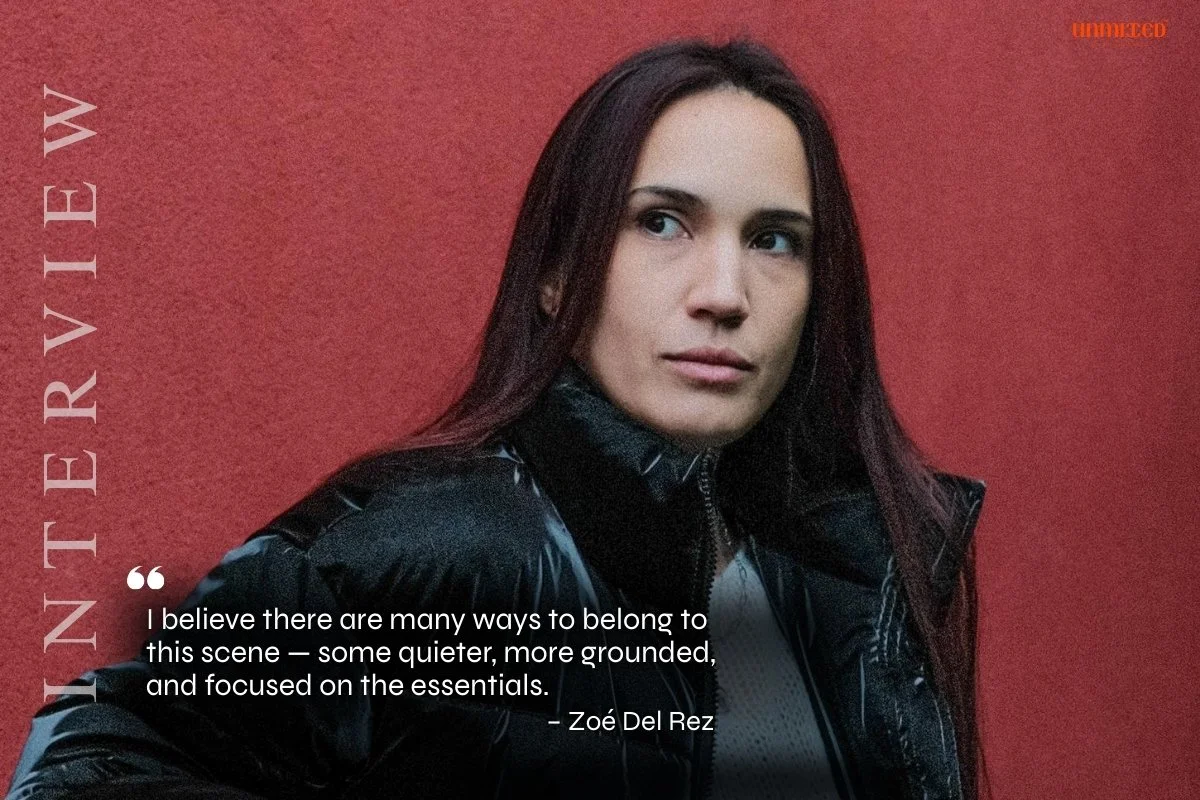
in frame: Zoé Del Rez. DJ / writer. Paris, FR.
photo by Chloé Fougeras
What drew you to Unmixed specifically, and what responsibility do you feel when writing for a platform that openly calls out the music industry instead of flattering it?
I was struck by Unmixed’s ability to take risks and analyze current cultural trends and dynamics within the electronic scene. Its lack of complacency felt necessary in a landscape that is becoming increasingly mainstream and polished, often ignoring deeper issues within its own sphere.
I saw Unmixed as a space capable of offering a more critical and independent perspective—one where artists and professionals can dig deeper, express their views honestly, and share insights about the realities of the electronic landscape. I also want to shine a light on artists and initiatives that prioritize ethics, integrity, and passion.
When did DJing shift from “I love music” to “I’m responsible for the room”?
Having spent countless nights on the dancefloor before ever stepping behind the decks, that sense of responsibility has always been part of my DNA. It directly influences how I dig for music—I’m always visualizing the specific context where a track could live. Sometimes, I’m lucky enough to find gems that trigger memories of a specific party or moment.
Experiencing different scenes—Paris and Buenos Aires—and a range of contexts, from illegal raves in forests and parking lots to intimate clubs and massive warehouses, gave me a deep understanding of how environment shapes energy. As a DJ, it’s a constant balance between staying true to your own sensitivity and remaining attuned to the crowd. Taking risks is exactly what creates lasting, collective memories.
In a landscape where anyone can download a USB and call it a career, what’s actually missing from most sets right now?
With the rise of algorithmic curation and the sheer number of new DJs, it’s easy to fall into sonic uniformity. Developing a personal signature is a long-term process that requires resisting the easy way out—like relying solely on automated recommendations.
As an emerging DJ, I know that identity isn’t built overnight. It’s a constant process of exploration. We’re all influenced by our environments, but the key is how we filter those influences. Curiosity and deep digging are the only ways to avoid becoming interchangeable and to find a meaningful place in the scene.
Outside of DJing and writing, what continues to shape how you think about culture, people, and power?
Before techno, I was immersed in the Paris indie rock scene, drawn to the repetitiveness of post-punk and psychedelic bands. I saw myself only as a spectator, partly because women were so rare on stage.
Transitioning into techno shifted my mindset. Seeing artists receive recognition from their peers—like Anetha in Paris or Sol Ortega in Buenos Aires—allowed me to finally project myself into the scene. Today, the place of women and marginalized voices directly shapes my tastes and my curation.
While I didn’t start DJing as a militant act, I am committed to challenging power dynamics and seeing more women on stage and behind the scenes. In my writing, I want to show that representation isn’t a trend—it’s a necessary evolution.
What should Unmixed readers get from you that they can’t scroll past on Instagram or find in a press release?
I’m interested in the gap between what la fête promises—freedom, emancipation, authenticity—and the way the industry actually functions. I want to go behind the scenes and explore how people and collectives navigate the tension between DIY ethics and high-budget commercial worlds.
I want to ask the questions people often avoid: How do you balance values with survival? When do compromises happen, and what does it truly cost to remain a person of integrity?
What are you actively unlearning about success and belonging as you move deeper into nightlife and media?
I’m unlearning the idea that you need to win a popularity contest to be legitimate. There are many ways to belong to this scene—some quieter, more grounded, and focused on the essentials.
Growth, for me, means distinguishing true goals from external noise. It looks like building long-term relationships, contributing value without constantly seeking validation, and staying aligned with my own vision while enjoying the craft.
How do you think about influence in scenes that often confuse visibility with impact?
Visibility is a tool, and I don’t blame anyone for using it sincerely. What worries me is when the system attracts people who are only interested in the spotlight without sharing meaningful values.
I believe it’s important to prioritize depth over speed. That’s why I choose Unmixed—it allows reflections to unfold. In an era of content that disappears in seconds, I want to create work that can be digested and retained.
What boundaries need to be drawn more clearly in nightlife and music media right now?
Passion and knowledge don’t always align with financial means. Large structures often rely on the energy of smaller collectives to draw crowds, yet profit distribution remains deeply unbalanced.
We see significant money circulating, but while big platforms capture the visibility and the revenue, independent organizers and artists are left fighting for survival. When media outlets charge for visibility, they stop being curators and become sellers of fantasy. That boundary needs to be restored.
What belief about music culture feels risky to say out loud—but necessary to stand by?
We often talk about the system and big promoters, but at the end of the day, the public is what keeps those commercial events alive. If the scene feels mediocre, it’s also because people are willing to pay for it and follow influencer DJs.
Where we choose to spend our time and money matters. If we don’t support smaller, more authentic spaces, they will disappear. I just hope there will always be places where we gather because we genuinely love the music—not the hype, not champagne bottles, not VIP areas.
