
Before Acid House Had a Name, There Was a Raag
“Culture is a living thing. Everyone involved is also co‑creating it.”
— Nina Katashvili
Raag is not a scale in the Western sense. It is a system of behavior. It dictates how notes may enter, linger, bend, and leave. Each raag carries an emotional charge — rasa — and is bound to time: dawn, dusk, monsoon, night. To perform one incorrectly is not a stylistic error; it is a breach of mood, season, and intent.
In Indian classical music, both Hindustani and Carnatic, a raag is a complete musical identity. It has rules of ascent (aroha) and descent (avaroha), emphasized tones, and strict constraints that nevertheless allow for deep improvisation. The goal is not repetition. It is immersion. Raag unfolds slowly, demanding patience from performer and listener alike. It resists compression. It cannot be rushed without consequence.
That such a system would later surface inside electronic machines seems unlikely. But inevitability often looks improbable in hindsight.
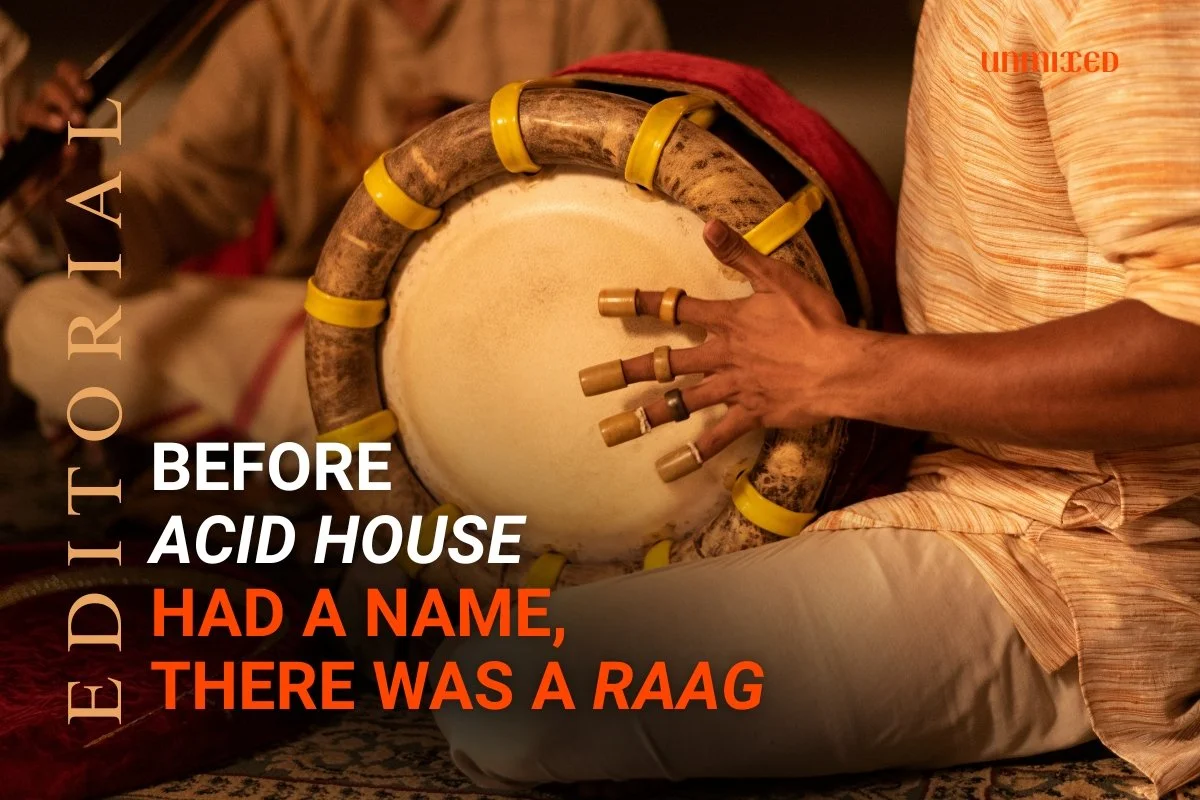
Photo by Rajesh Mishra “An artist playing with Thavil instrument during an Indian wedding ceremony”. Bangalore, Karnataka, India
In 1982, Charanjit Singh, a prolific Bollywood session musician, returned to India with two devices that were already considered commercial failures: the Roland TB‑303 bass synthesizer and the TR‑808 drum machine. Designed to replace human musicians, both had been rejected for sounding artificial. Singh did not treat them as imitations. He treated them as instruments capable of learning a different discipline.
On Ten Ragas to a Disco Beat (1983), Singh translated classical ragas into electronic sequences, removed the tabla, and anchored the structures to a steady disco sounds. The result was neither novelty nor fusion. It was exacting, hypnotic, and difficult to place. Disco was falling out of favor. Indian classical music was being preserved, not reimagined. The record arrived without an audience.
It failed.
When the album resurfaced two decades later, listeners heard something uncanny. By then, acid house had been canonized — its squelching basslines tied to Chicago clubs and the TB‑303’s accidental resonance. Singh had reached a similar sound years earlier, independently, through a different logic entirely.
This is why Singh is often retroactively described as an inventor of acid house. The label is convenient and incomplete.
Singh was a simple man. If you watch any of his interviews you can see he had no desire to become the “father of acid house.” He did not see himself as an inventor, nor was he attempting to inaugurate a movement. He understood himself instead as a connector — someone moving between two worlds that did not yet know how to speak to one another. That position, neither fully inside tradition nor fully aligned with futurism, is precisely what made his work so difficult to place, and so easy to misunderstand. He was not anticipating a genre that did not yet exist. He was applying a classical system of time, mood, and melodic restraint to electronic circuitry. The machines did not liberate the raag. They were made to obey it.
That distinction matters.
Singh was not interested in futurism. He was interested in translation. His work did not decorate disco with Indian motifs; it subjected new technology to old rules. The TB‑303 learned how to wait.
Culture, like raag, is not a fixed repertoire but a discipline shared across bodies, rooms, and machines. Everyone involved: the classical soloist, the session musician, the dancer in a Bombay nightclub, the later listener hearing “acid” where he heard only pattern, is co‑creating the same living system under different conditions. The work on Ten Ragas to a Disco Beat is not proof that tradition can be uploaded; it is proof that a strict grammar of time and mood can survive translation, altering the very tools asked to carry it. Culture is a living thing. Everyone involved is also co‑creating it.
