
Sold in the Headlines, Not in Court: Brooklyn Mirage’s Pacha Deal Blows Up in Bankruptcy
On New Year’s Day, outlets announced Brooklyn Mirage had been sold to the group behind Pacha. Three weeks later, the creditors’ committee withdrew support and told a Delaware judge the deal they were promised had been quietly gutted by Axar — and that without that very press leak, no one in the courtroom would have known.
words by Nina K. Malik

Photo: WikiCommons
WHAT HAPPENED?
In the first week of January, the story seemed settled. Brooklyn Mirage was gone; in its place, a new Pacha New York would rise from the bankruptcy ashes, backed by Dubai‑based FIVE Holdings, the hospitality group that owns the Pacha brand. Headlines called it a 110 million dollar sale, a done deal, a clean flip from distressed asset to global nightlife flagship.
Inside a Delaware courtroom, the story now looks very different. On January 27, the Official Committee of Unsecured Creditors — the artists, vendors, and trade partners that kept Avant Gardner running — filed a blistering statement withdrawing its support for the very plan that was supposed to deliver that future. The committee says Axar Capital, Mirage’s hedge fund backer and stalking‑horse buyer, quietly structured a side‑deal for the Mirage that would make their recovery “valueless from inception” and kept that structure hidden from the court, the debtors’ board, and the creditors themselves.
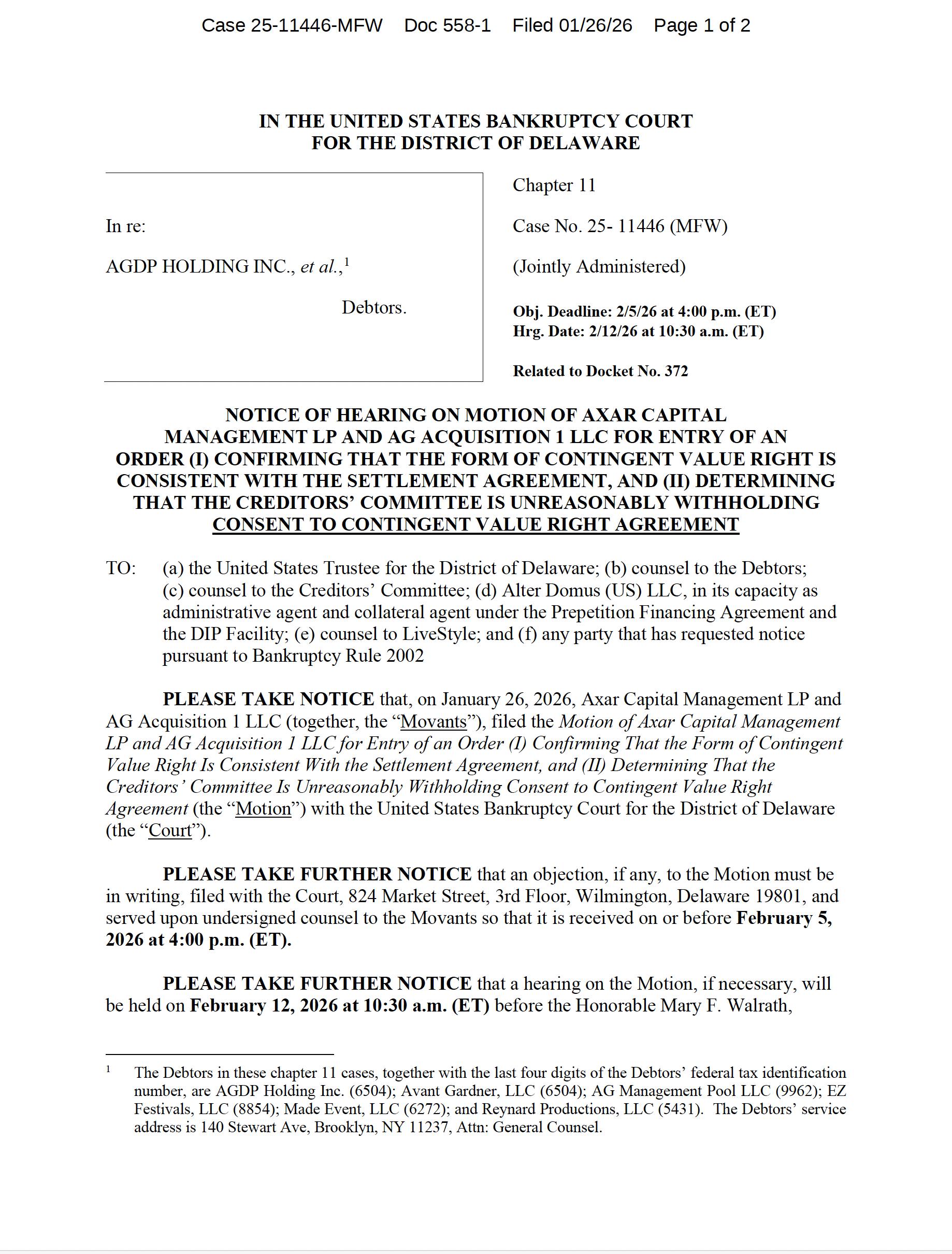
558 Axar vs CVR motion. January 26 2026
The “remarkable”deal that unraveled
When Brooklyn Mirage’s bankruptcy case reached its first turning point last fall, the court praised the Global Settlement between Axar and the committee as “remarkable” and “a very good deal.” The centerpiece was a contingent value right — a CVR — that would give general unsecured creditors a share of the upside if the post‑sale business turned out to be, in the judge’s words, “wildly successful.” In a world where artists and trade vendors usually get wiped out, it was marketed as a rare promise: if the Mirage thrived again, the people on the wrong end of unpaid invoices would participate.
According to the committee, that promise is exactly what Axar then worked around. “With disappointment,” the filing opens, “the Committee withdraws its support for confirmation of the Plan because recent events render the Plan and the consideration provided to general unsecured creditors thereunder inconsistent with the Global Settlement.” The “recent events” are not some shift in the economy or the club market; they are Axar’s negotiations with a third‑party buyer that, the committee says, were “negotiated in secret, concealed from the Committee, the Debtors’ management and board of directors…, and, most importantly, this Court.”
The committee’s accusation is simple: Axar capital side deal pre‑wired a transaction that pushes value to the new funding partner in a way that keeps it out of the CVR waterfall, undermining the bargain that justified the plan in the first place. In the committee’s words, the deal “would render the CVR valueless from its inception,” even if the business is wildly successful.
The leak that built the headlines — and blew the cover
If you follow the scene, you already know the press side of the story. On January 1, 2026 Brooklyn Magazine ran an exclusive stating that Dubai‑based FIVE Holdings, the company behind Pacha, was expected to enter into a deal with Axar to buy Avant Gardner and rebrand Brooklyn Mirage as Pacha New York, citing an anonymous industry source and the bankruptcy process.
What the article did not include was documentation. No court filing. No executed agreement. No motion, notice, or disclosure on the docket corroborating the claim or any other form of evidence.
Instead, the piece went further—asserting that “the deal between Pacha’s parent company, FIVE Holdings, and Axar is expected to become official around 2 p.m.” The specificity reads as certainty. In Avant Gardner Chapter 11 case governed by filings, hearings, and court approval, that detail should have raised immediate questions.
Bankruptcy transactions do not “go official” at a time of day. They are memorialized through documents, approved on the record, and reflected on the docket. Dates matter. Orders matter. Timestamps do not substitute for paperwork.
That level of precision — absent any public filing — was the first and clearest red flag. Not because rumors don’t circulate in nightlife, but because bankruptcy is not an industry whisper network. It is a federal process with an evidentiary trail. And at the time the story ran, that trail did not exist.
In the days that followed, dance media and real‑estate blogs treated that statement as reality. Beatportal described FIVE as being “in talks” to acquire Avant Gardner and turn Mirage into a Pacha flagship. EDM.com and Mixmag framed the takeover as a bankruptcy sale: the Pacha brand “set to take over Brooklyn Mirage” after Chapter 11. CRE‑focused Traded.co went further, narrating a flip in which Axar acquires Avant Gardner’s assets for around 110 million and then sells Mirage to FIVE on January 1, while The Real Deal reported Mirage “sold to nightlife brand for 110M”.
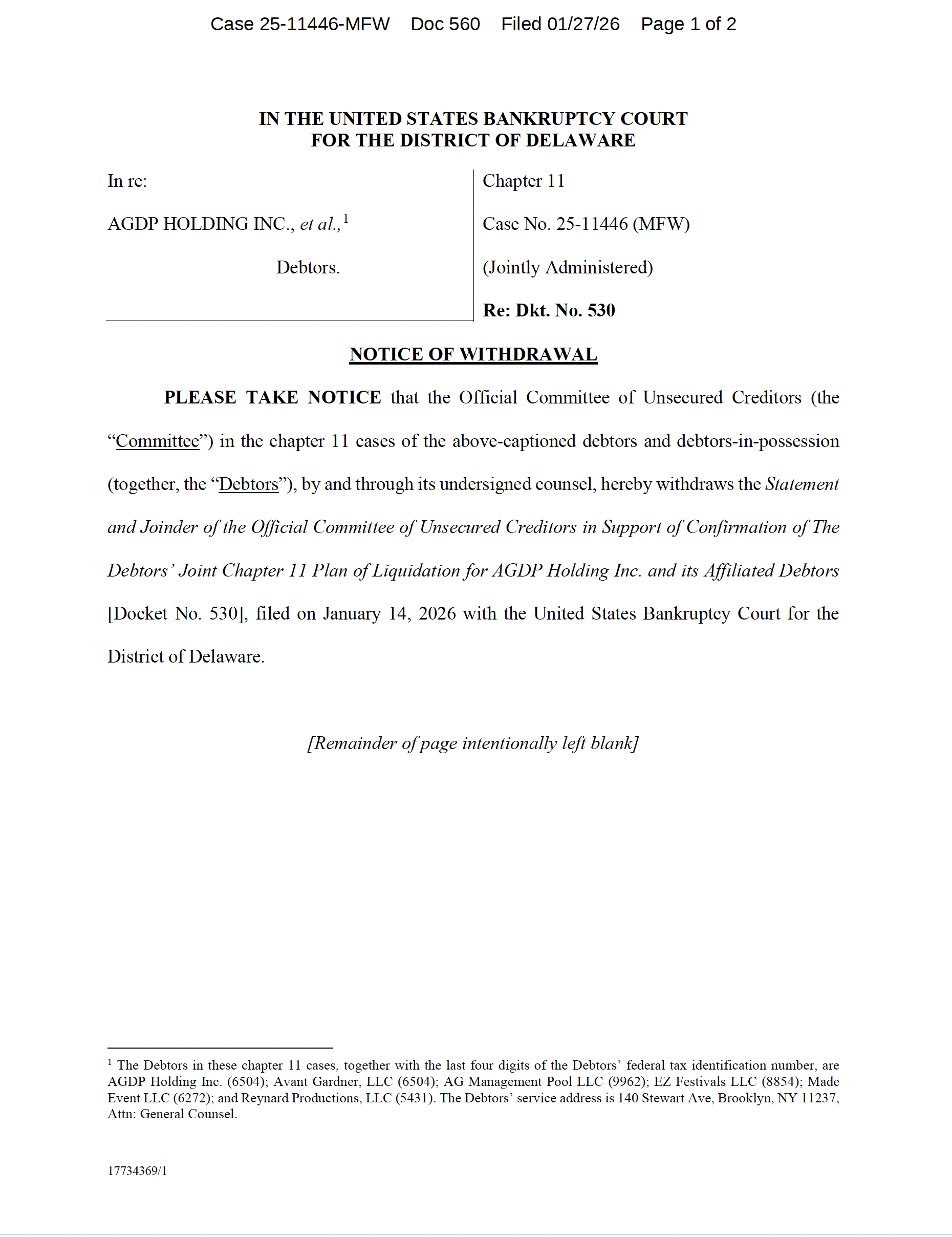
560 withdrawal notice. Janury 27, 2026
Those same reports now show up in the court record as Exhibit A of a very different story. “Fortuitously, on January 1, 2026, reports of a deal by Axar to sell The Brooklyn Mirage… appeared in the news,” the committee writes. The court, the debtors’ board, and the committee “would ever have known” about Axar’s arrangement “until long after the Plan had already been confirmed” if that leak had not forced the issue into the open.
Once the headlines hit, committee counsel pressed Axar’s lawyers for answers. At first, the filing says, Axar’s counsel flatly told them the story was “incorrect” and insisted Axar was merely looking at different financing options for the costly Mirage renovation. When asked again by other lenders on January 9, the message softened — there was “no definitive agreement in place” — but there was still no candor about the structure that, by then, was already being negotiated.
It was not until a January 12 call that the committee was “apprised orally of the basic contours of the arrangement,” learning that the deal was “all but done” and designed to be consummated after Axar’s own purchase closed. Even then, Axar refused to hand over the documents, insisting the committee had “no reason (or right)” to see them and pushing to finalize the CVR instrument on a timeline that kept the details out of view. The filing recounts that Axar only delivered a summary of terms late on the Friday before a holiday weekend, less than one business day before the originally scheduled confirmation hearing — and that even that summary was held back from the committee members and the debtors’ board for days under strict confidentiality.
The committee’s conclusion is blunt: Axar “by design, intended to avoid the oversight features of the Global Settlement so that it could pre‑wire a deal under cover of darkness” that “undermines the bargain struck with the Committee.”
“Sold,” “acquired,” or still under the court?
In the press, the Mirage‑to‑Pacha arc reads like a clean three‑act pivot: bankruptcy, rescue, rebrand. Brooklyn Magazine’s exclusive framed the Pacha‑backed buyer as stepping into Axar’s shoes and turning the troubled complex into a global brand asset. Mixmag MENA and Beatportal re‑told that story for dance readers. Traded.co and The Real Deal slotted it into a familiar real‑estate narrative: distressed asset, 110 million dollar sale, 2026 reopening under a stronger flag.
The January 27 filing makes clear that, inside the case, nothing is that clean. There is still no confirmed plan. The committee has withdrawn its support. Discovery into the Axar arrangement is ongoing and the summary of terms, the filing notes, has not yet been made available to the court in full. The creditors’ representatives “expressly reserve all rights” regarding enforcement of the Global Settlement, Axar’s conduct, and the actions of the unnamed third‑party buyer.
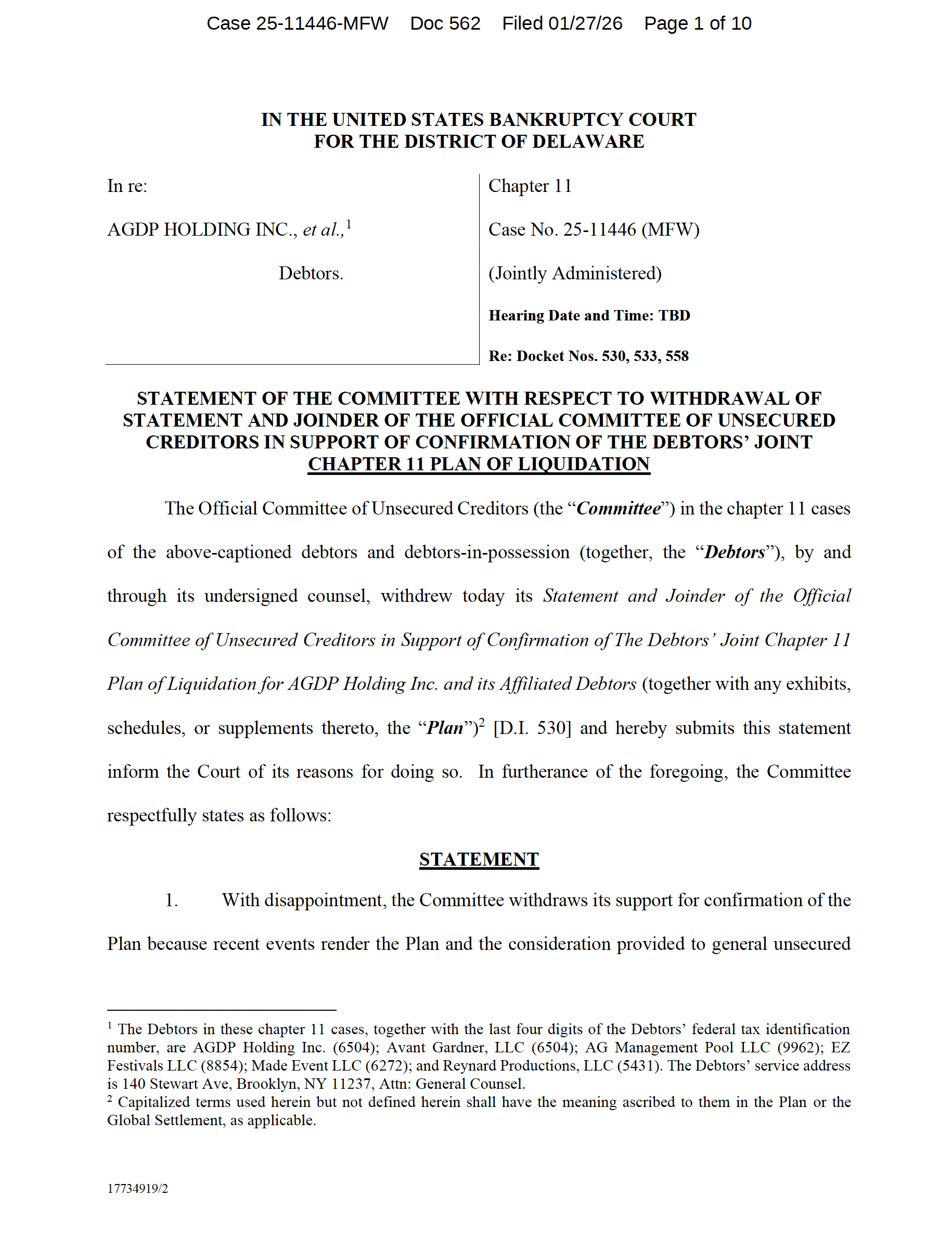
562 The Committee Statement. January 27, 2026
Most importantly, the very structure that fueled the “Mirage sold to Pacha” headlines is, in the committee’s telling, what kills the upside for unsecured creditors. The filing alleges that the implied value of the assets under the deal is “on par with” the original valuation — enough that, if the CVR worked as advertised, the contingent rights would be solidly “in the money” — but that Axar and its partner have chosen a form that “is simply structured to avoid payment on the CVR.” In their words, if the business turns out to be wildly successful, it is the new partner, not the Liquidating Trust for artists and vendors, that “will solely benefit,” with Axar already walked away.
For readers who saw “Mirage sold” as a closed chapter, this is the crucial correction: nothing is sold until the court signs off, and the court has now been told the deal on the table violates the very settlement it previously approved.
Who gets paid when the music comes back?
The committee goes out of its way to remind the judge who its members are: “the trade vendors and artists that are the lifeblood of Avant Gardner’s business.” These are the people who kept Mirage functioning through unpaid balances, who kept supplying talent, sound, rigging, cleaning, security, and promotion while the venue’s financial structure buckled under debt. The CVR was supposed to be their hedge against being written out of the story once the hedge fund and the new owner took over.
Court filings also show that the fallout extended beyond artists and vendors. The claims register includes submissions from former employees, including temp and hourly workers, who allege they were laid off without severance or continued healthcare coverage, despite contractual provisions requiring both. These workers, many of whom were terminated during the bankruptcy process, now appear in court not as staff but as unsecured creditors—their claims folded into the same restructuring that headlines framed as a clean “sale.” This dimension of the case was absent from public reporting, yet it underscores how bankruptcy decisions materialize not as abstractions, but as lost income, lost benefits, and broken protections for workers on the ground.
The committee now says Axar’s “trickery” would have turned that instrument into a shell from day one. The oversight features they negotiated — an independent director, a board observer at the purchaser, covenants protecting the economic benefit of the CVR — were precisely meant to prevent this kind of quiet value shift. Instead, the filing argues, Axar used the gap between settlement and plan confirmation to cut its own loss, writing off its upside, recouping principal, and leaving GUCs with an IOU designed never to pay.
For New York nightlife, the question is not just whether Pacha gets takes over Brooklyn Mirage. It is whether the workers, artists, and crew who built Mirage see any upside if a rebranded version of the business thrives — or whether they are written out while the capital structure resets around them. For journalism, the committee’s document is a spicy-reminder that the first story to land — the splashy “Mirage sold” scoop — can double as the trailhead for a far more complicated truth once you put it next to the docket.
For now, Mirage lives in limbo: demolished on paper, repurposed in branding decks, contested in court and uncertain in reality. There may yet be a Pacha New York on Stewart Avenue. But if this filing stands, the real battle won’t be over what name is slapped on an event flyer — it will be over who actually gets paid and whats behind that process.
SOURCES & VERIFICATION
All sources cited in this reporting are public court filings and recent media coverage with links in the sidebar.
All bankruptcy materials are legally accessible via PACER.
Readers are encouraged to verify the record independently.
KEY COURT DOCUMENTS
Official Committee of Unsecured Creditors Statement
Docket No. 562 — January 27, 2026Committee Withdrawal of Support for Plan
Docket No. 560 — January 27, 2026Axar Capital CVR Motion
Docket No. 558 — January 26, 2026
DOCKET INFORMATION
Case: In re Avant Gardner, LLC and associated
Case No.: 25-11446-MFW
Court: U.S. Bankruptcy Court, District of Delaware
TRANSPARENCY NOTE
This investigation is ongoing.
Unmixed Magazine is committed to source-driven, public-interest reporting. All factual claims in this piece are drawn directly from court filings or contemporaneous media archives.
If you encounter difficulty accessing documents via PACER, or would like specific filings or the full record (1,000+ pages), contact us at:
We will provide the requested materials directly.
Why this matters:
Multiple outlets reported a “sale.” Court filings show no sale was approved — and employees, other workers, vendors, and artists are now creditors in an ongoing bankruptcy dispute.
“Mirage Sold to Pacha” – Tracking the Myth.
Brooklyn Magazine – Jan 1, 2026
“Exclusive: Avant Gardner and Brooklyn Mirage to Be Sold to Global Nightlife Brand Behind Pacha”
Beatportal – Jan 1, 2026
“Pacha’s Parent Company in Talks to Acquire Avant Gardner and Brooklyn Mirage”
Traded.co – Jan 1, 2026
“Pacha Returns to New York After $110 Million Brooklyn Mirage Sale to FIVE Holdings”
Commercial Observer – Jan 5, 2026
“Site of Troubled Brooklyn Entertainment Complex Sells for $110M”
Greenpointers – Jan 6, 2026
“Avant Gardner and Brooklyn Mirage Sold for $110 Million to Dubai‑Based Hospitality Group”
The Real Deal – Jan 7, 2026
“Brooklyn Mirage Sold to Nightlife Brand for $110M”
Mixmag – Jan 7, 2026
“Pacha Ibiza Parent Company to Purchase Brooklyn Mirage After Bankruptcy”
Resident Advisor (RA) – Jan 8, 2026
“Pacha's parent company to buy Avant Gardner, Brooklyn Mirage”
Secret NYC – Jan 20, 2026
“Meet The New ‘Pacha New York’ — The Legendary Ibiza Brand Taking Over Brooklyn’s Most Famous Dance Music Venue”
