
My Techno Pilgrimage to Detroit: Reflections on Movement Festival 2026
By Natasha Cornelissen
The techno that emerged out of Detroit in the 80s was created by Black people who listened to Black music: soul and Motown, Parliament and Prince. During this time, the once-thriving automotive manufacturing hub was decaying into a post-industrial environment. Compounding onto the Motor City’s loss of economic identity, segregation's smothering legacy delineated public space and private life. With this backdrop of profound urban isolation, sonic experimentation and expression became a means of catharsis.
Between pioneers like Ken Collier and Juan Atkins, radio DJs like “The Electrifying Mojo” Charles Johnson and “The Wizard” Jeff Mills, and founding women on the decks like Stacey “Hotwaxx” Hale and DJ Minx, electronic music’s roots run deep in Detroit. For a generation of innovators, this was the sound of the future, and its explorations transported electronic music to new universes.
Quickly, Detroit techno found its way into the abandoned industrial zones of post-wall East Berlin. In 1991, Jeff Mills began playing at Tresor shortly after the nightclub’s opening. Built into a bank vault beneath the ruins of the Wertheim Department Store, this gritty environment matched the hard sounds he brought from home. As other Detroit DJs like Atkins began spinning there in the following years, a cross-cultural exchange was cemented between the two cities.
While the following decade saw techno explode in Europe as a cultural phenomenon, the scene back in Detroit remained underground and underfunded. Thus, Carl Craig led the first edition of the festival that would become Movement in May of 2000, a free event that sought to legitimize the genre in its founding city. Over two decades later, I spent the 2026 edition backstage doing live coverage of the weekend with Unmixed.
Day one kicked off at the Stargate Stage for Stacey “Hotwaxx” Hale. Hearing her live, there’s no question where she earned the nickname, “The Godmother of House.” Her sets have the unmistakable influence of funk and gospel, testaments to the Black American music that gave way to electronic’s earliest sounds. As she played, the crowd danced with fervor and cheered even louder.
In the festival’s underground, a mini installation titled “Respect the Architects” paid homage to Detroit’s electronic music pioneers, featuring illustrations of originators like Delano Smith and K-Hand. Over at the stage, the first night closed with a B2B between DJ Stingray, creator of Detroit’s 90s-era Urban Tribe project, and Ellen Allien, founder of Berlin’s BPitch Control label. With a driving techno and electro set, the legacy performers came together to reinforce the long-established exchange between their two cities.
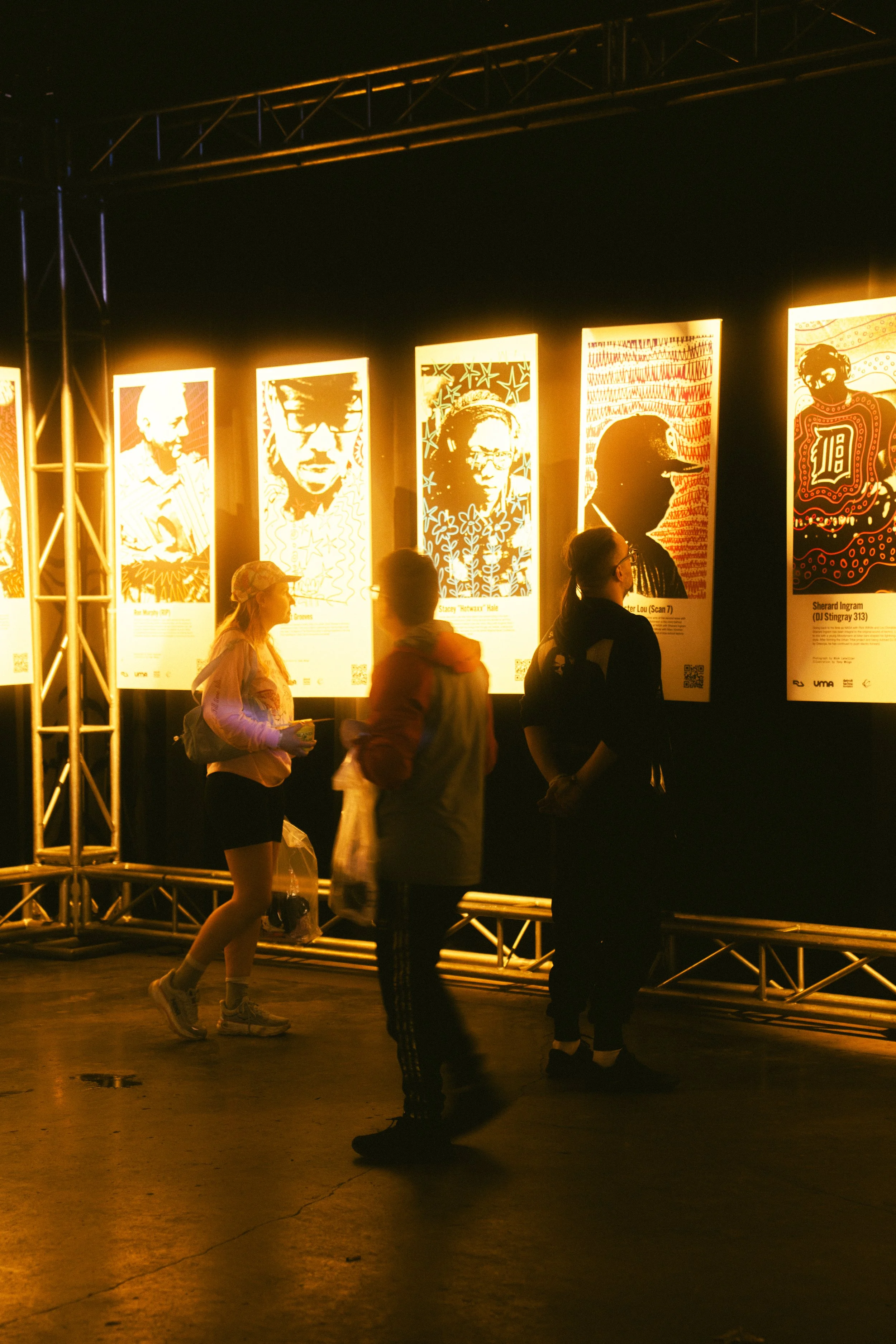
Festivalgoers take in the exhibition. Photo by Brenda Brooks.
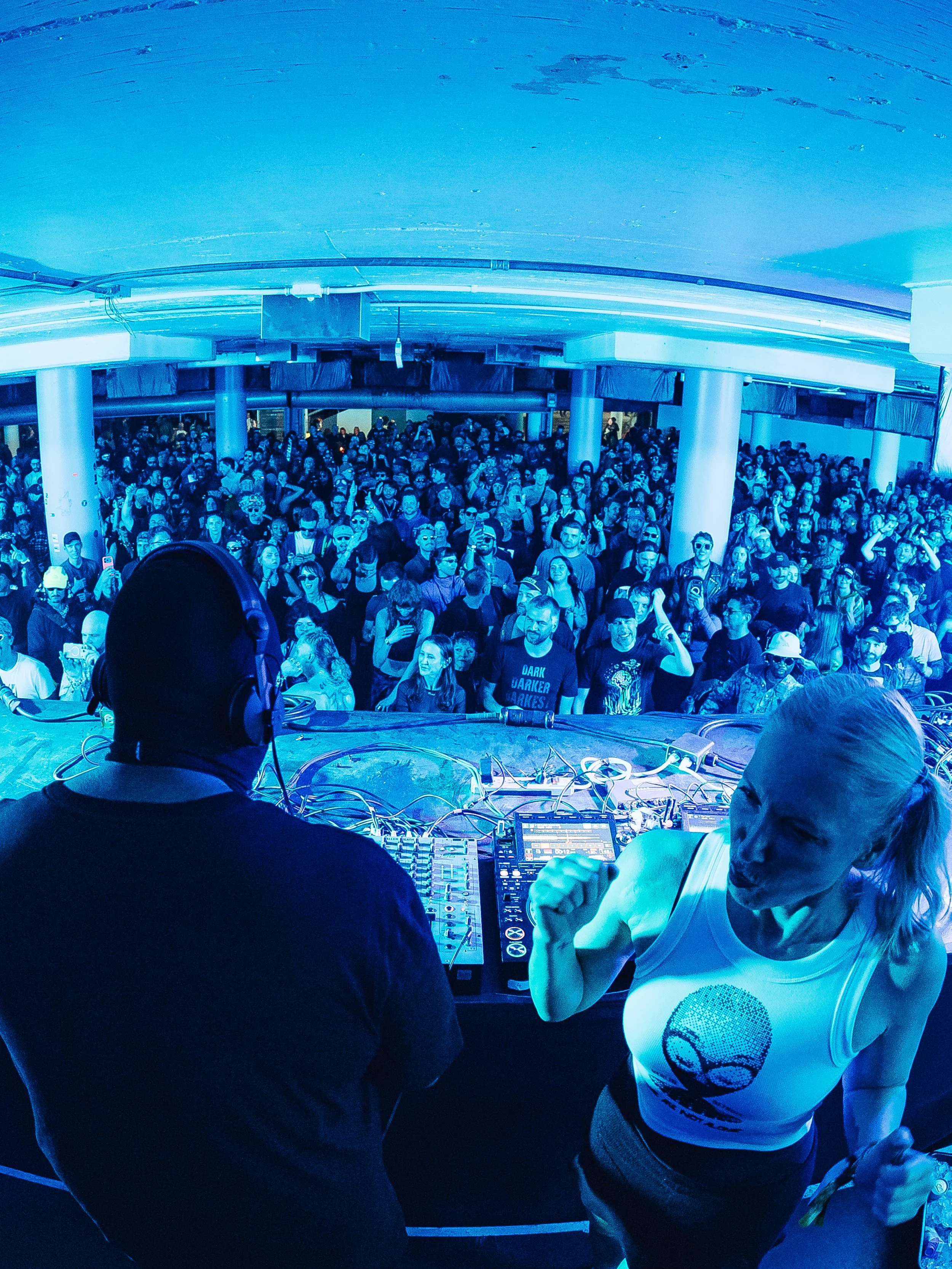
DJ Stingray and Ellen Allien perform at the Underground Stage. Photo by Nick LeTellier.
Before heading to the festival on Sunday, our Editor in Chief and I visited Submerge Records, an unassuming building dedicated to preserving landmarks of Detroit’s techno history. The main floor houses Exhibit 3000, a museum with collections of archival media and retro gear, while a record store, Somewhere in Detroit, operates in the basement. During a tour led by Tenko and Moses Malone, two longstanding participants of the local underground, the former said: “We’re focused on creating new waves, new sonics, new strains to infect the world with.”
Later that afternoon, Commissioner Alisha Bell joined Kevin Saunderson onstage before his set at Pyramid to present him with the Wayne County Testimonial Resolution. The award recognized the Belleville Three member for his lasting impact on music, culture and the city at large, and as the crowd applauded, the sky began to pour.
That performance was one of the most memorable of my weekend. There’s something about dancing in the rain that creates a joyful, carefree atmosphere, and as the water soaked my jacket, I let my hood fall in delightful acceptance. I understood then firsthand Saunderson’s well-earned reverence; his music possesses a profound, ancestral quality that’s emblematic of Afrofuturism. I’m convinced he somehow unearthed it from deep inside the ground.
After two days of rain, Monday made way for sunny skies. I arrived early for Detroit Techno Militia, represented by Tom Linder and DJ Seoul spinning some oldschool sound. Later on, we spoke with Ukrainian DJ Nastia about her thoughts on the festival, new production work and advocacy for her country amid Russia’s ongoing invasion.
Finishing off the weekend at the Underground Stage, we caught the last three sets from backstage. First was DJ Heartstring B2B X CLUB, two duos sharing the decks for an upbeat dance set, followed by MCR-T B2B Boys Noize leaning into vocal-heavy hard bounce. Finally, Amsterdam’s KI/KI brought her signature hard trance and acid sound to Detroit, and leaving the gates for the last time afterwards felt bittersweet.
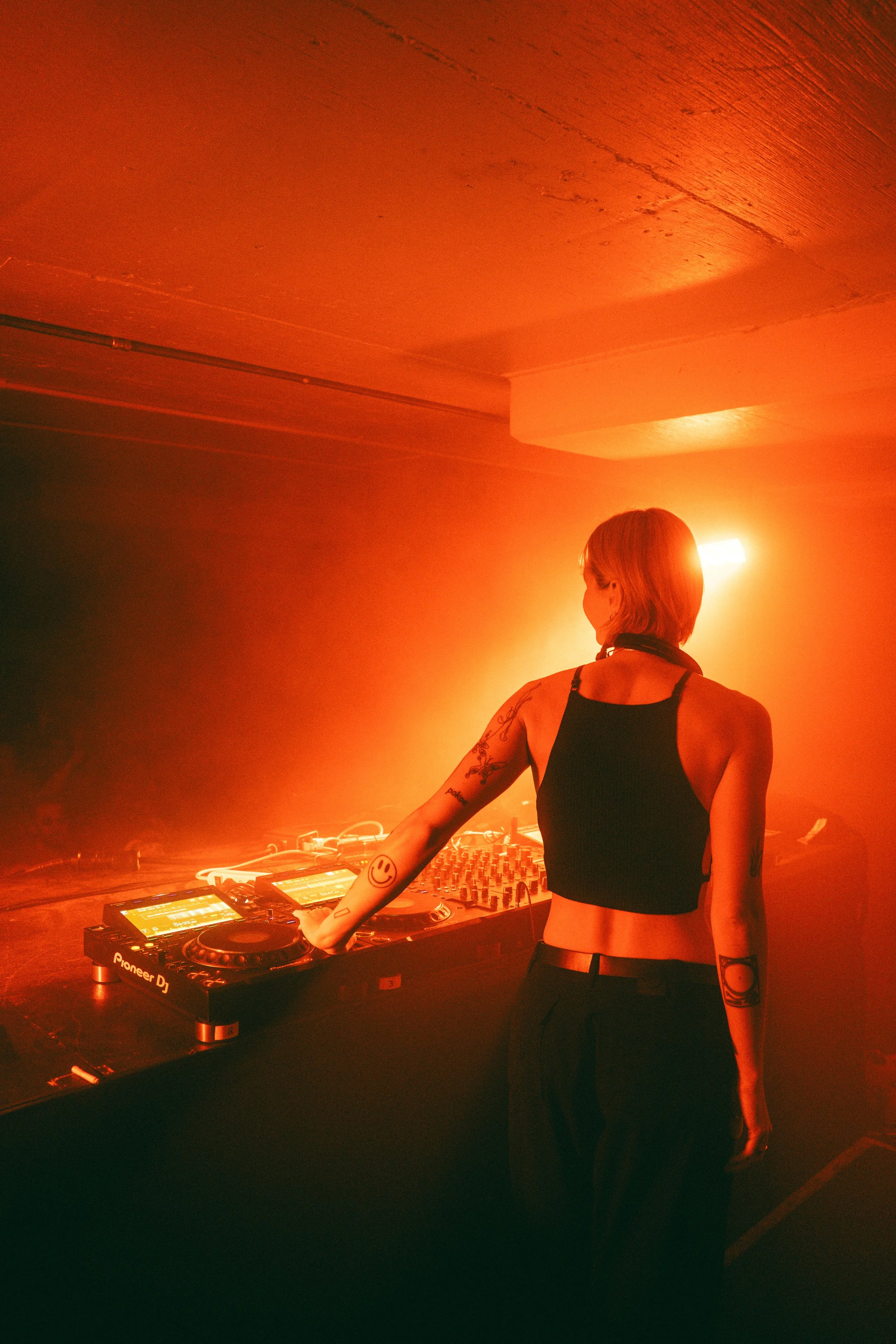
KI/KI closing out the Underground Stage. Photo by Brenda Brooks.
Overall, the festival was a lot of fun. As expected, the crowd was diverse and down to dance: attendees young and old, some with kids, goths and light-up hoopers and breakdancers. The atmosphere at the Underground Stage was especially exciting, and the tunnel leading into its distinct industrial environment speaks to Hart Plaza’s well-suited infrastructure. The lineup was also widely varied, reaching far beyond techno and house to include garage, drum and bass, ghetto-tech, even electro pop. Generally, the weekend captured the eclectic combination of sounds, vibes and aesthetics that characterize the undefinable American electronic music scene at large.
However, the day-by-day performance schedules also contributed to a sense of incongruency regarding the festival’s motivations. Fundamentally, Movement serves to bolster Detroit’s historical significance and legacy as techno’s birthplace; for example, signs above the entrance read, “Welcome to Techno City,” and the lineup spotlights both legacy acts like DJ Minx and DJ Roach alongside local up-and-comers like Disc Jockey George.
Concurrently, headliners also include commercial superstars like Sara Landry and Dom Dolla, who perform on the main Movement Stage and boost the festival’s mainstream appeal. Of course, these acts draw big crowds and drive ticket sales, and the performers’ celebrity status serves as an asset. Lamentably, the festival’s necessity to accrue profit means Detroit’s longstanding pioneers become peripheral to the spotlight.
Revisiting our foundational work, “Stop Calling Everything Techno!” Unmixed writer Fofi Tsesmeli asserts: “[Techno’s purpose was] to eradicate the performer-centered spectacle, focusing on the collective dancefloor experience. It was meant to decentralize authorship through the DJ culture by favoring rhythm and system over the idea of a star persona.” Thus, tension emerges from platforming the spectacle while simultaneously invoking the underground – the latter can’t truly be honored while the former takes the main stage.
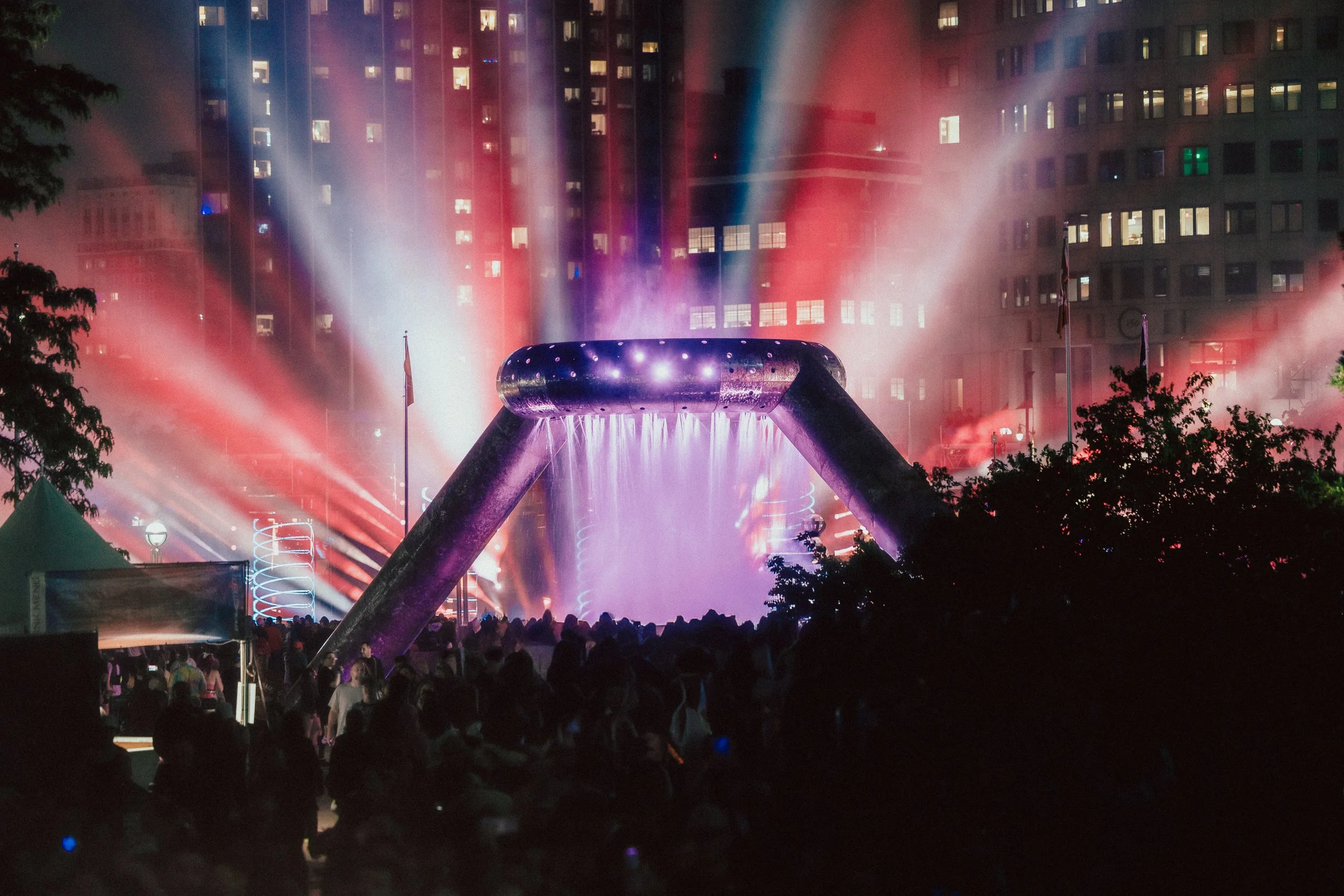
Since Movement Festival began, the fountain at Hart Plaza stands at its center. Photo by Sam Siegel.
Nevertheless, the festival doesn’t claim to align itself with one genre, and event organizers address the programming’s deviations from its source material. “Movement is not strictly a techno festival, but… its curation is specifically aimed to pay homage to the foundations of techno, its Detroit roots, and the strains of influence that are felt in current music,” says publicist Trevor Shelley de Brauw.
In Detroit, the pulse of the underground still beats strong. Its history is well documented, and its evolutionary power remains limitless. For me, the visit reinforced my admiration and reverence for electronic music, which came to be through a boundary-crossing exchange of ideation and unifying experience of struggle and liberation. To immerse myself in its past was ultimately to understand its cemented position in the future.
“I don’t feel confident that these other genres will survive over the long term, because they don’t seem to be as flexible as electronic music,” said Jeff Mills recently in an interview with DJ Mag. “We’re dealing with a genre that may be the last genre.”