
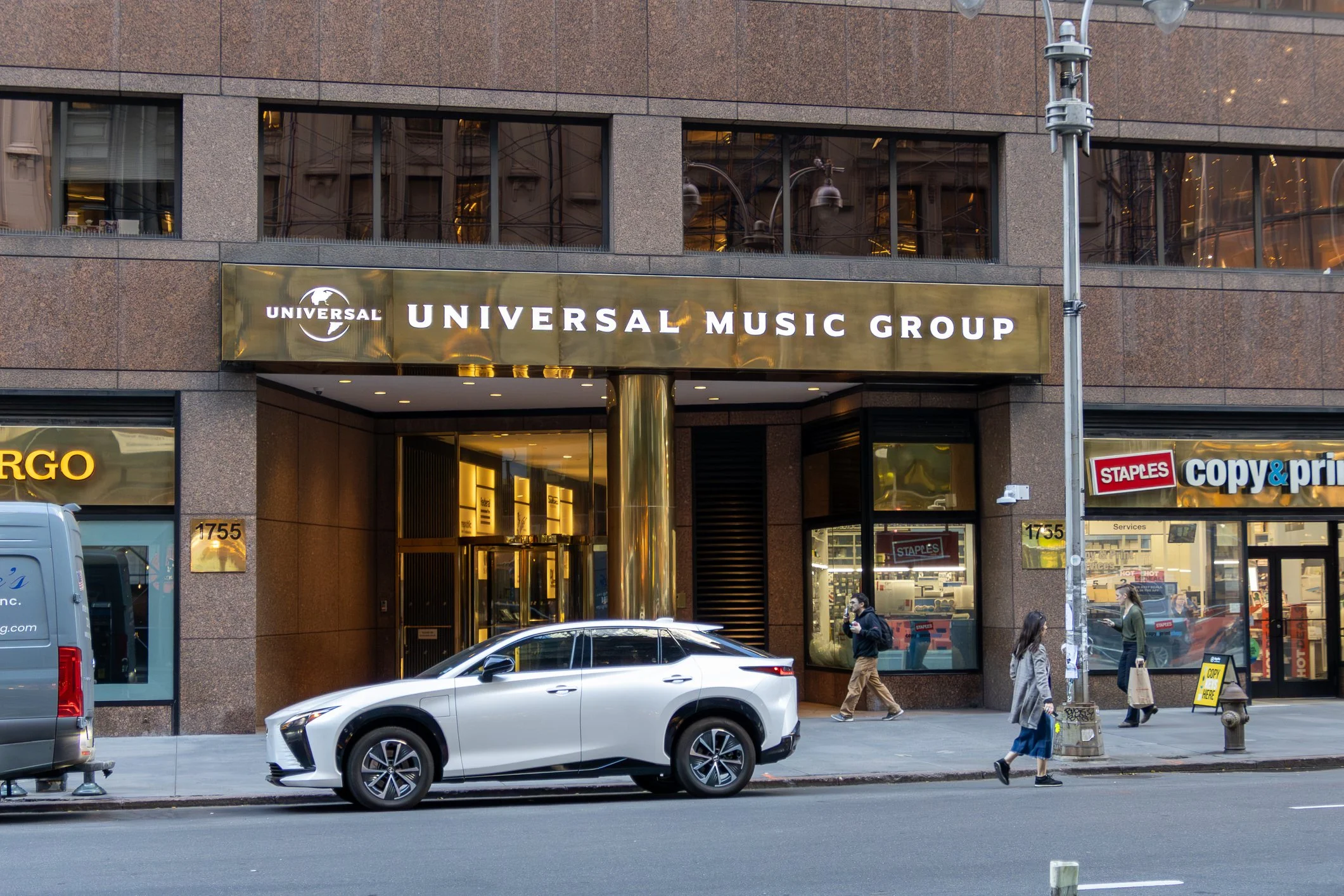
New York, NY, USA - 11.05.2024: Front view of Universal Music Group office in New York, a hub for global music production and distribution. Aziz Shamuratov.
Federal disclosures show the major labels and the musicians’ union back several of the same AI bills. Still, their filings diverge on state AI laws, collective bargaining for independent artists, and the future of the Copyright Office.
Universal Music Group and Sony Music Entertainment reported a combined $3.22 million in federal lobbying expenses in the first nine months of 2026, according to Lobbying Disclosure Act filings reviewed by Unmixed. The American Federation of Musicians, the union for working musicians in the U.S. and Canada, reported $120,000 over the same period. The labels also lobby through the Recording Industry Association of America, which reported $6.29 million in federal lobbying expenses over the same nine months.
Both labels spent the most in the second quarter. During that quarter, the NO FAKES Act of 2026 was introduced on May 20 and cleared the Senate Judiciary Committee on June 18, and the House passed a bill restructuring the U.S. Copyright Office. Universal reported $660,000 in the first quarter, $800,000 in the second and $600,000 in the third. It also paid the firm Forbes-Tate $40,000 in the first quarter to lobby for UMG Recordings on “copyright and licensing,” “artificial intelligence” and “creator rights.” Sony reported $380,000, $410,000 and $370,000 for the same three quarters, after $1.55 million in 2025. The AFM reported $40,000 each quarter.
Each total covers every issue the filer lobbied on and is not broken down by bill.
Universal, Sony and the AFM all list the NO FAKES Act, which would create a federal right over a person’s voice and likeness, and the TRAIN Act, which would let copyright owners subpoena AI developers to learn whether their work was used in training. Sony’s filings through September cite the bill numbers of the 2025 version of NO FAKES.
Universal and the AFM also list the CLEAR Act, introduced in February by Sens. Adam Schiff, D-Calif., and John Curtis, R-Utah. It would require AI developers to notify the Copyright Office of copyrighted works in their training data before releasing a model. Sony’s filings do not name it. Sony alone lists the AI Accountability and Personal Data Protection Act from Sens. Josh Hawley, R-Mo., and Richard Blumenthal, D-Conn., which would let people sue companies that train AI on their personal data or copyrighted work without consent. All three list the American Music Fairness Act, which would require AM/FM radio to pay performers.
The lobbying runs alongside litigation. Universal and Sony have sued AI music company Suno twice, in June 2024 and again on Sept. 18, when the labels alleged Suno copied 60,202 recordings without a license. Suno says training on copyrighted recordings is fair use. In September, the labels subpoenaed distributor DistroKid for data on how many tracks it flagged as AI-generated and how many it attributed to Suno. On Oct. 27, the parties told a federal court in Manhattan they were working on a resolution, according to Music Business Worldwide. Warner Music Group settled with Suno in November 2025. The TRAIN Act, listed by all three filers, would give copyright owners a subpoena route to AI training records without first filing a lawsuit.
The AFM opposes federal efforts to block states from enforcing their own AI laws. Its filings list “opposition to moratorium on state AI regulation” in every quarter of 2026. It is the only filer reviewed by Unmixed to name the issue this year. Universal’s, Sony’s and the RIAA’s 2026 filings do not mention it.
The RIAA publicly opposed a proposed moratorium in 2025. After the Senate voted 99-1 to strip it from the federal budget bill, RIAA CEO Mitch Glazier called the vote “a resounding dismissal of the shortsighted, zero-sum game thinking from some tech companies.”
On Sept. 30, Sen. Ted Cruz, R-Texas, objected to passing NO FAKES by unanimous consent, citing free-speech concerns. The bill has not passed the Senate. Until a federal law passes, state statutes such as Tennessee’s ELVIS Act remain among the main legal tools artists have against unauthorized voice clones.
The AFM also supports the Protect Working Musicians Act, introduced in May by Rep. Deborah Ross, D-N.C. The bill would let independent artists and labels negotiate collectively with AI companies and streaming platforms without antitrust liability. A2IM, the Artist Rights Alliance, the Recording Academy and the Black Music Action Coalition have backed it, and industry reporting lists the National Music Publishers’ Association as a supporter. The bill does not appear in Universal’s or Sony’s filings for any quarter of 2026.
Some issues appear only in the AFM’s filings: live event ticketing, artist visa processing, the Performing Artist Tax Parity Act, how the TSA and airlines handle instruments, and transporting instruments across borders. Both labels list anti-piracy, digital trade and the Digital Millennium Copyright Act. Universal also lists website blocking and privacy. Both labels list the RAP Act, which would limit prosecutors’ use of artists’ lyrics as evidence. The AFM’s filings do not.
In its third-quarter filing, Universal added H.R. 6028, the Legislative Branch Agencies Clarification Act, introduced by Rep. Morgan Griffith, R-Va. The bill would remove the Copyright Office from the Library of Congress’ supervision and make the register of copyrights a presidential appointee confirmed by the Senate. The House passed it by voice vote in June. Critics, including the Electronic Frontier Foundation, said it moved without hearings.
The Copyright Office advises on how copyright law applies to AI training and oversees the Mechanical Licensing Collective, which collects mechanical royalties. In May 2025, the administration fired Register of Copyrights Shira Perlmutter one day after her office released a report concluding that some AI training may not qualify as fair use. A federal appeals court later reinstated her. Universal’s filing does not say whether the company supports or opposes H.R. 6028. Sony’s filings list support for efforts to “modernize the U.S. Copyright Office” but do not name the bill.
The Copyright Office also sets registration fees. Under federal law, owners of U.S. works generally must register them with the office before filing an infringement lawsuit, including one against an AI developer. Statutory damages and attorney’s fees are available only if the work was registered before the infringement or within three months of publication.
In March, the office proposed raising registration fees by an average of 43%, its first adjustment since 2020, citing inflation. In May, 10 music groups led by A2IM, including the AFM, the Recording Academy and the Artist Rights Alliance, filed a formal opposition. A2IM CEO Ian Harrison said the increase “is not cost recovery; it is a barrier to justice.” Universal’s, Sony’s and the AFM’s lobbying filings do not list the fee proposal.
The law requires filers to list the issues they lobbied on but not their positions. Sony and the AFM state theirs anyway, with lines such as “support for” and “opposition to.” Universal’s filings list bill names only. They include both the American Music Fairness Act and the Local Radio Freedom Act, a broadcaster-backed resolution opposing new performance royalties for radio, without saying which side Universal is lobbying on.
Sony’s filings, nearly identical across seven quarters from early 2025 through September 2026, describe support for “fair compensation and rate standards for rightsholders.” The AFM’s filings refer to “musicians.”
The NMPA registered a new lobbying engagement with the firm Brownstein Hyatt Farber Schreck, effective July 2026, covering “musical works copyright and emerging AI technologies.” Three of the four registered lobbyists list prior congressional roles: a former deputy chief of staff and legislative director to former Rep. John Shimkus; a former House staffer to Greg Gianforte, Ryan Zinke and Lynn Westmoreland; and a former intern for Rep. Rosa DeLauro, D-Conn., and for the office of then-House Speaker Nancy Pelosi. A separate registration lists Brooks Consulting Group as a subcontractor on the NMPA account.
Methodology: Unmixed reviewed public LD-1 and LD-2 filings with the Clerk of the House and the Secretary of the Senate. The filings cover Universal Music Group (first through third quarters of 2026); Forbes-Tate on behalf of UMG Recordings (first quarter of 2026); Sony Music Entertainment (first quarter of 2025 through third quarter of 2026); the Recording Industry Association of America (first through third quarters of 2026); the American Federation of Musicians (first through third quarters of 2026); and Brownstein Hyatt Farber Schreck and Brooks Consulting Group on behalf of the NMPA (registrations effective July 2026). Unmixed also reviewed the Copyright Office’s 2026 fee proposal and the opposition filed by music groups. Lobbying figures are self-reported estimates covering all issues listed.
