
words by Nina Katashvli
There is no single definition that contains queerness, no umbrella wide enough to gather every life, body, or practice beneath it. What exists instead are shared traces: ways of moving, resisting, caring, and surviving; that surface differently depending on the space. These common threads do not unify experience; they allow it to be recognized, each in its own way.
Across these conversations, queerness appears less as an identity to be declared and more as a set of negotiations: with visibility, with power, with intimacy, with control. It shows up in how space is held, how time is taken, and how boundaries are drawn – often quietly, often without spectacle.
What connects these voices is not sameness, but a refusal to be flattened. A resistance to optimization. An insistence that culture remains relational, lived, and accountable to the people inside it – not the systems built around it.
What follows continues that thread.
Niki Sadeki does not perform identity for visibility, nor does she translate her interior world into slogans that fit platform logic. Her work – as a DJ, producer, and curator – moves instead through restraint, tension, and emotional clarity. It resists spectacle while remaining deeply felt.
Across global dance floors, Niki Sadeki has played spaces that range from intimate queer rooms to some of the most institutionally powerful stages in electronic music. What connects her practice is not scale, but intention: an insistence on presence over performance, relationship over branding, and care over speed.
In this conversation, Niki Sadeki reflects on queerness as a lived state rather than a marketed identity, on the quiet mechanisms of control shaping contemporary nightlife, and on how shareholder logic has begun to flatten risk, diversity, and experimentation into surface aesthetics. She speaks candidly about visibility fatigue, algorithmic pressure, and the importance of protecting one’s inner world in an era that rewards sameness.
This interview is not a manifesto. It is a gentle reminder that culture survives not through optimization, but through care.
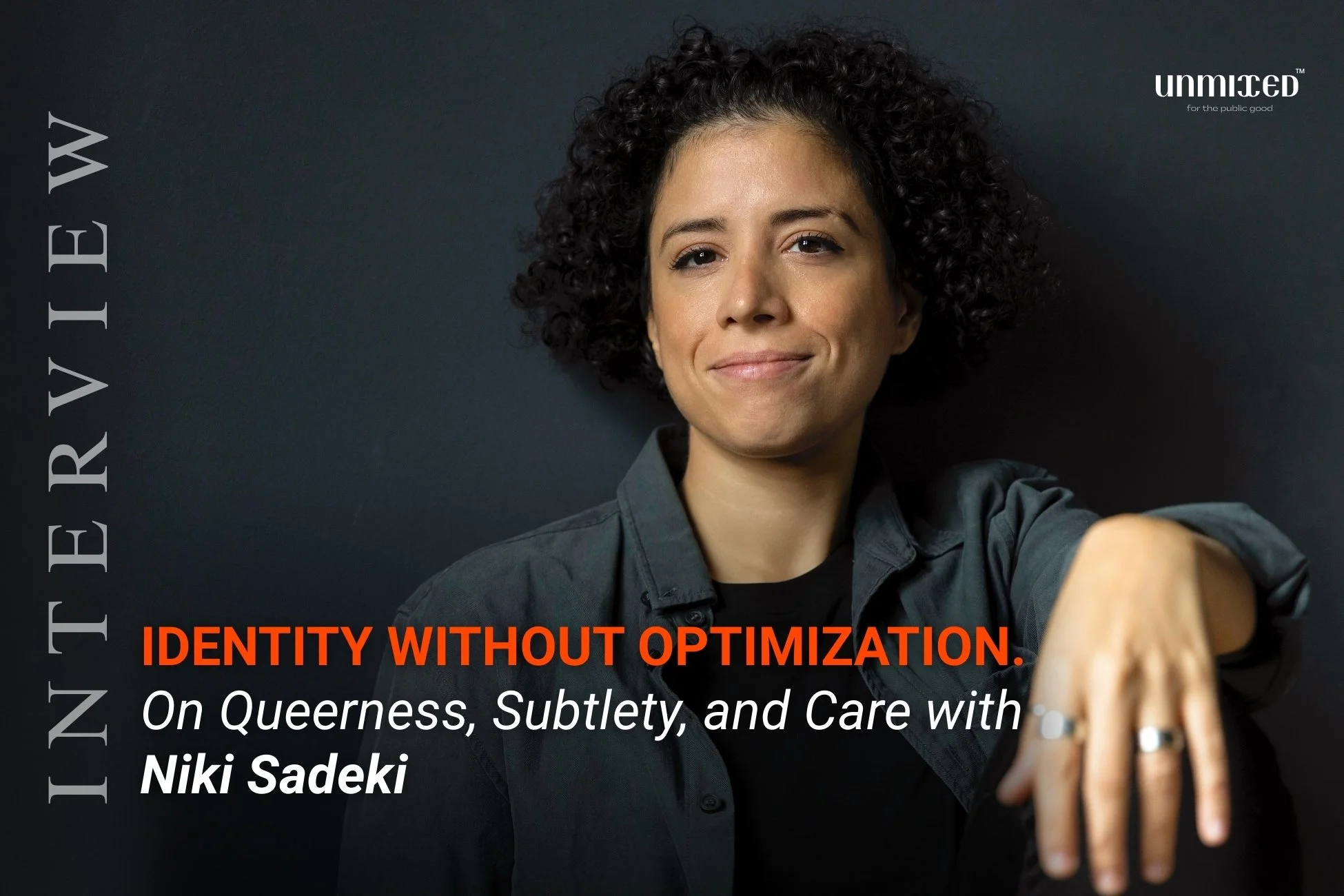
in frame: Niki Sadeki. Photo by Philip Nuernberger
Interview
What do you think is the culture around queerness these days, and how do you see it? Would you say it’s simply a state of being, who you are, without the need to constantly remind anyone about your private life? How would you describe it for yourself?
For me, queerness is a state of being, not a performance. It’s not something I feel the need to announce or package. It’s woven into how I move through the world, how I listen, how I create, how I connect. I think there’s a lot of pressure right now to constantly signal identity, to define yourself loudly and repeatedly. I understand where that comes from, but for me, queerness lives in subtlety, in presence, in truth without explanation. I don’t feel the need to turn my private life into a headline to be valid.
You’ve performed everywhere from intimate queer collectives to large scale festivals. How do you sense the difference between spaces that feel truly free versus those that feel surveilled or controlled?
Free spaces feel relational. You can sense trust in the room. People are there to listen, not to capture content or tick a box. There’s space for imperfection, for softness, for tension. Controlled spaces feel transactional. You feel watched, timed, branded. The energy is managed rather than shared. The difference is not about size, it’s about intention. Some of the smallest rooms feel expansive. Some of the biggest stages feel narrow.
As an Iranian Canadian artist, how do you navigate your heritage when performing in global circuits that may still carry orientalist or heteronormative biases?
I navigate it quietly and on my own terms. I’m aware of how easily heritage can be exoticized or flattened, so I don’t offer it up as a concept. It exists in my emotional landscape, in my sense of restraint and longing, in the tension between light and shadow in my music. I don’t perform my background. I let it inform me. That feels safer and more honest.
There’s a toll to constantly having to represent or defend authenticity in spaces that commercialize identity. How do you care for your mental and emotional health amid that pressure?
I step back when I need to. I protect my inner world fiercely. I remind myself that I don’t owe anyone a version of myself that fits a narrative. Therapy, solitude, music without deadlines, and staying connected to people who know me outside of my work all help. I’ve learned that sustainability matters more than visibility.
When we talk about authoritarian backsliding across the globe, what does that mean to you as an artist? Do you notice subtle forms of control even in Western contexts, like moral policing, algorithmic censorship, or corporate homogenization?
Yes, absolutely. Control doesn’t always look violent or obvious. Sometimes it looks like silence, shadow banning, softened language, or the narrowing of what is considered acceptable or profitable. Algorithms reward sameness. Corporations reward predictability. As an artist, you feel it in what gets amplified and what disappears quietly. It’s subtle, but it shapes culture in real ways.
Major nightlife holdings now control a huge portion of global festivals and clubs. What impact do you think this has on diversity and artistic risk taking?
It reduces risk. It favors familiarity over curiosity. When decisions are driven by shareholders instead of community, experimentation becomes a liability. Diversity becomes cosmetic. The danger isn’t just who gets booked, but what kind of ideas are allowed to circulate. Culture becomes optimized instead of alive.
Do you see PLUR being used more as a trending hashtag or still holding true meaning as a value of inclusivity?
I think the word gets used more than the practice. PLUR still exists, but mostly in smaller, intentional spaces where people are doing the work quietly. Online, it often becomes branding. In real life, it’s about how people treat each other when no one is watching.
What do you think freedom in nightlife will mean in the next decade? What might resistance look like outside of the dance floor?
Freedom will mean autonomy. Owning your means of expression. Smaller networks. Less dependence on large platforms. Resistance might look like independent labels, mutual aid, offline gatherings, slow growth. It might look quieter than we expect, but more rooted.
If you could speak directly to the next generation of queer and independent artists, what’s your message for keeping culture alive under tightening control?
Protect your inner compass. Don’t confuse visibility with impact. Build real relationships. Learn the business so it doesn’t own you. And remember that culture survives through care, not through speed. You don’t have to explain yourself to exist.
What’s next for you, anything exciting you’d like to share?
I’m focusing on creating from a more grounded place. Less noise, more intention. New music that feels closer to where I am now. I’m taking my time and letting things unfold naturally. That feels exciting in itself.
