
UNMIXED x Robag Wruhme x Beats on Time
Signal NYC · January 2026
Beats on Time opens 2026 by returning to a first principle: for the music. Not scale. Not spectacle. And definitely not velocity. But trust, listening, and time.
This showcase at Signal NYC is not just about names on a flyer. It’s about people on the dancefloor. A room built for listening attention, a label rooted in patience, and artists who understand the floor as a shared language rather than a product.
At the center of the night is Robag Wruhme - a foundational voice whose work across KOMPAKT and PAMPA has shaped how entire generations move, wait, and feel together. His presence isn’t symbolic. It’s structural.
Alongside him: Beats on Time founder Saqib, label artists Sana and Taylor Bradford, and a closing set from Esther Silex, each chosen not for momentum, but for intention. This is not a night engineered for peaks. It’s a night built for depth.
If electronic music still means something to you, if you believe the floor is a place for listening, not extraction, this is where 2026 begins.
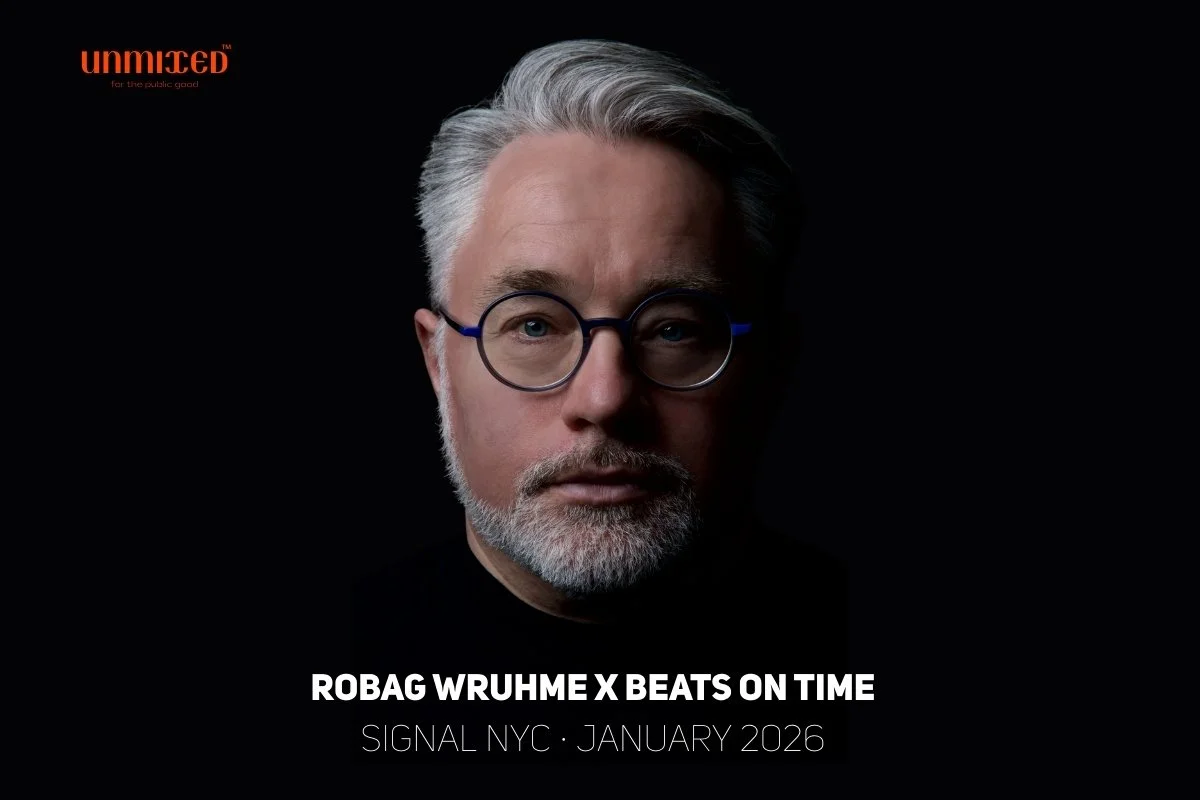
in frame: Robag Wruhme
Your music has always taken its time. What does slowing down do on the dancefloor today?
I follow a different mathematical approach. There’s the simplified one, which immediately suggests that the bang can be counted as four. And then there’s the more intricate one, which I’ve always found much more interesting.
Your sets feel like they’re teaching people how to listen again. Is that intentional, or a byproduct of how you work?
I’ve been DJing for about 35 years. Sören and I developed our Wighnomy style back then. I don’t use sync, and I don’t follow trends. I owe that to my profession as a DJ, and I owe it to Sören, who has been and still is at every DJ gig.
If the impression is given that I want to teach the audience something, then it’s really only that everyone should find their own place in the night and on the dancefloor in order to reward themselves with a good time, provided the public shares my taste in music.
You’ve existed outside trend cycles while still shaping them. What do younger scenes misunderstand about longevity?
New scenes will eventually become old scenes again. They have to experiment. They have to take different paths than we did, because the conditions are different. These are different times, different circumstances; and that’s a good thing.
Labels like KOMPAKT and PAMPA built worlds without chasing attention. What gets lost when scenes prioritize visibility over continuity?
For me, both labels remain relevant and very much present. The rapid pace of change is a consequence of our times. We must embrace the challenge of new structures. We will either survive this superficiality and find solutions, or soulless simplicity will prevail.
Signal NYC is an intimate room. How does a smaller space change the way you approach a set?
I appreciate both large stages and small, intimate clubs. Both are essential to me, and they create a beneficial symbiosis for my music.

-
Editor’s note
Robag Wruhme has never needed to announce his importance. For decades, his work has existed in the long game: records and sets that don’t chase relevance but quietly redefine it. His music resists urgency and excess in favor of patience, humor, and emotional depth.
At the time of our conversation, Robag Wruhme had just returned from a four-week break with his family. Before New York, before the booth, he was still in the process of re-entering routine: testing new material, listening, preparing.
“I’m really looking forward to going to New York,” he says. “It’s one of my favorite places in the world, and I can’t wait to catch up with my friends and all of you.”
In a culture addicted to immediacy, his approach doesn’t feel like a correction. It feels like a reminder of what still matters on the dancefloor: human connection.
Tickets: ra.co/events/2319508
Follow Robag Wruhme: Instagram · SoundCloud
Follow Beats on Time: beatsontime.com · Instagram · SoundCloud
Show more: Show more
