
Artists Accuse APRA AMCOS of Blocking Access to Records Amid Licensing Review
By Nina K. Malik
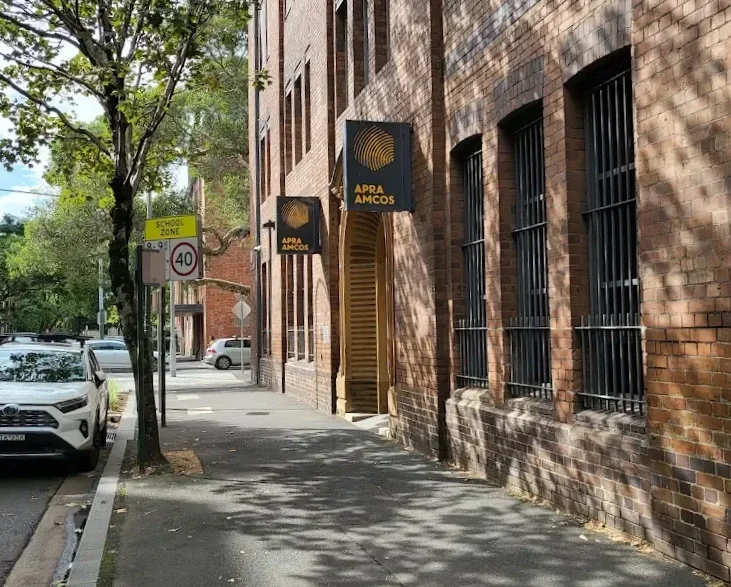
APRA AMCOS. Ultimo, Australia photo by John Karmas
AsAPRA AMCOSseeks another five years of authorization from the Australian Competition and Consumer Commission (ACCC) to continue operating its collective licensing framework, a growing number of artists and members are raising concerns regarding governance practices, royalty transparency, and access to company records.
Australian musicians and APRA AMCOS members Hein Cooper and Billy Otto allege they were denied access to general meeting minutes during a recent visit to APRA AMCOS offices. According to statements provided by the artists, staff informed them that the records were “not on premises” when they attempted to inspect them during designated access hours.
The artists argue the incident may conflict with provisions of Australia’s Corporations Act 2001 and APRA AMCOS’s own Constitution regarding member inspection rights.
APRA AMCOS maintains reciprocal agreements with numerous international collecting societies, includingASCAP in the United States, allowing affiliated organizations to administer and distribute royalties across jurisdictions.
Jo Loewenthal, a member of APRA, has filed an official complaint and made several claims regarding royalty reporting systems, member data access, and artists' ability to independently verify international royalty payments. His allegations include duplicate transaction records, unexplained negative royalty entries, and limitations in the underlying usage data provided to artists by collecting societies.
Separate concerns regarding APRA AMCOS's licensing framework have also been raised by Heart Music Group (HMG), an independent licensing company that recently submitted an interested-party filing to the ACCC as part of the reauthorization process. In its submission, HMG argued that APRA AMCOS's current opt-out and license-back framework creates structural barriers preventing commercially viable direct licensing within the background music market. HMG further argued that writers seeking venue-specific direct licensing opportunities are effectively required to opt out across broader categories of public performance income, creating what the company described as commercially impractical. In the same filling HMG has outlined “Real and Ongoing Harm” stating “participation becomes dependent on ownership structure rather than merit;” in their filing, HMG requested that the ACCC require venue-specific opt-out functionality and enforceable processing timeframes as conditions of any renewed authorization granted to APRA AMCOS.
The ongoing dispute has also expanded into criticism of the ACCC’s handling of APRA AMCOS’s current reauthorization process. According to correspondence reviewed by Unmixed, formal objections have since been submitted to the ACCC, and members of parliament and senators were copied into requests for additional oversight.
“The regulator overseeing this decision is making it harder for artists to submit evidence at the exact moment the decision is being made,” Loewenthal wrote in a public statement.
has focused on APRA AMCOS’s FY2025 financial filings lodged with the Australian Securities and Investments Commission (ASIC). The filings report approximately $214 million in royalties collected but not yet distributed, while current liabilities exceeded current assets by roughly $55 million. Administrative, finance, and legal costs also increased by 24.7% over the previous year.
“The $214 million in royalties payable is not APRA’s money,” Loewenthal wrote in correspondence with Unmixed. “It is member money held in trust, a liability owed to members, not an asset belonging to APRA.”
Loewenthal has further raised concerns about governance structures within APRA AMCOS, noting that executives from major publishing companies, including Universal Music Publishing and Sony Music Publishing Australia, serve on the organization’s board, while independent artists simultaneously pursue royalty and contractual disputes with those same companies.
In a statement provided to Unmixed, APRA AMCOS rejected suggestions that company records are inaccessible or improperly maintained, stating that inspection procedures operate in accordance with the organization’s Constitution. The organization also defended its royalty distribution framework and financial position, stating that sufficient non-current assets exist to meet obligations disclosed in its FY2025 filings.
APRA AMCOS maintains that its licensing framework remains necessary for the efficient collection and distribution of royalties across the Australian music industry.
The ACCC review remains ongoing.
For some artists involved, however, the dispute has evolved beyond royalty accounting itself, becoming a broader debate over transparency, oversight, and the relationship between collecting societies and the creators whose royalties they administer.



From May 23-25, Movement Festival will turn Detroit into a nonstop city-wide electronic music party. As the birthplace of techno music, the festival pays tribute to the genre’s roots in experimentation and expression during a time of urban decay.