
PART II, The Black Box: The Music Copyright and Royalties
In the music industry, "black box" doesn't mean a flight recorder. It means money. Specifically, it means royalties that were collected - from a stream, a radio play, a night at a club - but never matched to the person who wrote the song. The money doesn't disappear. It sits in an account, waiting for an owner nobody can confidently identify, until a collecting society decides how to hand it out anyway.
In 2024, David Rowntree - Blur's drummer, and a practicing attorney in his own right - put a number on that account. He filed a class action against PRSfor Music in the UK, alleging the organization was sitting on roughly £200 million (about $265 million) in unmatched royalties and distributing it in a way that structurally favored publishers over the songwriters who actually wrote the music. PRS argued its formulas were the most reasonable option available given the data it actually had. In August 2025, the Competition Appeal Tribunal agreed. On June 29, 2026, the UK Court of Appeal rejected Rowntree's appeal outright, ruling that PRS takes "reasonable and proportionate steps" and that he hadn't proposed a workable alternative.
I'm not citing this case to argue PRS did anything wrong - a court found the opposite, twice. I'm citing it because of what the number itself proves. A quarter-billion pounds is not a rounding error, and it's not a fringe complaint. It's large enough that a working musician with a law degree spent two years in court over how it gets divided up. The black box isn't a glitch in the system. It's a permanent, load-bearing feature of it - and once you know it's there, you start seeing the same structure everywhere money moves through music.
Part I of this seriesasked why an industry that can identify a three-second sample can't produce an itemized royalty statement. This piece goes underneath that question, into the actual machinery that decides who gets credited before a single dollar is calculated: the licensing structures built to manage music at a scale nobody could individually track, and the metadata systems that were supposed to modernize that tracking but instead became their own source of black-box money.
Start with how big the system actually is. Global recorded music revenue hit $31.7 billion in 2025 - the industry's eleventh straight year of growth, per the IFPI. Streaming generated more than $22 billion of that, 69.6% of the total, with paid subscriptions making up 52.4% of industry revenue across roughly 837 million paid accounts worldwide. Public-performance rights - money earned when music plays in bars, restaurants, hotels, festivals, and clubs rather than through someone's headphones - brought in an estimated $2.9 billion on their own. Zoom out further: the global night-time economy, the bars and clubs and festivals built around that public performance revenue, is worth an estimated $3 to $4 trillion a year, about 3% of global GDP, and supports roughly one in ten jobs on the planet, according to the 2026 Night-Time Economy Report.
None of that infrastructure was designed by people who could see it coming. Performing rights organizations - ASCAP, BMI, SESAC, and more recently Global Music Rights - exist because for most of the twentieth century, there was no realistic way to log every song played in every bar and dance hall in the country. Their solution was the blanket license: a venue pays one fee for the right to play from an entire catalog, and compensation underneath that license gets estimated through surveys, cue sheets, setlists, and sampling, rather than tracked song by song. Given the technology available at the time, that was a genuinely reasonable compromise. Exhaustive tracking wasn't just expensive. It was physically impossible.
It is not impossible anymore, and the industry's own enforcement actions prove it knows that. In June 2026, Swizz Beatz, alongside music publishers and Universal Music Corp, sued a North Carolina nightclub - BoatYard Lake Norman - for playing DMX's "Party Up (Up in Here)" and three other copyrighted songs without ever securing an ASCAP license, despite what ASCAP describes as years of licensing offers by phone, email, and mail. The suit seeks up to $30,000 in statutory damages per song. Cases like this are, in one sense, the system working as intended - a PRO catches unlicensed use and enforces payment. But look closely at what the enforcement mechanism still looks like in 2026: letters, phone calls, and eventually a federal lawsuit. That same venue almost certainly ran on point-of-sale software and a DJ setup capable of logging every track played that night automatically. The tools to make licensing compliance self-verifying already exist inside the building. They were simply never connected to the part of the system that decides who gets paid.
That gap between what gets tracked and what gets paid is exactly where black-box money is manufactured - and metadata is where it usually starts. Every recording and composition is supposed to carry an International Standard Recording Code (ISRC) for the recording and an International Standard Musical Work Code (ISWC) for the underlying composition, alongside songwriter splits, publishing ownership, and territorial rights data. In theory, that's the plumbing that lets a payment find its way back to whoever wrote the song. In practice, it's one of the most consistently broken parts of the industry. A widely cited Verge investigation documented how incomplete and inconsistent metadata has cost the industry billions of dollars in delayed or unmatched royalties, and legal analysis has since gone further, arguing that [poor metadata doesn't just slow payment down - it can undermine a rights holder's ability to prove infringement or enforce a copyright at all. Rowntree's £200 million didn't come from nowhere. It came from exactly this: songs whose ownership couldn't be confidently reconstructed once they left the studio.
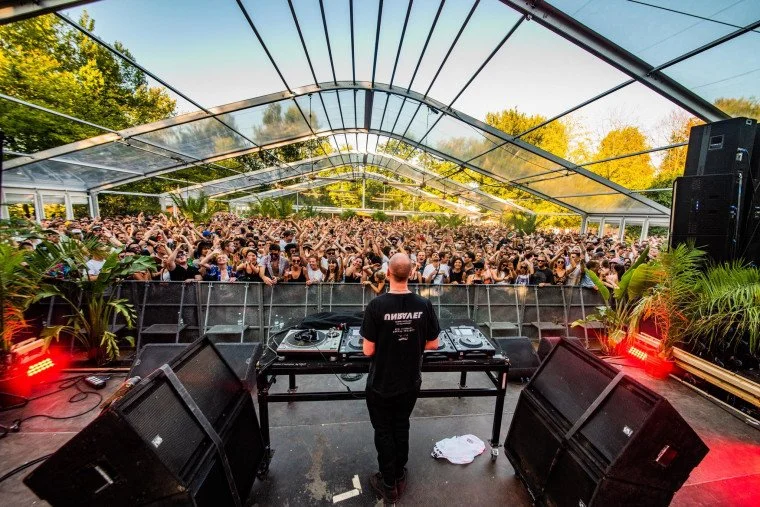
Nowhere is the contradiction between what's trackable and what's tracked sharper than in electronic music and nightlife - on paper, the most digitally native corner of the entire industry. A touring DJ today plays sets built almost entirely on software - Rekordbox, Serato, Engine DJ, Traktor - that logs every track, timestamp, cue point, and BPM automatically. A single set might cross three countries within a week, blend in unreleased "ID" tracks that don't formally exist in any database yet, and get Shazammed by fans mid-transition before the DJ has even said the name of the record out loud. This is precisely the kind of environment where song-level attribution should be the easiest problem in the industry to solve.
Instead, royalty allocation in that environment routinely still runs on venue declarations, partial setlists, and repertory sampling - the same estimation tools built for an era when nobody could know what was actually played. The software sitting on the DJ booth already has the answer. That answer almost never makes it into the pipeline that decides who gets paid. Electronic music culture may be the most measurable subculture in the industry's history, and its compensation system remains one of the least verified.
None of this is an argument for tearing out collective licensing. It still does something genuinely useful - it lets a bar in North Carolina or a club in Berlin legally play thousands of songs without negotiating rights one at a time, and it lets songwriters get paid without personally auditing every venue that plays their work. The institution isn't illegitimate. It was calibrated for a world where nobody could know what was played, and it has not caught up to a world where, in a growing number of cases, somebody already does know - the data is simply sitting in software that was never asked to talk to the royalty system.
That's the pattern underneath every black box in this piece: a PRO can find an unlicensed venue and sue it, a court can rule on how to divide a quarter-billion pounds nobody could attribute, a DJ's laptop can log a set down to the millisecond - and none of these systems currently talk to each other in a way that lets an artist independently check their own statement. The next piece in this series follows the money further upstream, to where it enters the system in the first place - streaming platforms, distributors, festivals, broadcasters, gaming platforms, and fitness apps - to map how many hands a single stream passes through before whatever's left reaches the person who made it, and exactly where along that chain the accounting stops being verifiable.
NEWS

EDITORIALS


U.S. Copyright Office proposed the registration fees’≈43%
increase. In return, they received 164 comments from some of the nation's most influential creative and news organizations; the response suggests widespread concern about the accessibility of copyright protection.