
The Fire in the Bin: Alex Wilcox
Let the Dangerous Artists Win
Interview by Nina Katashvili Malik
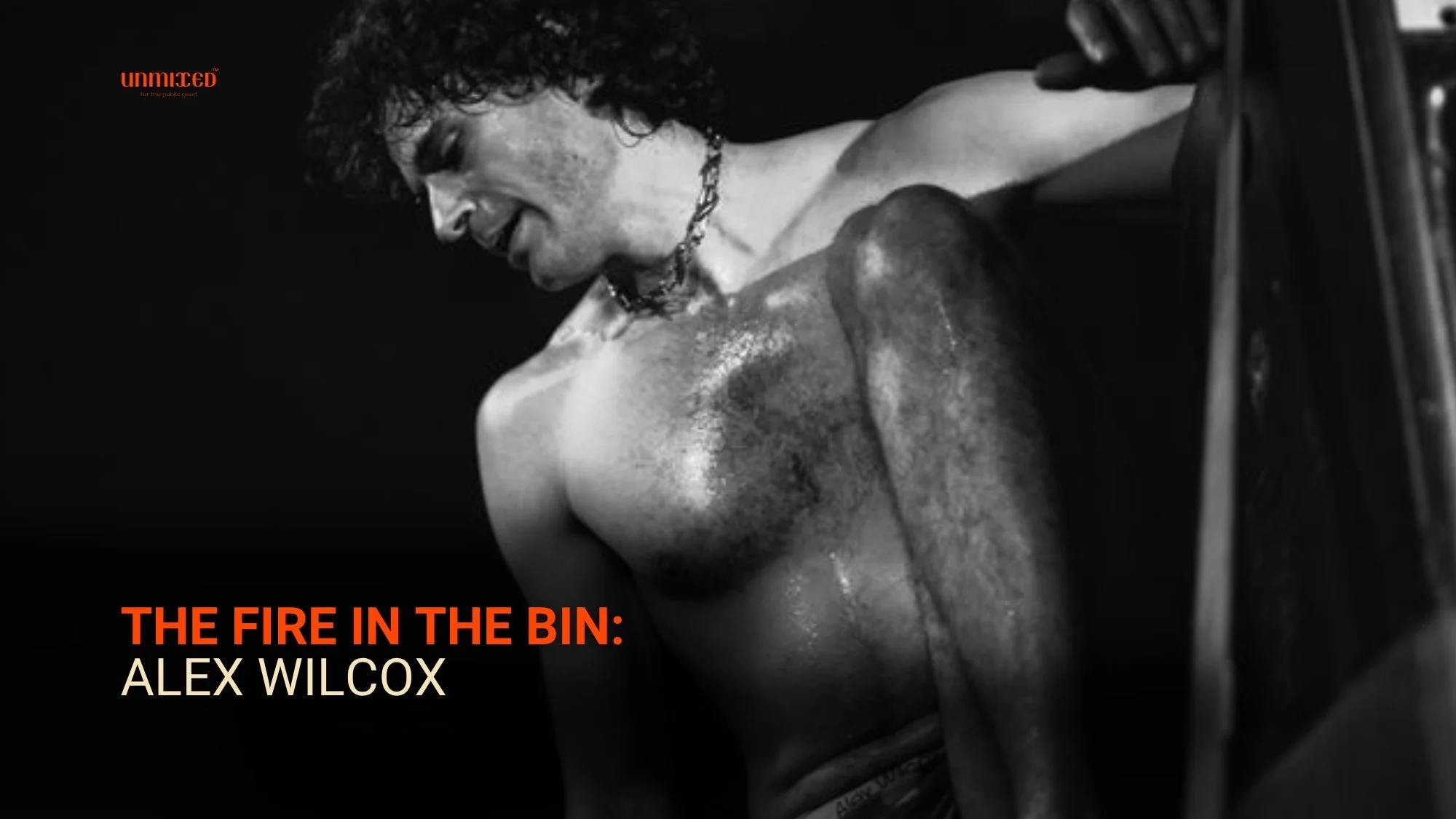
in frame: Alex Wilcox.
We love to hate on social media for a number of reasons, but not in this case. He found me first, followed Unmixed, and I followed back. Half-asleep at 1 AM, I watched his live performance on a tiny screen. That was Alex Wilcox. While Beatport was busy sorting music into genre bins, he was making something that ignored them entirely. Identity Crisis landed in late 2025 on BPitch, filed under techno. My punk rock bones heard something else. We published a full album review, rare for us. Read it alongside this.
Born in Texas, Wilcox has made his name in music through tireless pushes forward and constant reinventions of self, music, and artistry at large. And that’s what it should be about. After a few years of traveling around the US and going through all sorts of things, he finally got his damn-well-deserved recognition, mainly through the support of Anetha, Nina Kraviz, Ellen Allien, Bjarki, and more.
Eventually, he moved to Berlin, where he is now based.
Look him up, and you’ll find the madness first: jumping off stages, climbing guardrails, screaming inches from your face. I missed that. Someone giving everything, nothing held back. The music demands something in your bones, some grit, some roots, something that once annoyed your neighbors. If you don’t have it, you won’t get it. He’s not precious about ethics. Too much of it ruins the art. He’d rather have fun.
On stage, your senses tighten before you decide to let them. The younger crowd gets it instinctively, bored with the mundane, allergic to safe. Wilcox is the opposite.
The madness is obvious. The depth takes a minute. Sit with him one-on-one, and the performer drops back, the thinker steps in. I pushed hard. He didn’t dodge. Whatever you take from this, one thing is clear: he cares about music in a way that’s getting rarer by the day.
Managers spend careers manufacturing a thread, something sellable, something clean. Wilcox skipped that. The fire was already there.
The timing is really good too, because you, dear reader, get to pre-order the remixes from HYPNOSIS THERAPY, Kuss, and Catnapp that are scheduled to drop on April 24th on Bpitch, just a few days after NYC’s first PUBLIC HEARING on April 19th at the Herbert Von King Amphitheater.
And there is more. On April 1st, Wilcox released “EMERGENCY.” independently, no label, no middle man, pretty straightforward move. Whispers followed by screaming horns, fingered bass, post-punk percussion, and that's about it. This song teases you to jump up, and as one person described on YouTube: “This song makes me want to run in circles while I scream.” I get it, because I did that this morning. Was it an April Fool's joke? No. “I was annoyed,” he said, and we left it at that. That is enough. The best music does not always come from a good place. It comes from the place you weren’t planning to talk about.
Now, let go and hear him speak.
What did your relationship to music look like before electronic music entered your life? Were you playing instruments, in bands, and what originally pulled you toward the path you’re on now?
– I started playing guitar when I was 11, about 10 years, more or less, before I started producing electronic music. I was pretty into it, played in rock bands in high school and learned lots of songs, mostly rock, blues, funk, type of stuff. I was really into 90s alternative rock in particular. I had some difficult times in my early 20s and my relationship to live music suffered. Fortunately, it has been recovering. But yeah, I eventually learned about Ableton and figured that could be a cool way for me to make guitar-centric music with electronics surrounding it. I wasn’t happy with how things were sounding and often began replacing the guitars with synths. I also was lucky enough to visit Berlin and see the techno clubs. I thought they were super cool, never liked clubbing and thought it was sort of just a place for douchebags to go to. But I saw in Berlin that some were pretty cool. Got into Modeselektor, Trentemöller and Paul Kalkbrenner and sort of just got deeper into more electronic music. Recently, I find myself circling back to live music, and am happy to have purchased a new guitar that will likely be more and more coming onto future records.

in frame: Alex Wilcox.
What does making music actually mean to you today, not abstractly, but in the day-to-day reality of being a working artist?
– Hmmm.
I just want to be honest,
as honest as I can with the music, and hold a very high-level of ambition and passion with everything I make. I want to make music that I think is amazing.
You’ve said you believe you’re making very good music, and I agree, but we both know that quality alone no longer determines success. When did that realization really land for you?
– I’ve had several moments that taught me a lot. The main one that sticks to my mind is my track “Sleep Paralysis.” It’s been played by Anetha, Nina Kraviz, Francois X, many many people. I self-released and almost no one bought it or paid attention to it. It got re-released a couple years later on a label and then everyone started playing it and I started to get a lot more love from the scene. But the track is exactly the same, same master, same mix, everything. It’s just that a big techno label pushed it, so many more people heard it, and subsequently, it’s helped me grow significantly in a professional way.
Also just seeing many DJ’s pushing generic music, but doing well on socials and getting bookings, often reinforces this idea.
My guess is that this has always existed in some way though, not sure it’s new. For example, I just was recently exposed to a really funny standup comedian, but he’s in his early 70s, and I guess he’s been somewhat famous for a long time. It took me seeing him on a popular YouTube channel to know about him, so even though his quality has been high, it took this other channel I know for me to find him.
Do you think the average listener still knows how to hear quality, or has that muscle atrophied? Can we even tell the difference between good stuff and AI-made music?
– I can’t even tell all the time if something is AI generated or not. I’ve yet to hear anything “profound” that is AI generated (I also don’t go searching). But I was surprised recently when I got into a car and a friend was playing some vocal demos of his. The beats were Suno-made. One of them actually sounded pretty decent. I asked him who made it and it was Suno. I felt embarrassed inside. Cause yeah, I was fooled. Again, it wasn’t an insane instrumental or something, but it did sound “professional” and pretty decent.
Short answer: no. My guess is that most people cannot tell the difference between “good” and “AI-based” music. When it comes to truly “profound” music, I would say, or hope, that people could still tell a difference. I just did some searching. Ipsos did a study with Deezer that showed that 97% of people couldn’t tell a difference between AI and non-AI-generated music. That sounds right.
In your experience right now, what matters more: musical talent or algorithmic fluency?
– It depends on what you want. For me, musical talent matters much more. But that’s because my goal is to make classic albums. If your goal is to become a famous DJ that can make money and tour, algorithmic fluency is more important.
Learning to make profound music takes way too long.
I don’t even know for sure that I’m doing it yet.
In our previous chat you mentioned that the deeper you’ve gone into the industry, the more disillusioned you’ve become. What specifically feels broken, and what feels irreversible?
– I guess I was surprised at how little musical talent exists amongst professionals. I’m speaking specifically about the techno DJ scene.
It’s not that hard to play a competent techno set in a club that most people will feel okay with.
I don’t think the audience understands how simple it is, and I think a lot of the DJs also don’t understand how simple it is, since most of them haven’t gotten close to mastering an instrument (I’m including turntables and laptops when I say instrument). The amount of time, persistence, and knowledge needed to do that greatly, greatly exceeds the amount of time required to play a passable techno set in a club. So in a way, the whole scene is in a strange illusion. Thousands of people go to events, they see the DJ, they probably assume that DJ is a great musician. But the DJ often is not a great musician. So you go to an event with the feeling that you’re witnessing musical genius, the new Leonardo da Vinci, DJ edition, but you’re not. I swear, with a month or two of practice most people could play a passing set in many clubs.
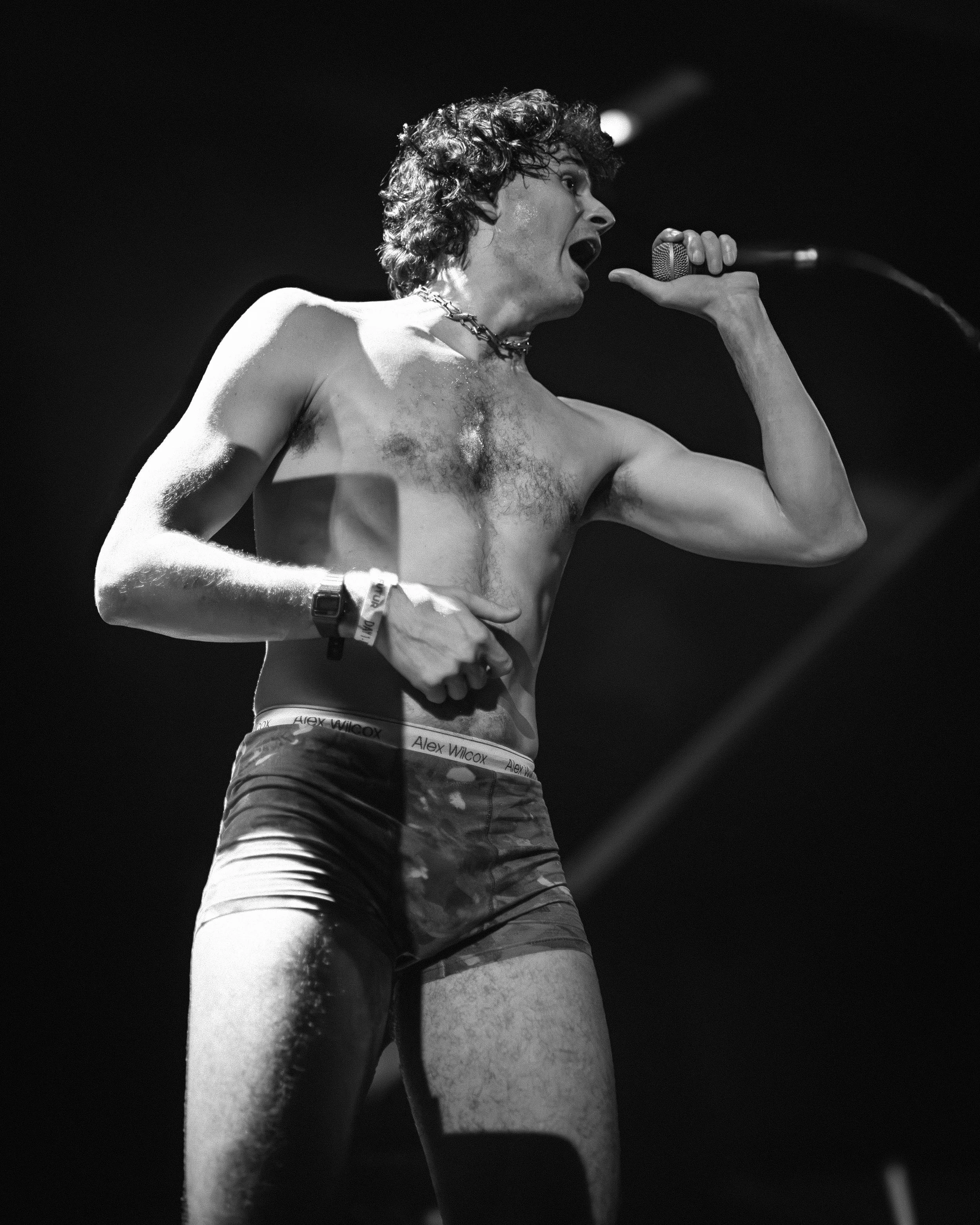
in frame: Alex Wilcox.
How do you understand the role of labels today, cultural curators, distributors, financial intermediaries, or something else entirely?
– To me, a label just needs to promote their artists and the music of their artists. From my perspective, I just want a label to market the crap out of me and get me fans. It’s also nice if they throw events, cause then I could play those and make some money. My feeling is if I were to run a label, my impetus would be: I want to push some really awesome and wild artists and help them get big so I can improve the artistry in the scene. So yeah, being crafty with social media, getting music placed in media where tons of people can hear it, throwing shows to promote the artists. Stuff like that.
You’ve described marketing as something that feels “gross,” but unavoidable. What part of it feels most misaligned with how you actually make music and/or approach an artist career?
– I think sometimes it’s more fun to know less about an artist, rather than more. It does not feel natural for me to look into my phone and try to make content. If I did not make music, I hope to god I would have no social media. I have no idea why people use this shit if they don’t need it for money. But yeah, I want people to judge me on the music they hear, not on my personality or online charisma. I like how, with Boards of Canada, I don’t really know much about them, but I know their music. My brain gets to fill in the gaps and create this mysticism around them. I’m sure they’re probably just two somewhat normal dudes, but the mystique is fun and I enjoy it. I don’t want to watch them making aglio e olio on TikTok or something. But yeah, it is what it is.
What does ethical self-promotion look like to you, if that’s even possible, for an artist who puts sound first?
– I don’t know. The word ethical is a big one. I just try to do it in a way that feels at least fun for me. I went to the Motown Museum a few years back, and Motown had this woman, Maxine Powell, who would help the acts get all dandy for TV and performing. Lady Gaga wore the meat suit, Odd Future scared people. I think promotion is very often part of this whole thing, and has been. Perhaps the difference is that the artists themselves do more of it now versus other people in the past. I’d need to look more into the history to properly answer this question.
I find fun in parody, and so I’ve been leaning into that more. I don’t know if I would necessarily call that “ethical,” but it at least feels true to my internal dialogue. In a perfect world, I would do none of this.
You’re one of the very few artists who still believes in music videos, and you’ve talked about wanting visuals that feel artistically consistent with your music. What does consistency mean to you here, mood, restraint, intention, something else?
– I think they’re mostly there to help the universe build, and can be good promotion. I’m still working on consistency in terms of my own visual output. The simple answer is using the same person for artwork can help with consistency. And consistency can help build up the myth, mystique, world of a musician. If I think that my music gives off a certain vibe, feeling, ideas, then having visuals that also represent a similar vibe can increase the listener’s overall experience of said music, and also it helps them better know how to associate me. “Ah Alex makes crazy music, and his visuals are crazy too, he’s a crazy artist.” That sort of thing.
Do you see visual work as an extension of your practice, or more as a necessary compromise in a market-driven environment? Do you enjoy making music videos? Talk about the process.
– My thoughts on this are not very deep. It’s mostly: I have a track coming out, I like that track a lot and want a lot of people to hear it, I think that having a dope person make the music video will get more people to hear the music. Do I enjoy it? I just think back to making the music video for “Fuck That.” My friend Thomas Harrington Rawle directed it, and I had fun making that one. Most of the interest was really from watching him get super into it. I like watching people who are passionate doing stuff. It was also nice because these two London collectives I really like, Pinhole and Impulse Control, pulled some strings to have the venue allow us to shoot. That feels nice, having many people find meaning in the process.
Where do you draw the line between honesty with your audience and performance on stage? Where does one end and the other begin?
– I don’t really think about this. When I’m on stage, I’m trying to bring the audience into intense feelings and grab their attention. That’s sort of all that matters, and not injuring anyone. It feels like it’s all honest. If you meet me in person, I likely won’t yell at you or throw my sweaty socks in your face. The question doesn’t make much sense to me. It’d be like asking an athlete if they are being honest while playing their sport. It’s not really about honesty, it’s about doing the best job I can to destroy the audience.
What kind of support structure do you think musicians actually need right now, not ideally, but realistically?
– Money. Not sure how you implement that. I haven’t done proper research, so I don’t know if it’s possible. If streaming paid more that would be fantastic. I do think the easy thing to do, right now, is for consumers to switch to streaming platforms that pay more per stream. I’m still mad that Tidal got shit on when they came out 10+ years ago. They still pay so much more than Spotify.
What are you unwilling to sacrifice, even if it slows your career growth?
– I don’t know. This feels like a case-by-case thing. I don’t care if someone uses AI-generated stuff. If using that means the final product is better, go for it. From a listening perspective, I just care about the end result. I have used AI-generated vocals before. Radiohead did it on Kid A. It was cool.
What deserves closer attention in dance music right now, something the scene isn’t taking seriously enough, but should be?
– I want to see more dangerous musicians breaking through.

in frame: Alex Wilcox in Korea for HYPNOSIS THERAPHY.
