
Deeper Dive: Where the Dog is Buried in the Brooklyn Mirage Case
By the time most New Yorkers heard the word “bankruptcy,” the real work on Brooklyn Mirage was already done. The dog had been buried years earlier–under term sheets, political favors, and construction shortcuts that never cleared daylight.
words by Nina K. Malik
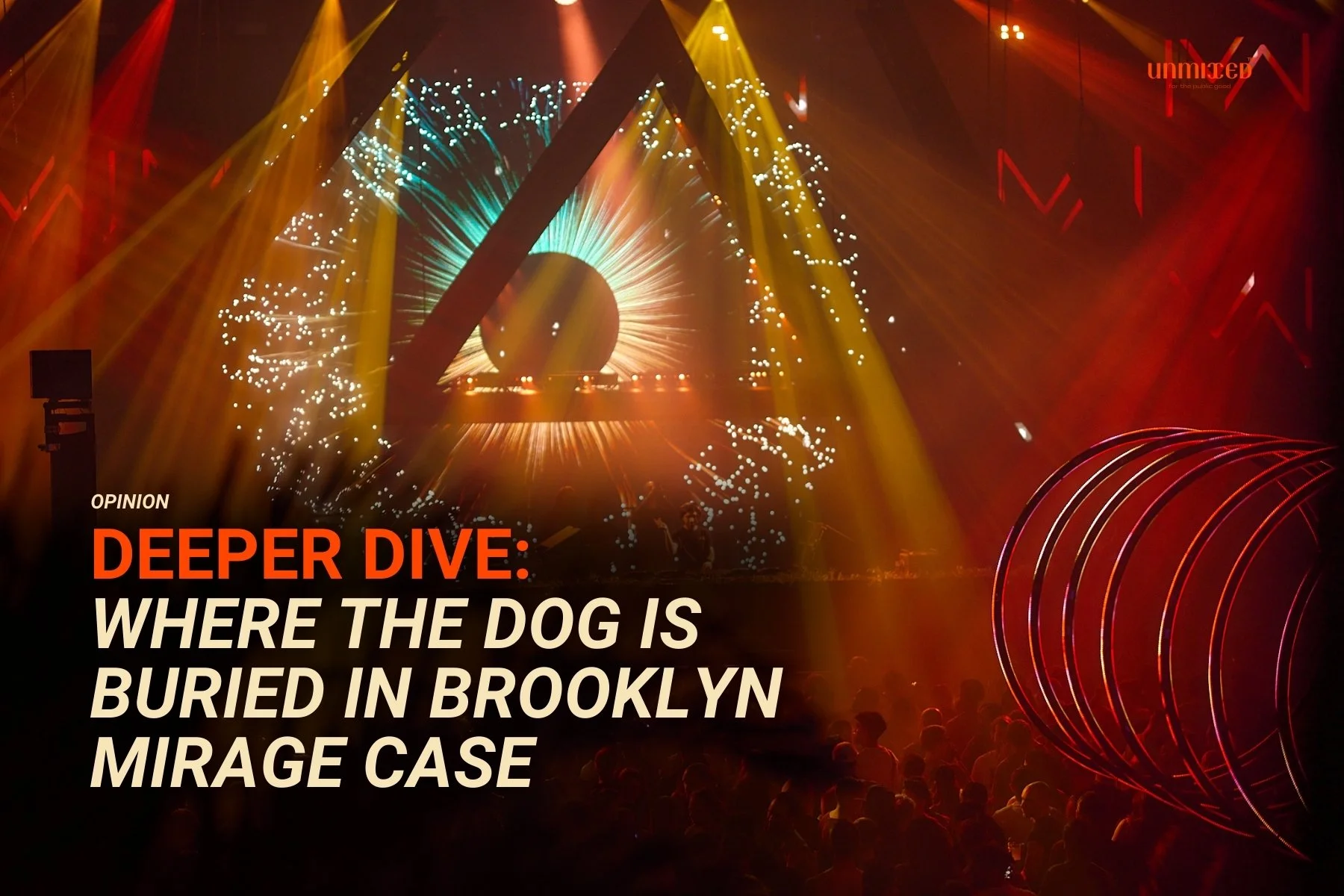
BROOKLYN MIRAGE. MAYAN WARRIOR photo by @ERIKLORCH. 2024 05 25
The city‑hall hum
In New York, power rarely announces itself; it shows up in who gets their calls returned. When Eric Adams was Brooklyn borough president, Brooklyn Mirage/Avant Gardner’s problems did not float alone in the bureaucracy. His deputy, Ingrid Lewis‑Martin, could ping attorney and fixer Frank Carone about Department of Buildings flare‑ups on behalf of clients like Jürgen “Billy” Bildstein. “I am actually on the road but will call,” she wrote in one now‑familiar email formulation. You don’t need to believe anything illegal happened to understand the point: while most operators sat on hold, Mirage had direct lines into the machine.
None of that appears as a smoking gun in the file. No judge cites “political interference” as a cause of the 2025 shutdown. City Hall insists ethics rules were followed, and on paper that’s the end of it. But the background radiation matters. In Brooklyn, the difference between “show ready” and “shut down” often depends less on physical reality than on whose problems the system chooses to take seriously—and when.
Axar’s long patience
The true protagonist of this story is not a mayor, not a DJ, and certainly not a hired‑gun CEO. It is Axar Capital - a hedge fund with an appetite for risks that leave other to live with the outcomes.
Axar started lending into the Avant Gardner orbit in 2021. This was not charity; it was encirclement. Senior secured loans gave Axar first claim on the venue’s future. The 2022 sale of Made Event, Electric Zoo’s parent, to Bildstein for fifteen million dollars did not mark Axar’s exit; it was a reshuffling of pieces on a board Axar still owned. Ownership floated; the lien stayed put.
When Electric Zoo stumbled and Mirage’s expansion collided with regulators in 2023 and 2024, Axar did not brace for impact–it doubled down. The senior term loan swelled into the 140‑million‑dollar range, padded by “protective advances” to keep the project moving even as the building itself drifted further from what any reasonable regulator would call safe. The more precarious the site became, the more indispensable Axar’s money was. That is not a bug of distressed lending; it is the business model.
The CEO as decoy
By the time the temporary certificate of occupancy arrived in April 2025, the structure was already a paradox: a venue loudly marketed as ready to reopen and a construction site that had never cleared a final safety inspection. The Department of Buildings issued, then yanked, the TCO in a matter of days. Internally, officials described structural and fire issues that made the place “unsteady, combustible, illegal”—pick your adjective, none of them compatible with thousands of people under a night sky.
Into this gap between fantasy and city inspections walked Josh Wyatt. Hired in August 2024, fired in May 2025, he is the easiest figure to blame: the CEO who “lost control,” the guy who showed up late and left before the final chapters have unveiled. But the sequence is backwards. The capital structure predated him. The construction decisions predated him. The political entanglements, the liquor wars, the regulatory baggage–none of that was his doing. He was installed atop a tower of risk designed years earlier by other men with better lawyers.

BROOKLYN MIRAGE. MAYAN WARRIOR photo by @ERIKLORCH. 2024 05 25
When the building failed the only test that mattered: can you legally and safely put people in here? the narrative quickly narrowed to managerial failure. It’s convenient, almost comforting, to pin collapse on one person. But the documents tell a colder story: the CEO was not the architect of the downfall; he was a temporary mask worn by a capital stack that had already decided how this would end.
Chapter 11 as harvest season
Bankruptcy is often described as a last resort. For a creditor who has planned well, it is closer to harvest season.
AGDP Holding’s Chapter 11 filing in Delaware laid out the familiar numbers: roughly one‑hundred‑fifty‑plus million dollars in secured debt, a smaller junior slice, a battered set of trade and ticket‑holder claims. Axar arrived to court with everything that matters in a modern restructuring: the senior debt, the willingness to fund debtor‑in‑possession financing, and a plan to roll its position into ownership through a credit bid.
The choreography followed industry script. Axar finances the case, sets the timeline, and bids its debt instead of cash for the core assets. Other creditors: like the merchant cash‑advance lenders who extended short‑term funding during the frantic months before the filing - cry foul, alleging they were misled about finances and DOB risk. They ask a judge to unwind the deal, to say that this time the game went too far.
The court nods at the drama, then approves a “remarkable” settlement: some sweetener for unsecured creditors, a bit of optionality, a headline that suggests fairness. Underneath, nothing essential changes. Axar’s affiliate walks away with the venue and the right to dictate its future. The dog, at this point, is not only buried; the headstone has been engraved.
The house that fees built
With the sale consummated, the estate is marched into a liquidating trust. This is where the last scraps of value: lawsuits, small asset sales, claim reconciliations are sorted and monetized. A professional trustee is brought in at a handsome monthly fee. Lawyers and advisors line up behind him. Bankruptcy law is clear on this point: they get paid first.
Only after the trustee, the professionals, and the secured creditors take their cut do taxes, wages, and general unsecured creditors have a shot at recovery. Ticket‑holders, small vendors, cash‑advance funds who thought they were buying time—all of them stand at the back of a line that moves only as fast as the fee clock allows. If there is anything left by the time the last invoice is stamped “paid,” it will be sold as proof the system works.
And we have barely scratched the surface here, severence package that was never seen. 465 full time employees and the rippled effect on the city workers around the Brooklyn Mirage. All has been scrambling to get day to day basics.
Meanwhile, Axar no longer appears as a distressed lender in someone else’s case. It appears as an owner, or the effective equivalent, having converted risk into title.
Enter Pacha, late and hungry
What remains of Brooklyn Mirage at this stage is less a venue than a vessel: a set of entitlements, a location, a brand husk that can be refilled with whatever global nightlife requires. Into that vessel steps FIVE Holdings, the Dubai‑based owner of the Pacha brand.
They are not buying the soul of a local institution; that was eaten a long time ago. They are arriving for what’s left: the scrapes and licked down bones after the hedge‑fund vultures have picked the carcass clean. They come, like jackals, with their own obligations: a Dubai‑banked loan that expects to be serviced, growth narratives that need new pins on the map, executives who have promised investors that “New York” is part of the story.
This is not a rescue. It is a repurposing. The biggest independent venue in Brooklyn becomes a revenue line in a global leisure portfolio, its past repackaged as “heritage” in a press release. The people who fought for the space when it was vulnerable—neighbors, workers, fans, DJs, production crews—are reduced to mood board fodder and legacy content.
Where the dog is actually buried
So where is the dog buried in the Brooklyn Mirage case?
It is not in a single corrupt phone call, though those calls may well have helped smooth the road until it could no longer be smoothed. It is not in an ex-CEO flame‑out, though blaming him is tidy and narratively satisfying. It is not even in one bad inspection or one revoked TCO.
The dog is buried in the structure: in a city that treats access as a currency, in a financing stack that rewards lenders for pushing right up to (and sometimes past) the edge of physical safety, in a legal system that calls it a victory when unsecured creditors are thrown a bone while the scavengers walk away with the meat.
By the time Pacha flips the lights back on, the story will be retold as one of “rebirth” and “new beginnings.” But if you follow the paper trail – if you read the filings, if you read the docket in full, claim by claim, trace the loans, sit with the order of who gets paid first – you see something else. Brooklyn didn’t get a miracle. It got a neatly executed extraction, followed by a well‑timed rebrand.
The music is promised to start again this summer. The dog will still be in the ground.
related:
Brooklyn Mirage Bankruptcy: When the Trustee Gets Paid First
Brooklyn Mirage Bankruptcy: $90K 'Services Provided' to Firm in Carone Corruption Probe
Pacha New York: What the Press Release Won’t Say Out Loud
Brooklyn Mirage’s Chapter 11: What’s in the Committee’s 14-Point Objection
Sold in the Headlines, Not in Court: Brooklyn Mirage’s Pacha Deal Blows Up in Bankruptcy
