
Virtue Signaling While Profiting from Violence: The case of Boiler Room and FC Palestina
Initiated in January 2025, this essay critiques the commodification of dance music and serves as a vital archive documenting how institutions and private equity firms use social washing to normalize genocide. The essay draws on verified accounts of Blaise Bellville's resignation as founder and ex-CEO of Boiler Room as a case in point for the commodification of culture that must be addressed to envision accountability. Ultimately, Bellville’s resignation should primarily be understood as a victory for the Wet’suwet’en people of the West of Turtle Island ("Canada"), whose leadership in the boycott and tireless resistance against the Kohlberg Kravis Roberts-backed Coastal GasLink (CGL) pipeline remain at the heart of this movement. We honor indigenous resistance and principled individuals who stood in solidarity to affirm that the people will never accept the culture-washing of genocide.
Fellow Journalists have asked about FC Palestina as an entity and questioned who they are on social media, but they haven’t provided many answers.
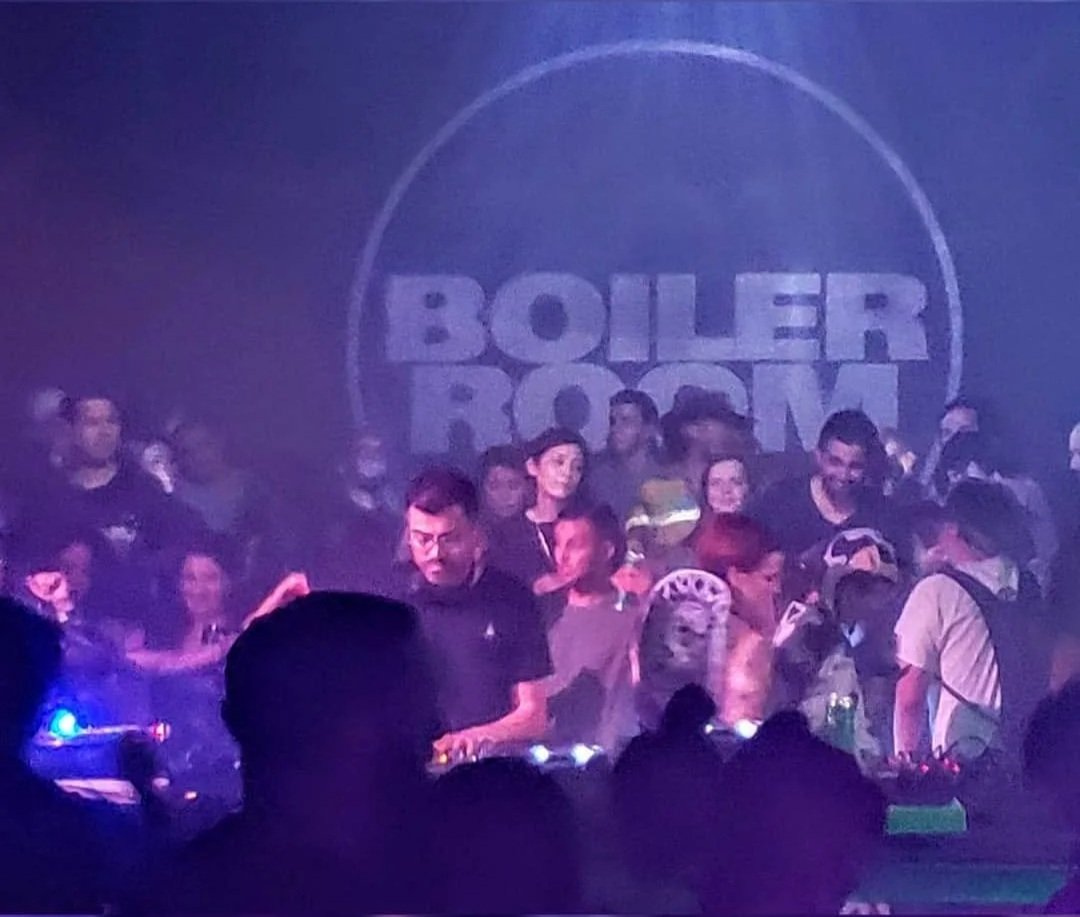
Photo by Evan Snow
FC Palestina trades as EZ Sportswear Limited, a UK-based streetwear soccer brand Zahid Hayat founded in 2015. Beyond Hayat’s appreciation for vintage football kits, the brand’s raison d’être, according to Hayat, is a response to the scarcity of Palestinian jerseys. In an interview with Urban Pitch, Hayat says the brand’s retro-inspired designs and vibrant colorways, drawn from the Palestinian flag, raise “awareness as well for Palestine itself”. Hayat did not stop at manufacturing and selling thousands of football jerseys but went as far as registering motifs associated with Palestine under the corporate veil of his brand, like the Palestinian flag, a coat of arms labeled “FC Palestina” and an outlined map of Gaza, turning national symbols into a proprietary brand identity. Additionally, Hayat registered FC Palestina as a for-profit limited private company, and while the entity is not required to disclose full revenue figures, an analysis of its latest available accounts on Companies House reveals significant financial growth. The company reported net assets of £65,000 at the end of June 2023. By the end of June 2024, this figure had increased substantially to £118,000. This increase signifies a recorded profit of £53,000 for the year ending June 2024. The company claims to donate at least 20% of profit to initiatives assisting Palestinians. Yet, aside from the mention of Medical Aid for Palestinians (MAP), the specific entities to which this percentage of sales is supposedly directed remain undisclosed. In April 2025, Boiler Room jumped on the bandwagon and announced a collaboration with FC Palestina, with 100% of profits going to The Sameer Project, a Palestinian-led aid initiative for Gaza. Supporters of Palestinian liberation questioned the collaboration, raising concerns about transparency and Boiler Room's credibility as an ally. In response to reports that Boiler Room is owned by Kohlberg Kravis Roberts (KKR), The Sameer Project published a statement rejecting the funds.
The charity framework that the collaboration between FC Palestina and Boiler Room exemplifies has been rightfully criticized for maintaining the status quo and reinforcing the scaffolding of the NGO industrial complex. As Dean Spade put it, the mainstream understanding of how to support people in crisis relies on charity and government-aid frameworks that do not address the root causes of people’s afflictions but instead offer a temporary fix while elite power remains largely intact. Coming from a family with aristocratic lineage, Bellville specializes in the conversion of cultural practices into objects for consumption. In 2016, a series of anti-Boiler Room graffiti flared up around London at the time of Boiler Room’s first collaboration with the Notting Hill Carnival, seen as an overt attempt to commodify and profit from a celebration of British West Indian culture and heritage. However, Carnival wasn't founded just as a party, but as a political response. The anti-imperialist and anti-racist campaigner Claudia Jones founded it specifically to challenge the media's racism that ran rampant after the Notting Hill riots in 1958. Yet, in a documentary from 2017, Boiler Room edited out the part where DJ Sarra Wild called out white men, admitting that they did it out of fear of “all sorts of political repercussions.”
In 2017, tensions erupted after it was revealed that Boiler Room had received a £297,298 Ambition For Excellence grant from the Arts Council England while the London Notting Hill Carnival Enterprises Trust (LNHCET), the actual group organizing Carnival, received a much smaller £100,000 from Kensington and Chelsea council to run the entire event. In an article titled “Is Boiler Room detrimental to electronic music culture?”, DJ and Producer Sam Karam expanded on the thesis of journalist and broadcaster Stephen Pritchard about the predatory and commodifying nature of the Boiler Room project. According to Karam, Boiler Room was registered under a venture capital (VC) company. Public filings from Companies House reveal that Belleville has had significant control in how the company was run. However, he held less than 50% of both shares and voting rights, alongside VC fund Conegliano Ventures, which invested £3 million in Boiler Room. He retained this high level of control thanks to his extended network in culture and his status as a founder, with the Californian VC fund unlikely to contribute anything beyond its deep pockets.
“Boiler Room is owned by two celebrated, public school educated white entrepreneurs and a US firm of venture capitalists,” Pritchard wrote, referring to Boiler Room founders Bellville and NAME. “Why fund them to make a film about a cultural event that’s primarily about celebrating Caribbean Culture?”
We can thus assume that aristocrats have been whitewashing Black culture into a palatable consumer product and creating lucrative marketing opportunities for brands to infiltrate Carnival on a much larger scale than previously seen. Not only were Caius Pawson and Belleville able to leech off Notting Hill Carnival funding, but they also funneled more public money into their own projects, armed with social capital they inherited from elite colleges where the British ruling class reproduces itself. Such institutions have long sought to discipline Black cultural expression, which shows how deeply unsettled they are by an anti-racist, unapologetically Black event with a history of resistance and political confrontation. This was never compatible with their vision of Notting Hill as a profitable, orderly, and compliant West London neighborhood.
Despite losing millions of dollars prior to the Covid pandemic, Boiler Room received a publicly funded grant of £791,652 from Arts Council England in 2020. It is profoundly obscene for a for-profit corporation to siphon off over a million pounds in taxpayer-funded "emergency" grants, especially when this same company, which has amassed a fortune through aggressive corporate partnerships and global brand deals, has been accused of not paying its performers. This isn't just poor optics; it is a systemic failure.
Another crucial point highlighted in Karam’s essay is that Boiler Room’s terms and conditions allow personal data and analytical assets to be shared with any of its owners or prospective buyers and that this information may be disclosed to authorities as a legal obligation. In an age where we are continuously grappling with large language models and other machine learning systems that use public data without consent —and given many of these systems have established links to the Zionist military industry — it is of utmost urgency to ask serious questions about how this data will be used in the future.
Here is where the plot thickens. In January 2025, KKR acquired Boiler Room. Upon the acquisition, Boiler Room became inextricably linked to both Canadian pipeline projects destroying Indigenous territories and to Israeli settler housing in the occupied West Bank. Wet'suwet'en land defenders protested Boiler Room in Tkaronto (Toronto) to denounce KKR's role in the Coastal GasLink (CGL) pipeline. This fossil fuel megaproject has been forced through unceded Wet'suwet'en territory, threatening their land, water, air, and people. As Saint, daughter of a Wet'suwet'en hereditary chief, clearly stated in an interview with CanCulture Magazine: "KKR is one of our targets." The Wet'suwet'en have opposed this incursion for years through ceremony, legal action, and resistance, despite facing police raids and criminalization.

And yet, in their press release, Boiler Room shared the following:
“In January 2025, DICE sold Boiler Room to Superstruct, the 2nd largest festival group in the world, which is itself owned by KKR, which has investments that categorically do not align with our values. No Boiler Room staff at any level held any ownership or voting rights in the company and had no control over the sale. We are also unable to divest because we have no say in our ownership.”
Written under the supervision of Blaise Bellville, this statement positions Boiler Room as a victim of private equity. It absolves Bellville of responsibility by claiming he had no say in the sale to KKR. But Bellville’s statement is possible to make and maintain only insofar as it is a byproduct of the deterioration of music journalism and criticism. The lack of critical journalism allows a statement like his to go unnoticed and erase 15 years of Boiler Room’s active commodification of the electronic music scene.
In this context, it is difficult to read the recent layoffs at Boiler Room as merely an economic necessity. Superstruct Entertainment and its owner KKR possess vast financial reserves, making claims of austerity or unavoidable restructuring largely unconvincing. A more plausible reading situates these redundancies within a political economy of discipline: workers who openly contested the acquisition, or who refused complicity with a company embedded in a broader ecosystem of genocide profiteering, became liabilities rather than assets. KKR’s documented ties to the military-industrial complex and its investments in companies implicated in ongoing genocidal violence render this conflict unavoidable.
Supporting or remaining silent in the face of such investments should carry material consequences. Cultural workers who resist these configurations expose the contradiction at the heart of “progressive” cultural branding, and institutions seek to neutralize precisely this resistance. Raising the cost of complicity through boycotts, refusals, and public pressure should be imperative. If cultural institutions insist on aligning themselves with genocidal policies and their financiers and backers, then they must be made to pay a reputational, economic, and political price.
Pressure from cultural workers, Wet’suwet’en, and their allies exacted just such a price from Bellville, who resigned on January 19th with a press release sent to Resident Advisor: “As founder of Boiler Room, Blaise has been pivotal and highly influential in underground club culture,” the statement read. “ There's much to thank him for, and we wish him all the best as he moves into a new future.” Reflecting Bellville’s broader involvement in commercialized culture, we are left with nothing more than corporate slop as a farewell text. Bellville remains a rich and powerful individual, but this episode still showed that an organized activist effort can land a blow against culture washing.
MORE
Essays & Critiques





Get in touch: