DAX J (LIVE) at Dekmantel Festival
In the week of Dekmantel Festival, we spoke with DAX J, a British DJ known for his intensity and drive. Busy as he is, he still found time to walk us through the process behind his newest live show - a completely new production of his own, using the TR-1000 as his main instrument.
Our internet connection nearly derailed the whole thing before it began - I lost count of how many times I reset the router - but DAX waited it out patiently on the other end of the line, and once we finally connected, the conversation ran for almost an hour with barely an interruption.
There's always a slight fear in meeting an artist whose music you've lived with for a decade - whose sets you've played on repeat, whose records have soundtracked every altered state of mind you've been in. Often it disappoints. This time it didn't. We did not have a list of pre-written questions, we just talked - and within minutes we were deep in quantum physics, technology, and whether AI's real beneficiaries will be the curious rather than the merely smart. At one point I floated a theory of my own: what if technology itself is a kind of alien species - one we think we created and control, but which has quickly been outgrowing us at a phase we can't catch up with?
DAX J wasn't so sure. Technology, he said, is still using us to build itself - it's only once it can fully sustain itself that it won't need us anymore. Until then, it needs us to build it out. It was that kind of conversation: one thread pulling into the next, from a convection oven in a São Paulo Airbnb to the double-slit experiment to the sheer number of calculations happening inside a phone every second just so two people can talk. By the end, we'd covered almost everything except a track list.
What we did get was the clearest picture yet of how this new live show came together - five weeks of work, a total rebuild of his process, and a set built entirely on machines he can no longer imagine performing without.
You're bringing a brand new live set to Dekmantel – how does it differ from what you played in Detroit in May?
The one that you heard in Detroit was my first iteration of this new live set, and this new one is completely brand new, and I started working on it five weeks ago. If someone had told me I'd build a whole live set in five weeks, I'd have said it's impossible – but I've done it, mainly because of these new machines, the Roland TR-1000s. I've gotten very comfortable and very fast on them.
The old set was a year's worth of studio tracks that I then spent four months breaking into stems and loops and rebuilding across two Octatracks plus a TR-1000 on top. It worked, but it always felt like I was playing a lesser version of the original – I'd made those tracks in a DAW and was performing a stripped-down reconstruction of them.
This time everything is made directly on the TR-1000s, so I have total control over every sound, and there's no MIDI syncing between the machines at all – I'm literally getting each track in time by feel, almost like DJing. I played this new set for the first time at Peacock Society in Paris after just three weeks of work, and enjoying it that much more made it clear: performing tracks on the same machine you made them on is the difference.
It also changes how I produce music. There's only one effect per track on this machine versus unlimited plugins in a DAW, so when something's not working, a filter, or a modulation, I have to think differently to solve it, and that constraint is pushing me toward genuinely new ideas.
Is there a trade-off, though – a DAW gives you a much wider palette of sounds and the ability to go back and tweak things, versus a drum machine?
That's true – with stems you get more mixdown control and you can always go back and adjust. What I'm doing now is pressing record, performing the whole track in one take, and that's it. If I decide afterward the kick needs to come up two dB, I can't – I have to re-record the whole thing. I'm still deciding whether to start recording into stems as a safety net, but honestly I don't want that safety net. I want to reach a point where I can make a track as complex as I want and still perform it live in a single take, with everything happening in the machine, no post-production. I'm only five weeks into working this way and I'm already happy with where it's going.

DAX J (live), Dekmantel Festival 2026. Photo by Melissa Strarup
How do you build your sample library for these machines – field recordings, sample packs?
Mainly I record straight off my own hardware – I've got a lot of machines I've picked up over the years, and I'll just play for an hour, then go back and chop out the parts I want and load them into the sampler. Sometimes near the end of a track I'll do a live pass of pads or leads to finish it off. It's not that different from how I worked before – I'm just loading samples straight into this machine instead of a soft sampler, and because it's so hands-on, I can control three or four parameters in the space of a second.
It sounds almost like playing an instrument – like a sophisticated electric guitar, in a way, where even the "mistakes" become part of the performance.
Exactly, and you get happy accidents all the time playing live. In Detroit, I was mixing in the raw analog bass drum from the TR-1000 and hadn't realized how powerful it was – I cranked it up and blew my monitor, completely overloaded, the safety cut it out. Out on the floor I think the speakers even cut for a second – but the crowd went wild. Everyone was like, "whoa, what just happened" – they thought the whole system had blown.
What makes the live set you're bringing to Dekmantel special, and why did you want to premiere it here specifically?
Dekmantel has one of the best sounds of any festival – they're known for it. The lighting is incredible too – we had a GoogleMeets chat with the light guy and my light engineer a month ago going through the fixtures, and it's insane the amount of work they put into the setup to make it special. I really like that they work with your own team and lighting engineer to find the best way to showcase the performance.
It's genuinely refreshing, because you'd be surprised how often other festivals fight you on this – you try to bring your own lighting person and they just say no, you have to use ours, even though all you're trying to do is make the show better. You end up sending fifty emails back and forth just to try to improve the show, and they're fighting against you the whole way. With Dekmantel it was just, let's have a call and figure out how to get the best of this. And on top of that, the amount of effort they've put into the fixtures – the moving heads in the UFO where I'm playing – it's mind-blowing. I don't think I've played anywhere else with that many fixtures before.
Dekmantel is known as one of the great festivals, and I think every artist and DJ aspires to play there. It wasn't like we chose them – we presented the idea and they said, let's do it.
Does the sound system itself shape how you perform?
It shapes it a lot – if something's tweaked a certain way, say there's way too much bass, you have to adjust for it, and vice versa. The tricky part is you can only really judge the room off your monitors, so if your monitors are bad – no bass, say – you might boost the bass thinking it's needed when actually it already sounds great out front, and you end up messing it up. Fortunately that's rarely an issue at a high-quality event like this, and they always have good engineers riding the faders live at front of house.
From pirate radio to now playing some of the biggest festivals in the world – what role do festivals occupy in music and nightlife today?
Festivals are important for many reasons and they'll always be here to stay. The good ones really showcase cutting-edge music, introduce people to new things, and people come away from them inspired and motivated – it can be the highlight of someone's whole year, their favorite weekend of the summer. There are festivals every week, but the special ones are defined by how they're curated – the music, the amount of love that goes into building the stages – and Dekmantel is definitely up there.
Congratulations on Sphinx. You once mentioned wanting to go back and witness the beginning of everything – the Big Bang. Has that curiosity found its way into how you think, even outside music?
It would actually be nice to do that – I was having a deep dive with ChatGPT recently and we ended up on that exact subject. I was asking, well, there has to be a "before." It told me they say that was the start of time, that there's no before – but they just don't know, they can't assume that.
What's your own take on it?
I don't believe something can happen from nothing – I think that's impossible. People say before the Big Bang there was just nothing, but there has to have been atoms, particles, something floating there before. The AI mentioned this idea of a "quantum Big Bang" – that it was really the collapse of a previous universe, which then expanded again into ours. Which would mean there could have been infinite universes before this one.
And it also told me there are more planets in our own Milky Way galaxy - at least 100 billion - than there are people on Earth: more than ten times as many. And that's just our corner of the universe.
I have a feeling you'd love quantum physics properly, if you don't already.
I read about the double-slit experiment a while back – where they fire atoms through slits and it creates interference patterns, but as soon as you observe it, the particle "decides" which slit to go through. When it's not observed it behaves like a waveform and can seemingly go anywhere; the moment you look, it's like the particle wakes up and becomes solid.
Then I went down a rabbit hole with Grok about how transistors and chips actually work, and the speeds involved were blowing my mind. I started thinking – we basically have alien technology already. These transistors are switching on and off millions of times a second, just to run a phone. That's insane.
I have a theory about that, actually – what if technology itself is the alien species? It's evolved partly on its own, so fast, and it keeps advancing with less and less need for human involvement. Maybe it's an alien species in its very nature.
Maybe – but right now it's using us to build itself. Once it can fully self-sustain, it won't need us anymore. Until then, it needs us to build it out.
That double-slit thing was really what set me off. I remember standing in an Airbnb in São Paulo last month completely baffled by a convection oven – how does it even heat up so instantly compared to a normal one? Turns out it's flipping magnetic polarity twenty thousand times a second to generate heat through friction. I was floored – and then Grok reminded me my phone's transistors are doing that a million times a second. We had basically a three-hour conversation and I came out of it with my brain completely fried.
Is this how you approach music too? Your track titles often orbit these same ideas – technology, the cosmic, the alien.
I find the whole convergence really interesting – technology, the spiritual side, the alien side, it all seems to connect somehow, and I've been thinking about that a lot lately. I've also been doing deep dives into how sound itself actually works – even something as basic as 44.1kHz. Most people know the number but not what it means: the waveform is being chopped into 44,100 snapshots per second, and each one is just a number describing how "tall" the wave is at that instant. At 16-bit that number runs from zero to about 32,000; at 24-bit it jumps to about 8 million – and it has to calculate that, 44,100 times every second, just so this conversation and all music can exist. It's mind-boggling how fast that's actually happening.
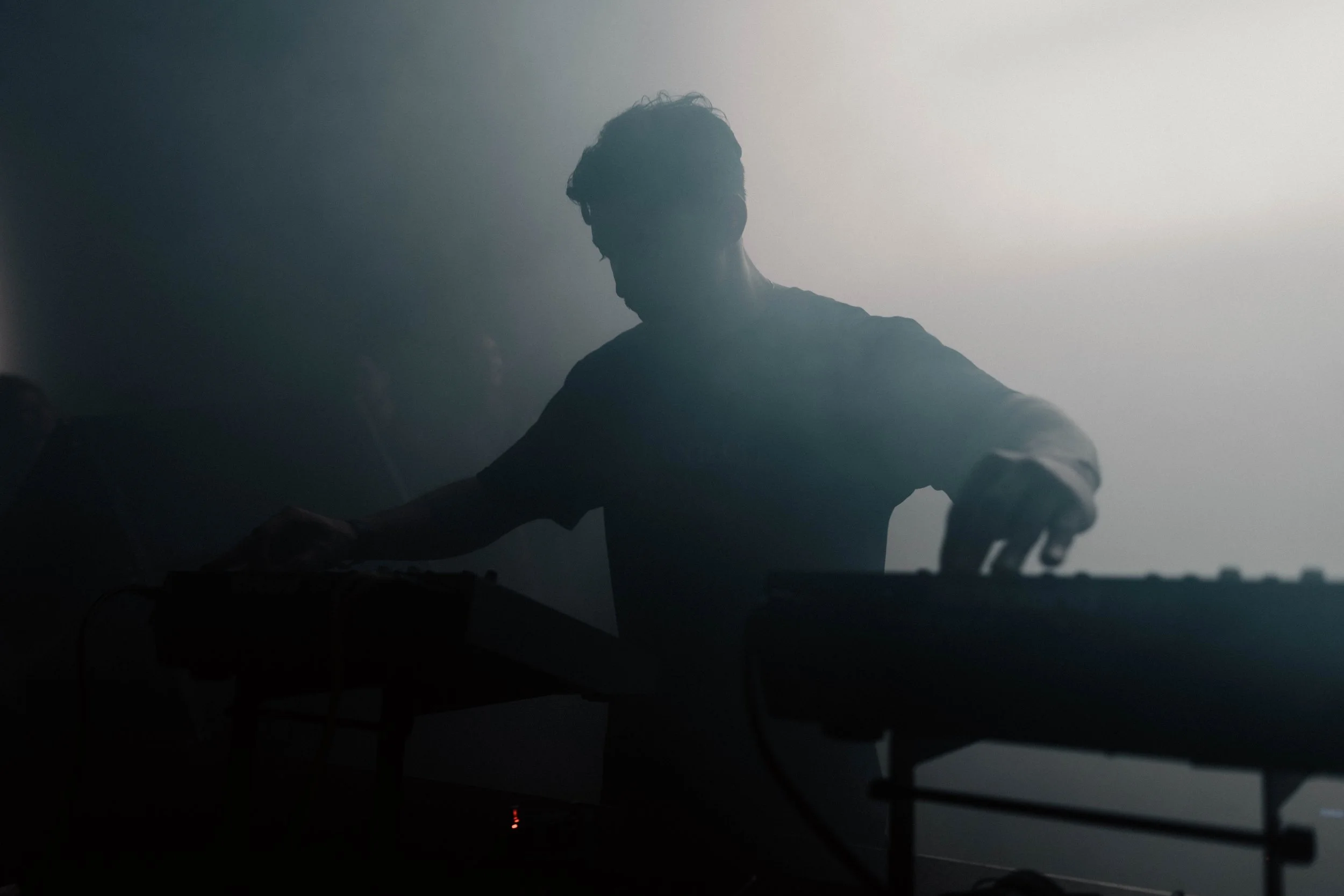
DAX J (live) at Dekmantel Festival 2026. Photo by Sander van de Ven.
Sound is such an interesting medium precisely because you can't see or touch it, yet it moves you internally in ways vision often can't. Does that emotional, invisible quality guide how you know a track – or a moment in a set – is "right"?
When I make music, I'm going off intuition of feeling, and I'm trying to create an emotion. A lot of the time you can't really describe it in words - it's not enough. You only really feel it inside, and you know you've got there because you feel it. All my music is made 90% on emotion, because that final decision - which sound, which direction - that's the most important part of the whole process, and it's done entirely from inside. It can sound right and still not feel right, and when that happens you know something's off, even if you can't say exactly what. It's almost like seeing a painting - it doesn't have to be a beautiful, complex work of art, it can be quite basic, but everything about it is just placed correctly. Everything has a reason to be there. You could look at a very similar picture and think, no, something's unfinished, that element should have been moved ten centimeters over. You just kind of know when you see it. So you know when you hear it too.
Does that intuitive process change once you move from the studio to playing live?
It's a different process because my last live set was built from a year's worth of studio material, and I spent four months figuring out how to present it - separating tracks into kick, bass, leads, percussion, building stems and loops for two Octatracks and a TR-1000 on top. It worked as planned, but because I was playing loops and stems of tracks I'd made in a DAW and then broken apart, it felt like I was playing a worse version of the original. I felt restricted.When I got home from Detroit, I decided to just try making a few tracks directly on the TR-1000 and see how it went - and within a few days I had three or four tracks, made surprisingly fast and surprisingly good. By the third week I had enough for a live set in Paris, and that's when I really understood the difference: performing tracks on the exact machine you made them on makes it so much more enjoyable, because you know exactly where everything is and you have full control. I'm not even syncing the machines with MIDI - I get everything in time by feel, almost like DJing, and I can mix elements of one track into another live. It's fun, and it's got longevity - every time I finish a new track, I can perform it immediately.
Traveling with this much specialized gear and a lighting engineer, flying out the morning after your Dekmantel set - how do you manage the physical toll of touring at this pace?
The main thing is being really mindful about sleep - if you get that right, everything else is easier. I'm naturally a night owl; I go to bed around four or five a.m. on weekdays and six or seven on weekends, so it's only about a three-hour swing, which keeps some kind of rhythm intact. If I try to force an earlier bedtime after a late night, I usually just can't sleep at all.That's actually why I'm flying out the morning after this set rather than staying the weekend - a couple of days ago in Bosnia they wanted me to stay near the festival and get up at 9 a.m. after going to bed around six, and I just said no, I'll stay closer to the airport instead so I can sleep two extra hours and get up at something closer to my normal time.For longer-haul jet lag, I'll actually shift my eating window a couple of days ahead of a big time-zone change - eating a huge "dinner" at 1 p.m. local time if that lines up with 10 p.m. back home, then not eating again until the next morning, so the body starts adjusting on its own. It's long-haul that really gets me, though - Europe I've got a system that works, but coming back from somewhere like the West Coast or South America properly wrecks me.
Any non-negotiables when you travel - an aisle seat, a particular ritual?
Window seat, always. I don't sleep well on planes, so when I finally do drop off, there's nothing more infuriating than someone tapping me awake because they need to get to the aisle. A window seat means nobody's waking me up for that.Give the man his window seat and let him sleep unbothered.
Last one - what's next after Dekmantel?
After this weekend I'm going to finalize the new material and get eight tracks ready for an EP. I've genuinely never worked this fast in my life - I'm usually putting out one release a year, maybe every eighteen months, and I reckon I'll have a full eight-track EP ready within a month of finishing this live set.

DAX J, Dekmantel Festival 2026. photo by Melissa Strarup