
Axar Capital, a private equity firm, has been previously accused of wrongdoing by MCA funders and the Committee in the Avant Gardner Bankruptcy case. Yet, despite these allegations, Axar has managed to secure deals and is now on a fast track to exit all legal liabilities. The torch is now being passed to PACHA, owned by Five Holdings, with Kabir Mulchandani - a person once acquitted of real estate fraud, who spent 140 days in jail back in 2009, now has a decisive voice the future of the Brooklyn nightlife scene.
words by Nina K.Malik

Brooklyn Mirage 2023 photo by Chris Lavado
What if everything you’d heard about Brooklyn Mirage's collapse pointed to structural disaster, only to discover the building itself was never the problem? Unmixed has reviewed nearly all structural reports and uncovered a disturbing yet fascinating fact: the new building had no issues big enough to tank the project. Structurally speaking, the new Mirage was built to be safer and sturdier, ready to host up to 7,000 guests on a single night.
We also reviewed internal reports and found even more interesting facts: The Avant Gardner was receiving DIP loans from TVT Capital, Insta Funding, and other companies before filing for Chapter 11. DIP loans, or debtor-in-possession loans, are essentially emergency cash for companies in crisis, and while they may seem like a lifeline, they often come with sky-high interest rates, sometimes 20 to 40 percent, that can end up burying a business deeper in debt. These loans are secured by "future receivables," meaning the lender gets paid from ticket sales or other income the business is expected to make.
In this case, the Mirage offered its ticket sales as future receivables that were trackable all summer long. These ticket sales reports, delivered daily and weekly to executives and monitored by financial advisors, revealed consistent sales figures even after the venue entered financial distress. However, despite the steady stream of ticket revenue, the numbers often hovered just at or below the estimated break-even point of 70 percent occupancy per show according to industry benchmarks, signaling ongoing strain in demand and liquidity. This pattern suggested that while the business maintained enough cash flow to secure short-term loans, it consistently struggled to generate the surplus required to address mounting vendor obligations or fund promised renovations. The reports painted a picture not of booming success, but of a daily and weekly scramble to cover urgent debts, rather than building true financial sustainability.
Following Josh Wyatt's departure in May, tickets continued to sell at the Mirage venue, generating short-term liquidity as vendors (think lights and equipment) pulled out and filed liens. The lien amounts are as follows: Heini LLC – approximately $2.35 million ; McAlpine Contracting – roughly $788,000 ; BrownTech – about $420,000 ; Herc Rentals – roughly $273,000 ; Telecom Infrastructure Corp – around $187,000 ; Cid Maintenance Corp – approximately $202,000.
We know they were running out of cash because Axar Capital, a Private Equity firm and a senior lender to Avant Gardner, decided to pull the plug on the financing it had promised. Remember Axar Capital? They sold eZooo to Mirage for what our financials have reviewed as $5 million over market price, and later was bankrupted.
Case 25-11446-MFW Doc 335
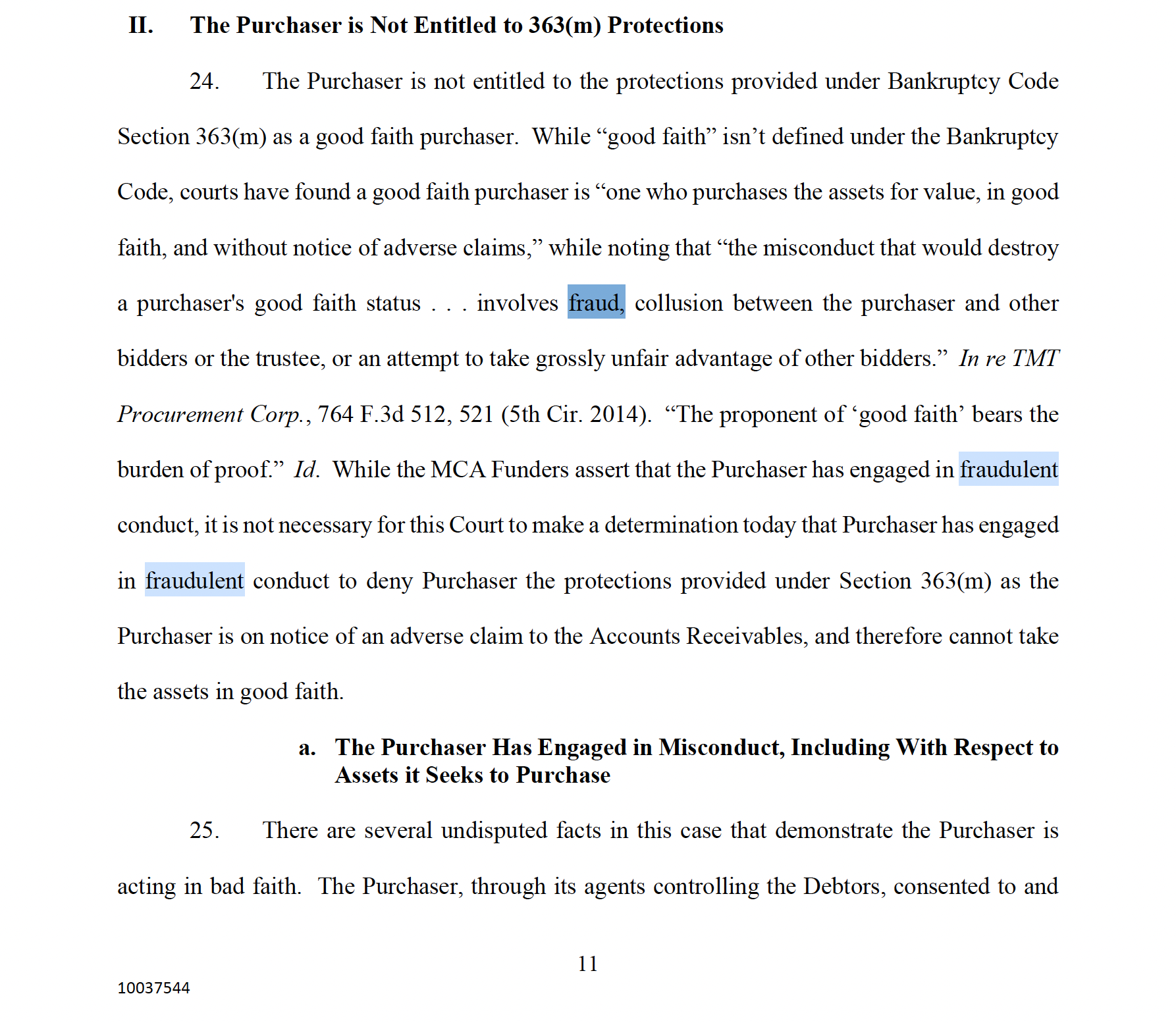
These high-interest loan companies have expressed their objections towards the sale, or to say more accurately, the LEASE transfer from Avant Gardner to PACHA (with its parent company FIVE Holdings). These companies have accused Axar Capital of insider trading and not acting in good faith. The Docket states: "...the Court should deny approval of the Sale Orders to the extent it seeks to (i) transfer assets that the Debtors have admitted are in dispute and are part of the Adversary Proceeding styled AGDP Holdings et al. v. TVT Capital Source LLC, et al. (the "Adversary Proceeding")..."In other words, the court was being asked to approve a transfer of assets that are still being argued over in a separate legal battle.
And what does the court do? Approve the motion. Quite strange for a bankruptcy to enter Chapter 11 in August – announce the sale, contact ponytail buyers, review the bidders, and then sell it for a "stalking horse bid" back to the company that bankrupted it, and all this within just a few months time period.
We have contacted the buyers and interested parties, who all claim one thing: they were not given a fair chance or notice to place their bid and have a chance of buying the assets. And here, we invite you to review in the parallel timeline: what is Pacha doing? Doubling down on announcements starting in August, acquiring the loan in September and in December the rumors of sale finally leak in the press. The first leak? "Overheard at a restaurant," come on, even you, Brooklyn Magazine, could come up with something better.
The truth, as we learn through multiple sources is that Axar Capital’s Andrew Axelrod had already envisioned plans for the club's future, including the sale/transfer of the assets to their affiliate, Pacha.
Nobody stood a chance of buying the assets.
The judge was allured by Alexander Faris's, Axar’s shark-like lawyer’s, assurances to creditors that they will all be paid via contingency value, which we predict will never happen. There simply won't be enough cash left after paying off the lawyer fees and other expenses related to the court case, and the waterfall won't reach all the way to the bottom: to the unsecured creditors.
Who will get paid? First in line once administrative fees are gone: Axar Capital – Senior lender – walks away with the cash.
What about the tickets? Why'd they keep selling tickets, announcing shows after they fired Josh – these should have been a clear signal that the venue needs more liquid cash. The cash received provided short-term relief and was not used to fund the promised renovations, but rather to secure an extremely high-interest loan backed by the venue's future receivables.
What Axar Capital did here is what some financiers call: loan-to-own scheme. Axar Capital, controlled by Andrew Axelrod used debt-in-possession financing pressure to gain control of the debtor group. This allowed them to acquire the Mirage assets at a discounted price through a stalking-horse bid, meant to invite competition without paying a single dollar in cash, instead using the ‘debt owed’ for this purchase.
The Adversary Court Case: TVT Capital, InstaFund, and Triple P are now involved in an adversary court case against Axar Capital, Gary Richards, Hooman Yazhari, and Andrew Axelrod, with these companies previously alleging that they did not act in good faith, engaged in insider trading, and intentionally drove the company into bankruptcy.
How was the bullet train speed of the sale finalized? After the venue filed for bankruptcy in August, the sale case moved at an alarming pace; within months, it was sold. However, not the venue's ownership – it's the lease that's most valuable, which is left off the Mirage.
We tracked the ownership of 140 Stewart Avenue to “Stewart Purchaser LLC” and found documents listing Davina Mansur as authorized signature on file; she previously worked under Philipp Wiederkehr, the OG Avant Gardner creator, alongside Billy Bildstein. Billy bought Phil out of Avant Gardner in 2021 through funds provided by Axar. Philipp Wiederkehr, a financier, who is renowned for real estate deals, most likely acquired the space back in 2022 via PropCo, of which Phil and Davina own 100% of the shares and are now sitting in the landlord seats.
We get it, we are all growing up and growing older, and operating this gigantic machine called Mirage was getting harder and harder. Compare this to being a landlord? It's like a walk in the park. They get to collect rent, not worry about taxes or tickets sold – sweet!
Meanwhile, Billy walks away without paying his workers, without explanation, and almost a mockery: remember the email they sent to their employees to pick a new name? Excellent diversion plan – media turns its attention elsewhere, workers think they still have jobs, Axar proceeds with the super-rushed deals, closed behind 465+ becks that will never get their fair compensation, severance, or anything for that matter, other than being encouraged to reapply for jobs at soon-to-open Pacha.
Pacha, on the other hand, was either tricked too, or had a plan panned out for the next decade, because rent is not cheap at $4.5 million.
But worrying about the Dubai state bank-backed luxury lifestyle brand is not something anyone but them should be bothered with.
When considering job opportunities or event bookings, it is important to reflect on the organizations you support. Your employment and tax contributions may indirectly fund activities or entities you may not endorse. For example, attending Pacha supports Kabir Mulchandani, an Indian billionaire who owns FIVE Holdings, a real estate company valued at $2.9 billion. Mulchandani was previously arrested for real estate fraud and embezzlement in 2009. He later commented on his 140 days in jail: “I never knew that losing one’s freedom can be physically painful.” As reported by the Seattle Times, the Land Department stated in June 2009, “All claims mentioned have been replied to with documents, while the statements of the complainants are mere statements and baseless allegations. No criminal punishment shall be imposed based on those baseless allegations.” Kabir Mulchandani has since reestablished his business presence. In November 2023, FIVE Holdings acquired Pacha Group, which operates hotels and nightclubs in Ibiza, Spain, for $330 million and as of September 2025, secured a significant new loan in the amount nearing $500 million backed by Dubai state bank. While we are not loan experts, it is reasonable to assume that such a loan would require a detailed investment plan presented to the bank. It is likely that Mirage was included in this plan during the loan review process, which coincided with AGDP’s voluntary Chapter 11 filing.
With the venue's reputation in tatters and its financial woes mounting, it's only a matter of time before the talent pool begins to dry up. And when it does, we'll be watching with great interest to see which DJs and performers will take the booking offers that are soon to come their way. Who will be the first to take the stage, and what will they say to the crowd? Will they acknowledge the elephant in the room, or will they try to spin the disaster into a success? Only time will tell, but one thing is certain: we'll be watching closely, and we'll be judging harshly.
Is all this just a coincidence? Maybe, if you choose to believe in fairytales.
Either way it is quite strange for a culture once known for its resilience and courage to now sit and wait for crumbs to be thrown its way.
related:
How Brooklyn Mirage Became a Financial Asset: Inside the Bankruptcy and $120M Axar Loan
Brooklyn Mirage Bankruptcy: What Weekly Updates Knew – and Who Was Briefed on Them
Brooklyn Mirage Bankruptcy Plan Fast-Tracked in 17-Minute Hearing
Brooklyn Mirage Bankruptcy: When the Trustee Gets Paid First
Sold in the Headlines, Not in Court: Brooklyn Mirage’s Pacha Deal Blows Up in Bankruptcy
Brooklyn Mirage’s Chapter 11: What’s in the Committee’s 14-Point Objection
Pacha New York: What the Press Release Won’t Say Out Loud
Brooklyn Mirage Bankruptcy: $90K 'Services Provided' to Firm in Carone Corruption Probe
